
| Riferimento: | A54238 |
| Autore | William ROGERS |
| Anno: | 1590 ca. |
| Misure: | 140 x 200 mm |
| Riferimento: | A54238 |
| Autore | William ROGERS |
| Anno: | 1590 ca. |
| Misure: | 140 x 200 mm |
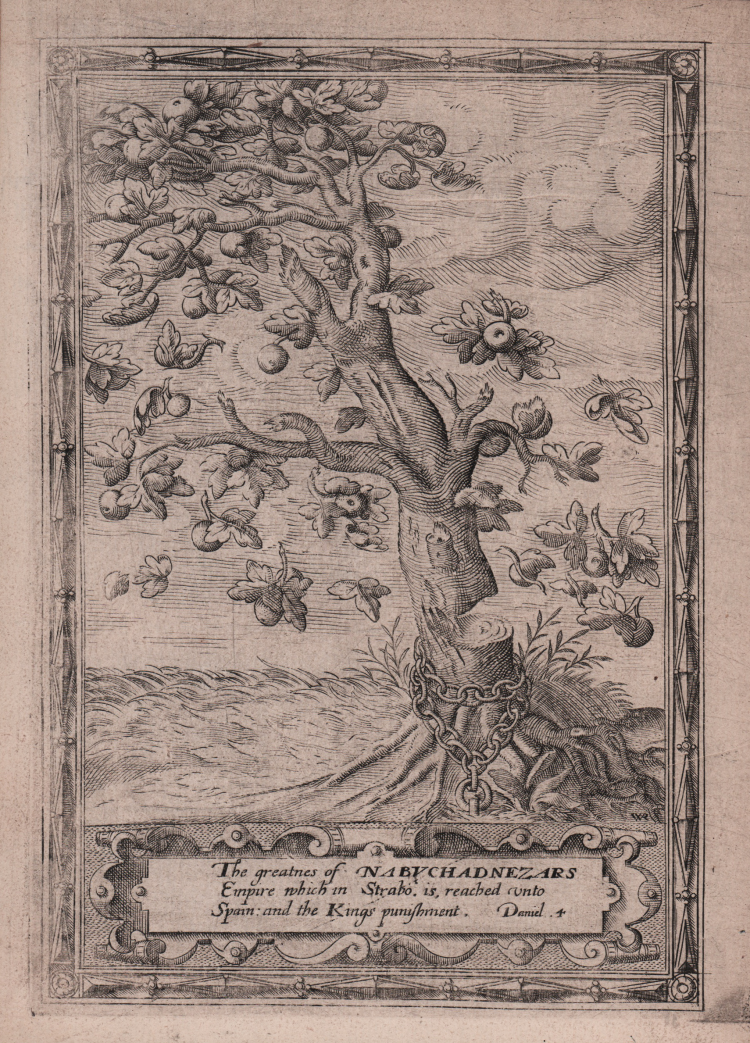
The greatnes of Nabuchadnezars Empire which in Strabo, 15, reached unto Spain: and the Kings punishment.
La grandezza dell'impero di Nabucodonosor. Espressa nella frase in basso, è simboleggiata da un albero da frutto spaccato, con una catena attorno al tronco.
Illustrazione incisa da William Rogers per il celebre libro di Hugh Broughton, "A Concent of Scripture" stampato a Londra nel 1590.
Dedicata alla regina Elisabetta, l'opera è una cronologia e genealogia delle Scritture, concepita per mostrare l'ordine cronologico degli eventi da Adamo a Cristo e per armonizzare i passi discordanti. L’opera, che venne stampata con la supervisione di John Speed, venne duramente attaccata in entrambe le università inglesi e l'autore fu costretto a difenderla in una serie di conferenze.
Le lastre furono realizzate da William Rogers e sono esempi delle prime incisioni su rame inglesi
Acquaforte, 1590, stampata su carta vergata coeva, con margini, in buono stato di conservazione. Rara.
Bibliografia
Hind 1952-64, Engraving in England in the Sixteenth and Seventeenth Centuries, I.272.21, n. 2.
William ROGERS (attivo 1584 - 1604)
|
William Rogers (born c. 1545, active c. 1589–1604)[2] was an English engraver. A Citizen of the City of London – one of his surviving engravings is signed Anglus et Civis Lond(oniensis). – he is the first English craftsman known to have practised engraving and the greatest portrait engraver of the Tudor period. The English were extremely late in coming to printmaking, though several artists from the thriving Flemish industry had worked in England already; the engraved print had been invented over 150 years before Rogers began to produce them. Rogers was also a goldsmith, and presumably acquired his technique in that context. His portrait style reflects Flemish models, while his backgrounds are often "overloaded with ornament" that is "redolent of the goldsmith's shop". Rogers is known for his engraved portraits of Queen Elizabeth I of England, which are very scarce. Eliza Triumphans (1589), celebrating the defeat of the Spanish Armada in 1588, shows Elizabeth surrounded by the allegorical symbols of empire common to her portraiture at this time. Queen Elizabeth Standing in a Room with a Lattice Window, one of the best-known Tudor engravings, is based on a drawing of the queen by the miniaturist Isaac Oliver; the densely ornamented setting is probably the invention of Rogers. Elizabeth I as Rosa Electa, of which the two surviving impressions are in the Bodleian Library at Oxford University and the British Museum, is undated but can be assigned to the later years of Elizabeth's reign by the style of the costume. The portrait depicts the Queen surrounded by roses, symbolising the Tudor union of the houses of York and Lancaster. Rogers also engraved a version of the large allegorical picture of Henry VIII and his family attributed to Lucas de Heere, now at Sudeley Castle. Rogers' print, of which only three impressions are known, shows Elizabeth in the updated fashions of the 1590s and adds verses at the bottom making explicit the contrast between Mary I's marriage and its accompanying war on the left, and Elizabeth's virginity accompanied by Peace and Plenty on the right.
|
William ROGERS (attivo 1584 - 1604)
|
William Rogers (born c. 1545, active c. 1589–1604)[2] was an English engraver. A Citizen of the City of London – one of his surviving engravings is signed Anglus et Civis Lond(oniensis). – he is the first English craftsman known to have practised engraving and the greatest portrait engraver of the Tudor period. The English were extremely late in coming to printmaking, though several artists from the thriving Flemish industry had worked in England already; the engraved print had been invented over 150 years before Rogers began to produce them. Rogers was also a goldsmith, and presumably acquired his technique in that context. His portrait style reflects Flemish models, while his backgrounds are often "overloaded with ornament" that is "redolent of the goldsmith's shop". Rogers is known for his engraved portraits of Queen Elizabeth I of England, which are very scarce. Eliza Triumphans (1589), celebrating the defeat of the Spanish Armada in 1588, shows Elizabeth surrounded by the allegorical symbols of empire common to her portraiture at this time. Queen Elizabeth Standing in a Room with a Lattice Window, one of the best-known Tudor engravings, is based on a drawing of the queen by the miniaturist Isaac Oliver; the densely ornamented setting is probably the invention of Rogers. Elizabeth I as Rosa Electa, of which the two surviving impressions are in the Bodleian Library at Oxford University and the British Museum, is undated but can be assigned to the later years of Elizabeth's reign by the style of the costume. The portrait depicts the Queen surrounded by roses, symbolising the Tudor union of the houses of York and Lancaster. Rogers also engraved a version of the large allegorical picture of Henry VIII and his family attributed to Lucas de Heere, now at Sudeley Castle. Rogers' print, of which only three impressions are known, shows Elizabeth in the updated fashions of the 1590s and adds verses at the bottom making explicit the contrast between Mary I's marriage and its accompanying war on the left, and Elizabeth's virginity accompanied by Peace and Plenty on the right.
|