
| Riferimento: | S53078 |
| Autore | James Baylis Allen |
| Anno: | 1850 ca. |
| Zona: | Venezia |
| Luogo di Stampa: | Parigi |
| Misure: | 345 x 250 mm |
| Riferimento: | S53078 |
| Autore | James Baylis Allen |
| Anno: | 1850 ca. |
| Zona: | Venezia |
| Luogo di Stampa: | Parigi |
| Misure: | 345 x 250 mm |
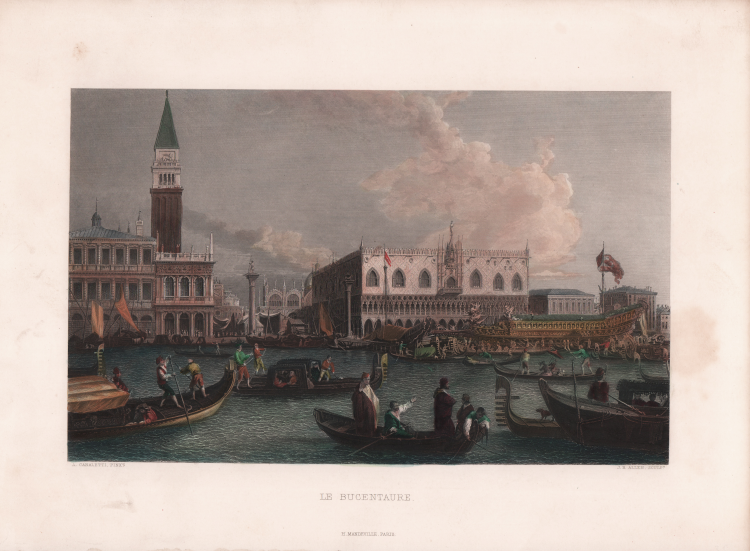
Il Bucintoro torna al Molo il giorno dell'Ascensione; gondole in primo piano e, oltre, la galea di stato che naviga oltre il Palazzo Ducale e si avvicina alla piazzetta San Marco.
Incisa da James B. Allen dal celebre dipinto di Canaletto.
Magnifica veduta, pubblicata a Londra e inserita in The Art Journal.
James Baylis Allen (1803 - 1876) è stato un incisore britannico che si formò sotto la guida del fratello maggiore, Josiah Allen, anch'egli incisore, e dei pittori John Vincent Barber e Samuel Lines. Allen era particolarmente noto per le sue incisioni di paesaggi, realizzando una celebre serie sui fiumi francesi e diverse altre serie dedicate a paesaggi britannici, italiani e greci, oltre a scene di battaglia. Molte delle sue incisioni apparvero su The Art Journal, la principale rivista d'arte britannica del XIX secolo.
Bellissima prova, impressa su carta coeva e finemente colorata a mano, in ottimo stato di conservazione.
James Baylis Allen (1803-1876)
|
James Baylis Allen (1803–1876) was a British engraver. Allen, together with Edward and William Radclyffe and the Willmores, belonged to a school of landscape-engravers which arose in Birmingham, where there were numerous engravers working on iron and steel manufactures.
Allen was born in Birmingham, 18 April 1803, the son of a button-manufacturer. As a boy he followed his father's business; then about age 15 he was articled to Josiah Allen, an elder brother and general engraver in Birmingham. Three years later he began his artistic training by attending the drawing classes of John Vincent Barber and Samuel Lines.
In 1824 Allen went to London, and found employment in the studio of the Findens, for whose Royal Gallery of British Art he engraved at a later period "Trent in the Tyrol", after Augustus Wall Callcott.
Allen died after a long illness at Camden Town on the 10th January 1876 and was buried on the western side of Highgate Cemetery. The grave (no.144) no longer has a marker but the remains of the plinth are still visible.
|
James Baylis Allen (1803-1876)
|
James Baylis Allen (1803–1876) was a British engraver. Allen, together with Edward and William Radclyffe and the Willmores, belonged to a school of landscape-engravers which arose in Birmingham, where there were numerous engravers working on iron and steel manufactures.
Allen was born in Birmingham, 18 April 1803, the son of a button-manufacturer. As a boy he followed his father's business; then about age 15 he was articled to Josiah Allen, an elder brother and general engraver in Birmingham. Three years later he began his artistic training by attending the drawing classes of John Vincent Barber and Samuel Lines.
In 1824 Allen went to London, and found employment in the studio of the Findens, for whose Royal Gallery of British Art he engraved at a later period "Trent in the Tyrol", after Augustus Wall Callcott.
Allen died after a long illness at Camden Town on the 10th January 1876 and was buried on the western side of Highgate Cemetery. The grave (no.144) no longer has a marker but the remains of the plinth are still visible.
|