
- New
| Reference: | A54741 |
| Author | Benvenuto DISERTORI |
| Year: | 1912 ca. |
| Measures: | 295 x 185 mm |
| Reference: | A54741 |
| Author | Benvenuto DISERTORI |
| Year: | 1912 ca. |
| Measures: | 295 x 185 mm |
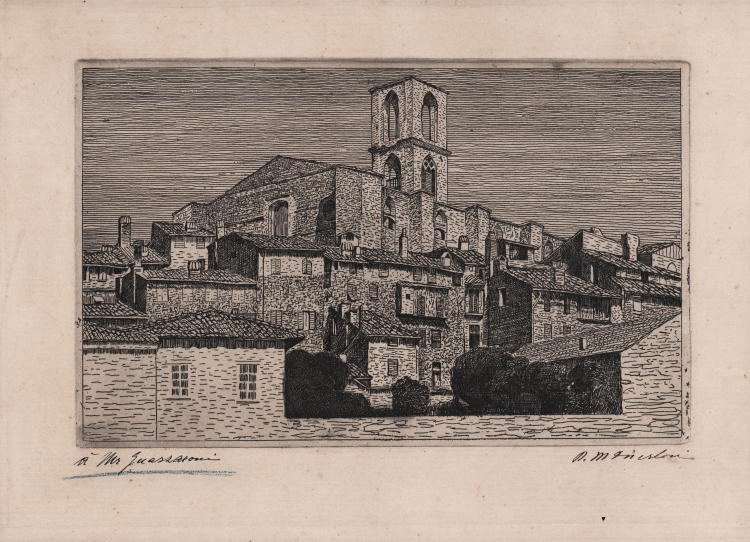
Extremely rare proof, signature before.
Etching and engraving, circa 1912-15, without the signature at the lower left in the inscription "BDISERTORI" (which will appear in the final state of the engraving), with the artist's handwritten signature in pen at the lower right. In the same handwriting, also in pen, the dedication at the lower left reads: a Mr. Guazzaroni. As stated in the artist's catalogue raisonné, compiled by Paolo Bellini and Alessia Alberti, only one example of the first state (more correctly, perhaps, a proof) was known, because it was cited in Lancellotti (1917, p. 372).
It depicts a characteristic urban view of Perugia dominated by the monumental bell tower of the church of San Domenico, nestled between the roofs and houses of the historic village.
“A preparatory drawing for this engraving, in ink, is preserved in the A. Disertori collection. It is in reverse, also includes a lower part with some writings and is dated « Perugia 29 luglio 1912». There is also another drawing that represents the church of S. Domenico in a similar way and on the same side, now preserved in Rovereto in the Mart print collection (2818), colored pens. The etching portrays, on the same side as reality, the upper part of the facade, the right side and the bell tower of S. Domenico in Perugia. The point of view can be identified in Piazzale Bellucci, in front of the old station of S. Anna. The basilica of S. Domenico, built in Gothic style starting from 1305, following the collapse of the naves, was rebuilt by Carlo Maderno (1614-1615). The facade is devoid of any type of covering. The grandiose side and the apse retain the buttresses and the windows ogival elements of the fourteenth-century building. The bell tower, designed by Gasparino di Antonio (late 15th century), is truncated above the two orders of Gothic windows and contains a bell described by Disertori in his print The Great Bell in Perugia. This work is mentioned for the first time in a catalogue of a London exhibition in the spring of 1916 (Esposizione... 1916, p. XVII), but it is likely that its execution should be anticipated to the years 1912-1915, due to stylistic similarities with some drawings dating from the artist's early years, such as San Domenico in Perugia, Ponte a Burano (both preserved in Rovereto Mart., inv. 2818, 2828). The drawings are reproduced in Emert (1967, plates 58-60). The overall edition planned by Disertori for this plate were 40 copies. Certainly, 14 were printed, as evidenced by the numbering "40/14" on the Rovereto copy (2788)" (see Paolo Bellini, Alessia Alberti, Benvenuto Disertori. Catalogo Ragionato dell'opera grafica e degli ex libris, entry no. 13 p. 26).
Benvenuto Disertori was a great engraver who created beautiful woodcuts, etchings, and drawings in burin and drypoint, an artist whose works were exhibited at the Munich International Exhibition and the Venice Biennale. Carlo Tridenti, for many years an art critic for the "Giornale d'Italia," Rome's leading social and cultural newspaper in the first half of the twentieth century, wrote of Disertori: "He reveals a strong preference for ancient and solitary places, the villages of Tuscan and Umbrian cities, where he is an attentive interpreter of the character imprinted by men and time, the vanishing of houses, bell towers, and trees toward the fading distance of the hills. A classic, therefore: his form is reduced to its primary element, the line, the clearly defined contour, are the most suitable means of expression for rendering the eternal beauty of nature" (in "La Fiorentina Primaverile," Florence 1922, pp. 86-87).
Magnificent work, on contemporary laid paper, with margins, in excellent condition.
Bibliografia
Paolo Bellini, Alessia Alberti, Benvenuto Disertori. Catalogo Ragionato dell'opera grafica e degli ex libris, scheda n. 13 p. 26; A. Lancellotti, L'86a esposizione degli amatori e cultori a Roma, in "Emporium", Bergamo 1917, pp. 363-376; Pica 1920, n. 55; Calabi 1935, n. 30; Petrucci 1950, n. 2; Emert 1967, tav. VI; Bellini 1972, n. 17.
Benvenuto DISERTORI(Trento, 16 febbraio 1887 – Milano, 22 gennaio 1969)
Benvenuto DISERTORI(Trento, 16 febbraio 1887 – Milano, 22 gennaio 1969)