
- New
| Reference: | A53973 |
| Author | Marco RICCI |
| Year: | 1723 ca. |
| Measures: | 350 x 250 mm |
| Reference: | A53973 |
| Author | Marco RICCI |
| Year: | 1723 ca. |
| Measures: | 350 x 250 mm |
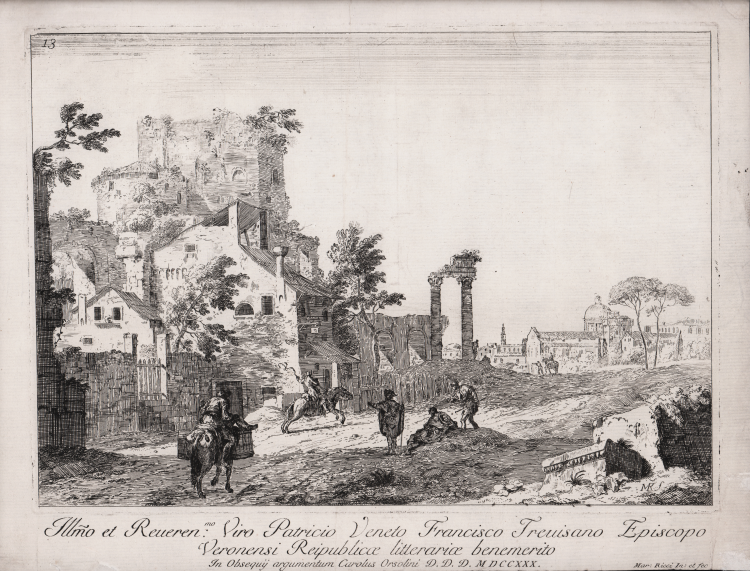
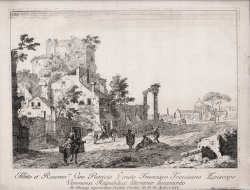
A typical Venetian and Roman landscape capriccio. On the left, imposing architectural ruins stand out, integrated with rural dwellings, while at center-right are two surviving Corinthian columns from an ancient classical temple and, in the background, the dome of a church, evocative of the Roman countryside. In the foreground, the narrative action depicts several moving figures, including two men intent on crushing a serpent with a boulder and a horseman seen from behind.
Etching, circa 1723-30, signed "MR f" on the lower right, signed in full lower right on the dedication plate.
Example of the second state of two, with the number 13 added at the upper left.
The Latin inscription at the bottom is a formal dedication addressed to Francesco Trevisan, bishop of Verona from 1710 to 1732 ("Ill.mo et Reveren.mo Viro Patricio Veneto Francisco Treuisano Episcopo Veronensi Reipublicae literariae benemerito"), edited by Carlo Orsolini ("In Obsequij argumentum Carolus Orsolini D.D.D. MDCCXXX").
Marco Ricci's etchings were published in 1730 by Carlo Orsolini in the famous collection Varia Marci Ricci Pictoris praestantissimi experimenta ab ipsomet auctore inventa. The collection includes the frontispiece designed by Visentini, the portrait of Ricci engraved by Faldoni, and 20 landscapes monogrammed on the plate by the artist.
Marco Ricci was a painter, engraver, and landscape artist born on June 5, 1676, in Belluno. Following a brawl, his violent temper forced him to move to Split. During this period, he created a series of works depicting the Dalmatian coast and the Piave River, which still stand out for their Titian-like style and their fusion of the Romantic views of his predecessors. The works from this period are characterized by dark or yellowish tones. He later met Alessandro Magnasco, and their collaboration led to the creation of a collection of sea storm scenes, in very dark tones. In his final creative period, the artist devoted himself to tempera on parchment, which can now be admired at Windsor Castle. Although he was a landscape painter, his caricatured portraits of dramatic actors are still appreciated today. Thanks to his great skill, he served as an example for the great Venetian painters of the 18th century. On January 21, 1729, he committed suicide in Venice.
A magnificent work, printed on contemporary laid paper with the typical "three moons" watermark, with thin margins, in good condition.
Bibliografia
D. Succi, La Serenissima nello Specchio del rame, vol. 2, pp. 161-162, n. 15, II/II; Bartsch n. 13; Succi, Da Carlevarijs ai Tiepolo, n. 425; Bellini (Ricci), n. 13.
Marco RICCI (Belluno 1676 – 1730)
|
Marco Ricci was an Italian painter of the Baroque period. He was the nephew of Sebastiano Ricci. After receiving his first instruction in art from his uncle, he visited Rome, where he was for some years occupied in drawing vedute.
In 1708 he came to England with his uncle, and his vedute of ruins and architecture (capricci) found many patrons. Marco Ricci etched several plates from his own designs, consisting of views and landscapes, with ruins and figures, including a set of twenty-three prints, entitled Varia Marci Ricci Pictoris priestantissimi experimenta ab ipsomet auctore inventa, delineata atque incisa, et a me Carolo Orsolini Véneto incisore in unum collecta, c. Anno 1730, Venetiis. He died in Venice. Among his pupils were Domenico and Giuseppe Valeriani.
|
Marco RICCI (Belluno 1676 – 1730)
|
Marco Ricci was an Italian painter of the Baroque period. He was the nephew of Sebastiano Ricci. After receiving his first instruction in art from his uncle, he visited Rome, where he was for some years occupied in drawing vedute.
In 1708 he came to England with his uncle, and his vedute of ruins and architecture (capricci) found many patrons. Marco Ricci etched several plates from his own designs, consisting of views and landscapes, with ruins and figures, including a set of twenty-three prints, entitled Varia Marci Ricci Pictoris priestantissimi experimenta ab ipsomet auctore inventa, delineata atque incisa, et a me Carolo Orsolini Véneto incisore in unum collecta, c. Anno 1730, Venetiis. He died in Venice. Among his pupils were Domenico and Giuseppe Valeriani.
|