
| Reference: | S44316 |
| Author | Egidio Patigny |
| Year: | 1666 ca. |
| Measures: | 440 x 665 mm |
| Reference: | S44316 |
| Author | Egidio Patigny |
| Year: | 1666 ca. |
| Measures: | 440 x 665 mm |
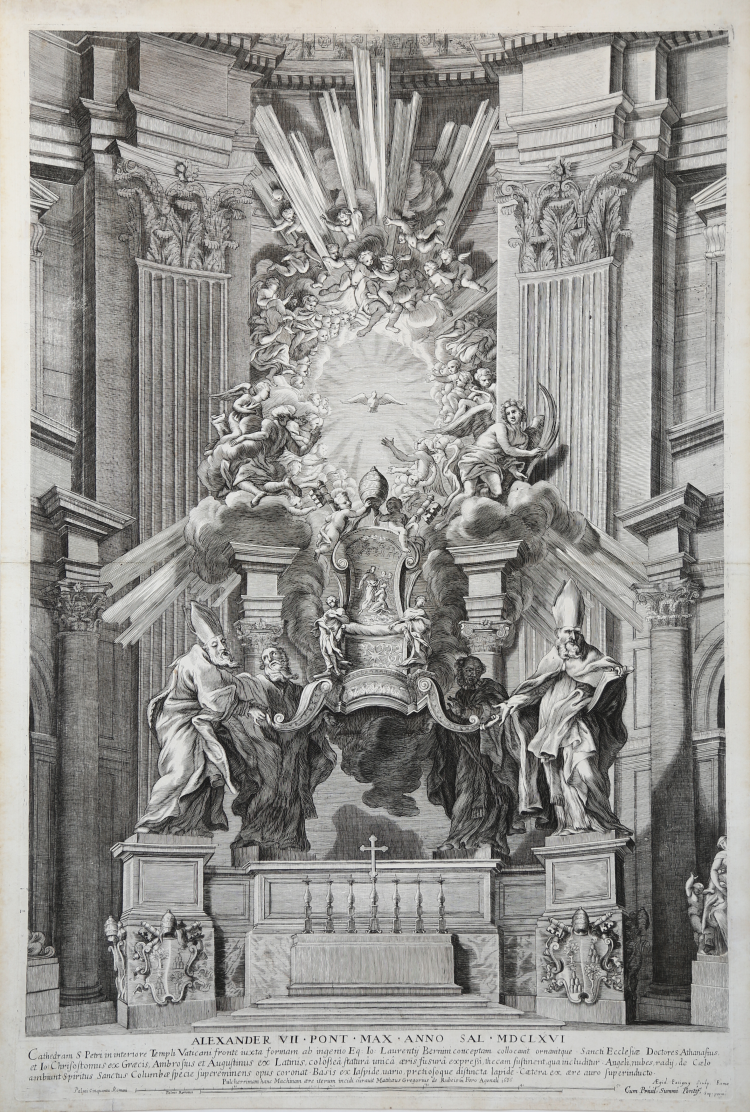
Etching depicting the High Altar of St. Peter's Basilica in the Vatican, with brief information on the construction of the Baldachin designed by Gian Lorenzo Bernini in the title.
This is a replica of the engraving by François Spierre (1639–1681), engraved by Egidio Patigny for the publisher Giovanni Battista de Rossi. Spierre's original, published in 1666, is based on a drawing previously attributed to Bernini himself but now attributed to Giacinto Giminiani (1606–1681) and Lazzaro Morelli (1608–1690).
“The Cathedra Petri is the chair from which, according to tradition, St Peter preached. Around 1655, shortly after his election as pope, Alexander VII commissioned Bernini to design a monument in which the chair was to be housed. It was Alexander's most important donation to St Peter's and Bernini's crowning achievement. Taking eleven years to plan and execute it was completed in January 1666 and positioned at the end of the central nave. The chair is set into a bronze structure supported by sculptures of four Doctors of the Church. Sts Ambrose and Athanasius at the left, Sts Augustine and John Chrysostom at the right. […] Surviving documents record the considerable payments made to Spierre for this large and impressive print. It is likely that it is the print that is mentioned in the diary of Pope Alexander VII (11 October 1666), testifying to its quality and its status as an official record of the monument: 'with Cavaliere Bernint we looked at the print of the Chair of St Peter' (col Cav Bernino vediumo l'intaglio dell Catta di S. Pietro). […] The print was published soon after the chair was inaugurated in January 1666. A preparatory drawing for it, once attributed to Bernini but now given to Gimignani and Morelli, survives in the Fondo Chigi to the Vatican. Given the size and quality of the print, it is nevertheless possible that Bernini was involved in its production; the ambiguus inscription at lower left might refer to this, or just to his design of the momument itself” (cf. Mark McDonald. The Print Collection of Cassiano dal Pozzo, Architecture, Topography and Military Maps, vol. I, p. 248).
Spierre's print was published by Gian Giacomo de Rossi's printing house. Rival publisher Giovan Battista de Rossi commissioned Patigny to produce this replica. Example of the second state with the imprint of the son Matteo Gregorio and the date 1686.
Egidio Patigny, likely the son of Jean Patigny, was active in Rome at the end of the 17th century, designing several architectural works.
A magnificent work, printed on contemporary laid paper, with margins, in excellent condition. Rare.
Bibliografia
cfr. Mark McDonald. The Print Collection of Cassiano dal Pozzo, Architecture, Topography and Military Maps, vol. I, p. 248).
Egidio Patigny (Attivo a Roma alla fine del XVIII secolo)
|
The son probably of Jean Patigny, he was active in Rome in the late 17th century, signing some architectural works for the publisher Matteo Gregorio de Rossi.
|
Egidio Patigny (Attivo a Roma alla fine del XVIII secolo)
|
The son probably of Jean Patigny, he was active in Rome in the late 17th century, signing some architectural works for the publisher Matteo Gregorio de Rossi.
|