
- New
| Reference: | A54018 |
| Author | Johann Jacob HAID |
| Year: | 1750 ca. |
| Measures: | 430 x 345 mm |
| Reference: | A54018 |
| Author | Johann Jacob HAID |
| Year: | 1750 ca. |
| Measures: | 430 x 345 mm |
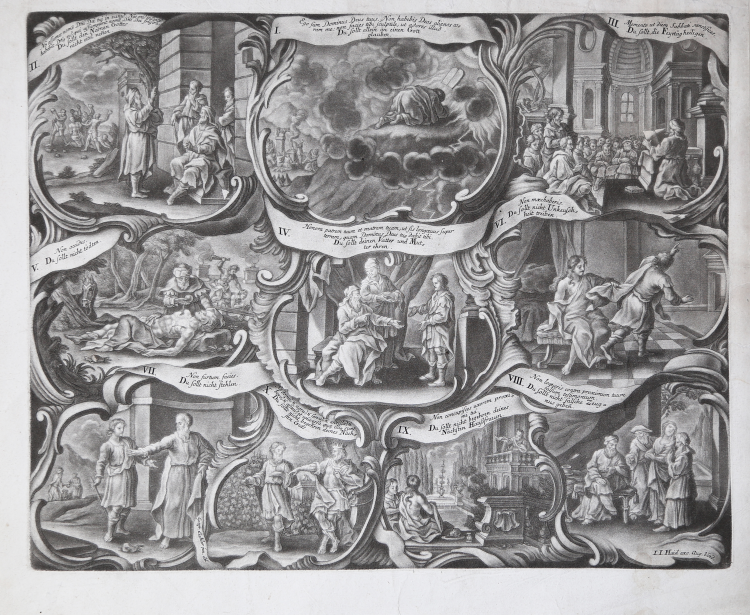
Mezzotint, circa 1750, signed lower right "J. J. Haid exc. Aug. Vind."
Important allegorical representation of the Ten Commandments (Decalogue), created by the artist and engraver Johann Jakob Haid (1704–1767).
The print is characterized by a complex composition of ten narrative vignettes framed by rich cartouche and rococo ornamental elements typical of 18th-century Augsburg production. Each scene illustrates one of the commandments in a didactic and illustrative manner, accompanied by bilingual inscriptions in Latin and German.
The numerical order follows the traditional Lutheran and Catholic order of the commandments:
I (Top center): Adoration of God. It shows Moses kneeling on Mount Sinai before the Tablets of the Law and the divine glory.
II (Top left): Prohibition of blasphemy. Represents the respect due to God's name.
III (Top right): Sanctification of the feast day. Set in an ecclesiastical context during a religious service.
IV (Center): Honor thy father and mother. A classic Baroque family scene illustrating filial respect.
V (Left, below the second): Thou shalt not kill. Depicts a dramatic scene of aggression and violence.
VI (Right, below the third): Thou shalt not commit impure acts. Depicts a temptation or warning against infidelity and impurity.
VII (Left, below): Thou shalt not steal. Depicts a theft or embezzlement confronted with justice.
VIII (Right, below): Thou shalt not bear false witness. Set in a court of law or before a judge to condemn lying.
IX and X (Bottom center): Thou shalt not covet another's wife or property. Vignettes dedicated to controlling desires and greed towards others.
Jacob Haid (1704 – 1767), after 1735, was an extraordinary and prolific mezzotint engraver. Around 300 portraits of him are known, executed from his own drawings and based on paintings by other painters such as Johann Georg Bergmüller, Jan Kupecký, and Nicolas de Largillière. A large portion of his works are collected in Johann Jacob Brucker's Pinacotheca Scriptorum nostra aetate literis illustrium and in the Ehrentempel der deutschen Gelehrsamkeit.
An excellent work, printed on contemporary laid paper, with margins, in perfect condition.
Johann Jacob HAID (Kleineskingen 1704 – Ulm 1767)
|
Johann Jacob Haid or Johann Jakob Haid (1704–1767) was a German engraver who worked in Augsburg. Haid came from a German family of artists and engravers and was known for large mezzotint portraits. He worked in England, and it has been suggested that he borrowed from the work of Robert Robinson (c. 1651 – 1706), who was a popular English mezzotint engraver, painter, and stage designer. Haid also produced botanical work after Bartholomäus Seuter [de] (1678–1754) and with Johann Elias Ridinger, and worked on Johann Wilhelm Weinmann's "Phytanthoza iconographia".
|
Johann Jacob HAID (Kleineskingen 1704 – Ulm 1767)
|
Johann Jacob Haid or Johann Jakob Haid (1704–1767) was a German engraver who worked in Augsburg. Haid came from a German family of artists and engravers and was known for large mezzotint portraits. He worked in England, and it has been suggested that he borrowed from the work of Robert Robinson (c. 1651 – 1706), who was a popular English mezzotint engraver, painter, and stage designer. Haid also produced botanical work after Bartholomäus Seuter [de] (1678–1754) and with Johann Elias Ridinger, and worked on Johann Wilhelm Weinmann's "Phytanthoza iconographia".
|