
| Reference: | A53761 |
| Author | Louis ROUHIER |
| Year: | 1651 ca. |
| Zone: | Piazza Navona |
| Printed: | Rome |
| Measures: | 145 x 205 mm |
| Reference: | A53761 |
| Author | Louis ROUHIER |
| Year: | 1651 ca. |
| Zone: | Piazza Navona |
| Printed: | Rome |
| Measures: | 145 x 205 mm |
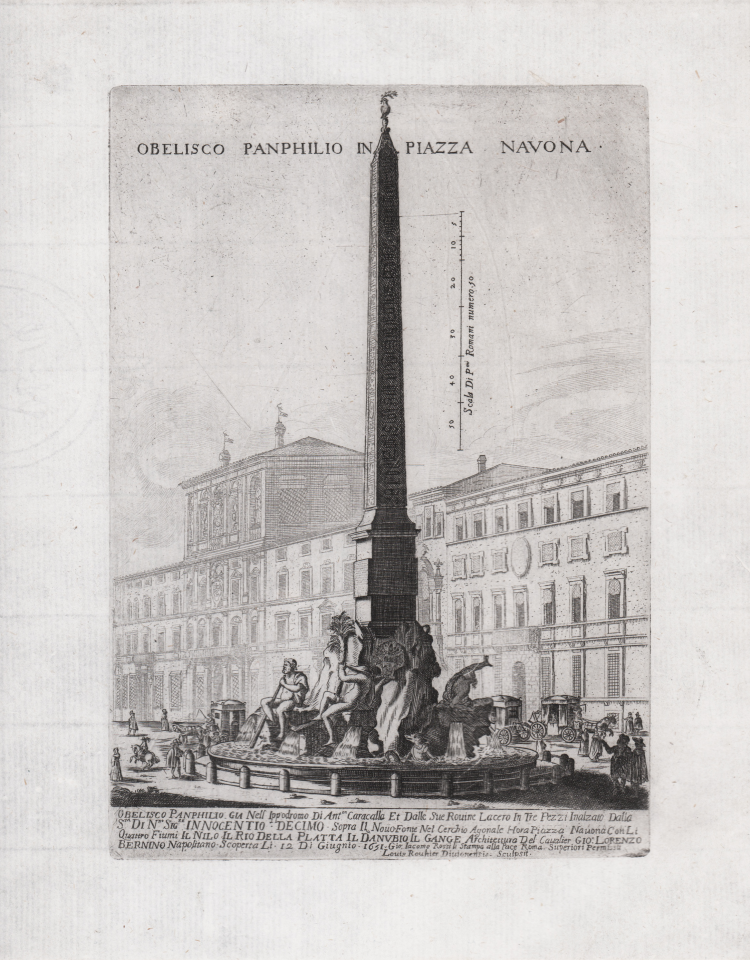
View of the Fountain of the Four Rivers in Piazza Navona, signed by the French engraver Louis Rouhier, originally from Dijon but primarily active in Rome, for the publisher Giovan Giacomo de Rossi.
It shows the Fountain of the Four Rivers with the newly installed obelisk. The date we read, June 12, 1651, is the inauguration day of the famous sculpture that, as is well known, Bernini created after falling out of favor with the Pamphili family; his great fame had suffered a setback, following the failure of his bell tower in St. Peter's and for having worked with the Barberini family, who had always been at odds with the Pamphili family. It was his sister-in-law, Donna Olimpia, who presented Innocent X with a vision of the silver model of Bernini's fountain, which left a very favorable impression on the pontiff, and so the important commission was entrusted to the sculptor, who created the extraordinary allegory that aimed to express the triumph of the Catholic Church over the four continents symbolized by the personifications of the rivers: the Nile, the Ganges, the Rio de la Plata, and the Danube.
Plate from the Nova Racolta degl’Obelischi et Colonne Antiche, della Alma Citta di Roma, con le sue Dichiaratione date in Luce da G. G. Rossi printed in Rome about 1651.
Rare edition, enlarged, of an undated series of 17 plates depicting the obelisks and ancient columns of Rome; each engraving is supplemented by a descriptive caption and most with a scale or height indication. This very focused collection, probably inspired during the pontificate of Innocent X (Camillo Pamphili, reigned 1644-55), was implemented with a plate by Louis Rouhier showing the Pamphili obelisk atop Bernini's Quattro Fiumi fountain in Piazza Navona.
The use of ancient obelisks as the centerpiece of the remarkable transformation of Rome's architecture during the Baroque period has been well documented by architectural historians. Beginning in the last decades of the 16th century, in a grandiose effort to demonstrate the new dynamic spirit of the Counter-Reformation, Sixtus V [reigned 1585-90] moved the Vatican Obelisk to St. Peter's Square and rebuilt those now located in Piazza del Popolo, Piazza dell'Esquilino, and in front of the Lateran. His example was followed by many of his successors during the 17th century.
Etching, printed on contemporary laid paper, with margins, in excellent condition.
Louis ROUHIER (attivo a Roma intorno al 1650)
|
An engraver from Dijon who had settled in Rome around 1650.
|
Louis ROUHIER (attivo a Roma intorno al 1650)
|
An engraver from Dijon who had settled in Rome around 1650.
|