

| Reference: | S50962 |
| Author | Hieronimus WIERIX |
| Year: | 1602 |
| Measures: | 185 x 240 mm |
| Reference: | S50962 |
| Author | Hieronimus WIERIX |
| Year: | 1602 |
| Measures: | 185 x 240 mm |
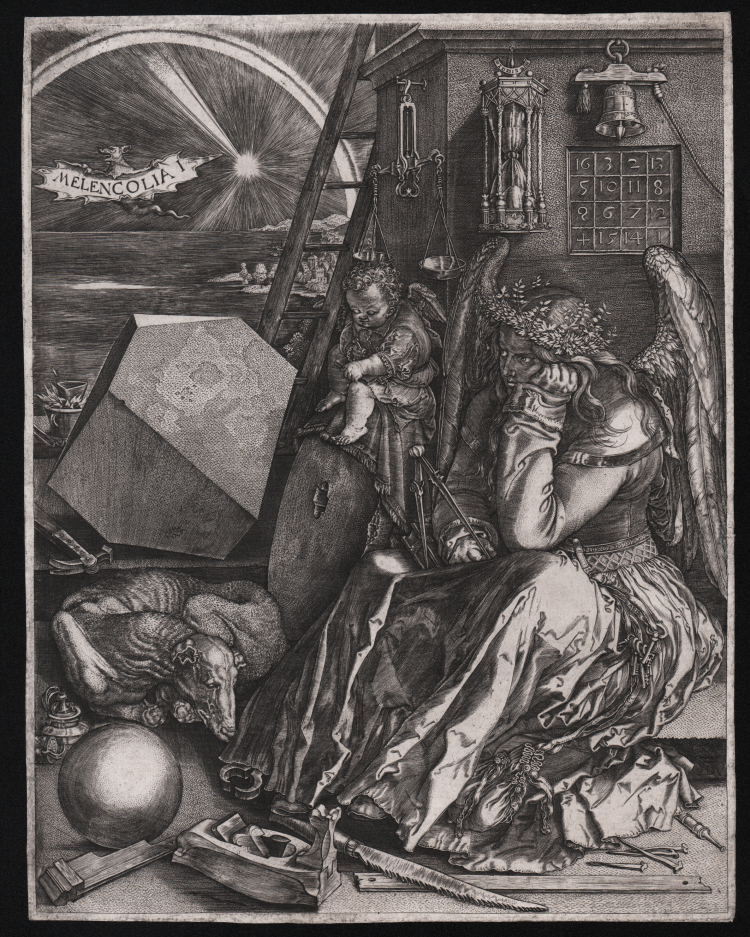
Melancholia; a winged woman representing Melancholy wearing a wreath seated amongst numerous objects, including a bell, an hourglass, scales, and a magic square; a putto seated on a grindstone, next to a sleeping dog; in the background a flying bat, carrying a banner with the inscription 'Melencolia I'; in the foreground, carpenter tools and a sphere.
Engraving, 1602; a copy by Jan Wierix from the engraving by Dürer of 1514.
The print copies one of the most famous and complex engravings that Albrecht Dürer made in 1514. The copy is very faithful, perhaps the best of the known copies, and is distinguished by the absence of the decoration between the A of the word Melencolia and the letter I. The winged woman is depicted seated with her head resting on one hand and her gaze lost in space, towards a distant horizon. She is surrounded by numerous objects, all symbols belonging to the world of alchemy dominated by the planet Saturn: a bell, an hourglass, a scale, and a magic square. A dog sleeps at her feet, and a cherub sits on a millstone. In the background, a building flanks a body of water, above which a bat holds a scroll with the inscription MELENCOLIA I. Melancholy is intended to represent the artist and his state of genius, in an eternal struggle between creativity and restlessness. In the image at the bottom right, Dürer’s monogram and the year 1514 are engraved on the riser of the step.
Jan Wierix, was a Flemish engraver and draughtsman, born into a family of famous engravers. The Wierix family was active in Antwerp and Brussels between the 16th and early 17th centuries. Known primarily for his depictions of landscapes and religious figures, like his brother Jan, he began his career translating the works of Albrecht Dürer (Nuremberg 1471 – Nuremberg 1528). He produced approximately 325 prints, working for his own and other publishers.
A fine impression, printed with tone on contemporary laid paper, trimmed to the platemark, in good condition.
Bibliografia
Bartsch 74/A; Mauquoy-Hendrickx 1556; Hollstein, Dutch and Flemish etchings, engravings and woodcuts c.1450-1700, Wierix (2000); Meder, Dürer Katalog (75 copia).
Hieronimus WIERIX (Anversa, 1549 - Bruxelles, 1618 o poco dopo)
|
Flemish family of artists. They were active mainly in Antwerp in the last quarter of the 16th century and the first quarter of the 17th. Anton Wierix I (c. 1520/25–c. 1572) was registered as a painter in 1545–6, after an apprenticeship of seven years with the otherwise unknown painter Jan Verkelen. Anton I is sometimes also referred to as a cabinetmaker. Given his professions, it is unlikely that he taught any of his three sons, Jan Wierix, Jerome Wierix and Anton Wierix II, all of whom have left large numbers of engravings. Both Jan and Jerome probably trained with a goldsmith, and Anton II presumably studied with one of his older brothers, probably Jan. Although listed as Lutherans in 1585, it seems likely that the Wierix brothers returned to Catholicism soon afterwards, because much of their engraved work was commissioned by the Jesuits and other militant Counter-Reformation sects; their prints played an important role in the recapturing of the southern Netherlands for the Catholic Church. Despite this, all three brothers were famous for their disorderly conduct, and, in a letter of 1587 to the Jesuit priest Ferdinand Ximenes, the Antwerp publisher Christoph Plantin complained that whoever wanted to employ the Wierix brothers had to go and look for them in the taverns, pay their debts and fines and recover their tools, which they had pawned; having worked for a few days, they would then return to the tavern. There is enough archival evidence to corroborate Plantin’s story, but, on the other hand, the sheer mass of engravings produced by Jan and Jerome and their excellent quality indicates a certain amount of hard work on their part. Anton II’s son, Anton Wierix III (1596–before 21 Sept 1624), who was probably trained by his uncle Jerome, joined the guild in 1621–2 but died too young to have had a significant oeuvre. In 1620 Christine, one of the daughters of Jerome, married the engraver Jan-Baptist Barbé (c. 1578–after 1649).HIERONYMUS WIERIX: Engraver, brother of Jan Wierix. At his father’s death, one of the guardians to whom he was entrusted was Jerome Manacker, who was probably a close relative of the goldsmith of the same name ( fl Antwerp, 1520–56). Jerome also began his training by making engravings after Dürer, an activity in which he showed himself to be more precocious than his older brother. He joined Christoph Plantin in 1570 and, like his brother, became a master in 1572–3. In 1574 Plantin paid a fine for Jerome, who had been arrested drunk at night. The publisher was even more exasperated by Jerome’s lifestyle than by Jan’s, and after he had rescued Jerome from prison the next year, he decided not to continue to employ him. From 1577, the date of his first independent engraving, Jerome worked for several other publishers. Between 1577 and 1580 he made many prints for Willem van Haecht and his nephew Godevaard van Haecht (1546–99). These were mostly allegorical and political in theme and demonstrate a sympathy for those rebelling against the Spanish.
|
Hieronimus WIERIX (Anversa, 1549 - Bruxelles, 1618 o poco dopo)
|
Flemish family of artists. They were active mainly in Antwerp in the last quarter of the 16th century and the first quarter of the 17th. Anton Wierix I (c. 1520/25–c. 1572) was registered as a painter in 1545–6, after an apprenticeship of seven years with the otherwise unknown painter Jan Verkelen. Anton I is sometimes also referred to as a cabinetmaker. Given his professions, it is unlikely that he taught any of his three sons, Jan Wierix, Jerome Wierix and Anton Wierix II, all of whom have left large numbers of engravings. Both Jan and Jerome probably trained with a goldsmith, and Anton II presumably studied with one of his older brothers, probably Jan. Although listed as Lutherans in 1585, it seems likely that the Wierix brothers returned to Catholicism soon afterwards, because much of their engraved work was commissioned by the Jesuits and other militant Counter-Reformation sects; their prints played an important role in the recapturing of the southern Netherlands for the Catholic Church. Despite this, all three brothers were famous for their disorderly conduct, and, in a letter of 1587 to the Jesuit priest Ferdinand Ximenes, the Antwerp publisher Christoph Plantin complained that whoever wanted to employ the Wierix brothers had to go and look for them in the taverns, pay their debts and fines and recover their tools, which they had pawned; having worked for a few days, they would then return to the tavern. There is enough archival evidence to corroborate Plantin’s story, but, on the other hand, the sheer mass of engravings produced by Jan and Jerome and their excellent quality indicates a certain amount of hard work on their part. Anton II’s son, Anton Wierix III (1596–before 21 Sept 1624), who was probably trained by his uncle Jerome, joined the guild in 1621–2 but died too young to have had a significant oeuvre. In 1620 Christine, one of the daughters of Jerome, married the engraver Jan-Baptist Barbé (c. 1578–after 1649).HIERONYMUS WIERIX: Engraver, brother of Jan Wierix. At his father’s death, one of the guardians to whom he was entrusted was Jerome Manacker, who was probably a close relative of the goldsmith of the same name ( fl Antwerp, 1520–56). Jerome also began his training by making engravings after Dürer, an activity in which he showed himself to be more precocious than his older brother. He joined Christoph Plantin in 1570 and, like his brother, became a master in 1572–3. In 1574 Plantin paid a fine for Jerome, who had been arrested drunk at night. The publisher was even more exasperated by Jerome’s lifestyle than by Jan’s, and after he had rescued Jerome from prison the next year, he decided not to continue to employ him. From 1577, the date of his first independent engraving, Jerome worked for several other publishers. Between 1577 and 1580 he made many prints for Willem van Haecht and his nephew Godevaard van Haecht (1546–99). These were mostly allegorical and political in theme and demonstrate a sympathy for those rebelling against the Spanish.
|