
- New
| Reference: | A54001 |
| Author | Jan Harmensz MULLER |
| Year: | 1566 ca. |
| Measures: | 245 x 210 mm |
| Reference: | A54001 |
| Author | Jan Harmensz MULLER |
| Year: | 1566 ca. |
| Measures: | 245 x 210 mm |
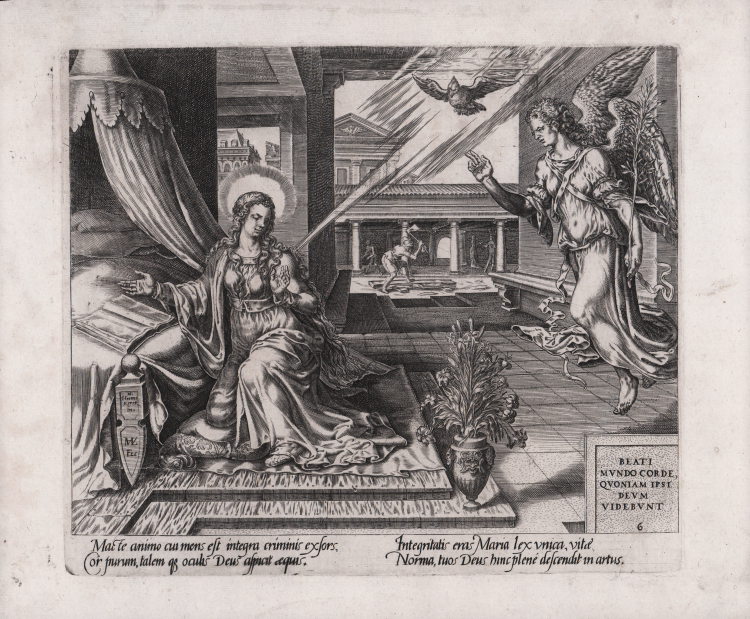
Engraving, circa 1566, signed on the plate with the monogram lower left.
From the series "The Eight Beatitudes" all based on subjects by Maarten van Heemskerck.
This example is in the first state of the three described by Hollstein, before the second number added in the lower margin.
The engraving, by Harmen Jansz. Muller, is the sixth in a series of eight prints on the theme of the Beatitudes (Matthew 5). The sixth Beatitude, "Blessed are the pure in heart, for they shall see God" is represented through the episode of the Annunciation (Luke 1:26-38). Three editions of the series, designed by Maarten van Heemskerck, are known. The first - to which we can trace the engraving in the entry - dates circa 1566; the publisher has not been identified. A second version was printed in Antwerp by Carel Collaert. Finally, the plates appear in the editions of the Theatrum Biblicum hoc est historiae Sacrae veteris et novi testamenti tabulis aeneis expressae, published by Nicolaus Visscher in Amsterdam in 1674.
The scene depicts the Annunciation, the biblical moment when the angel Gabriel visits the Virgin Mary to announce that she will conceive and give birth to the Son of God. Mary is depicted seated, her hand raised in a sign of humility and acceptance, while the angel appears in flowing robes, holding a palm branch. A dove descends overhead, symbolizing the Holy Spirit, and rays of divine light flood the composition. An ornamental vase with lilies in the center emphasizes purity, a traditional Marian symbol.
The Latin inscription "Beati mundo corde: quoniam ipsi Deum videbunt" (Blessed are the pure in heart, for they shall see God) frames the moral and spiritual lesson of the scene. Other verses below the image reinforce the connection between Mary's purity and divine grace.
A magnificent work, rich in tone, printed on contemporary laid paper, with margins, in excellent condition.
Bibliografia
The New Hollstein: Dutch and Flemish etchings, engravings and woodcuts 1450-1700, The Muller Dynasty (Jan Harmensz Muller), vol. 1, pp. 122-129, n. 42 I/III.
Jan Harmensz MULLER (Amsterdam 1571 - 1628)
|
Dutch engraver, draughtsman and painter. He was the eldest son of Harmen Jansz. Muller (1540–1617), the Amsterdam book printer, engraver and publisher. The family business, called De Vergulde Passer (‘The gilded compasses’), was situated in Warmoesstraat, and Jan Muller worked there for many years. He may have been apprenticed to Hendrik Goltzius in Haarlem. Between 1594 and 1602 he is thought to have gone to Italy, where he stayed in Rome and Naples. He was related by marriage to the Dutch sculptor Adriaen de Vries, who was a pupil of Giambologna. He also maintained contacts with Bartholomeus Spranger and other artists in Prague, which under the rule of Emperor Rudolf II had become a flourishing centre of the arts. In 1602 he made an unsuccessful attempt to mediate on behalf of Rudolf II, who wanted to buy Lucas van Leyden’s Last Judgement. When Harmen Jansz. Muller died, he left the entire stock of his shop, including a number of copperplates, to his bachelor son Jan.
|
Jan Harmensz MULLER (Amsterdam 1571 - 1628)
|
Dutch engraver, draughtsman and painter. He was the eldest son of Harmen Jansz. Muller (1540–1617), the Amsterdam book printer, engraver and publisher. The family business, called De Vergulde Passer (‘The gilded compasses’), was situated in Warmoesstraat, and Jan Muller worked there for many years. He may have been apprenticed to Hendrik Goltzius in Haarlem. Between 1594 and 1602 he is thought to have gone to Italy, where he stayed in Rome and Naples. He was related by marriage to the Dutch sculptor Adriaen de Vries, who was a pupil of Giambologna. He also maintained contacts with Bartholomeus Spranger and other artists in Prague, which under the rule of Emperor Rudolf II had become a flourishing centre of the arts. In 1602 he made an unsuccessful attempt to mediate on behalf of Rudolf II, who wanted to buy Lucas van Leyden’s Last Judgement. When Harmen Jansz. Muller died, he left the entire stock of his shop, including a number of copperplates, to his bachelor son Jan.
|