
- New
| Reference: | S30361.6 |
| Author | Vincenzo Florianello |
| Year: | 1875 ca. |
| Zone: | Verona |
| Measures: | 260 x 205 mm |
| Reference: | S30361.6 |
| Author | Vincenzo Florianello |
| Year: | 1875 ca. |
| Zone: | Verona |
| Measures: | 260 x 205 mm |
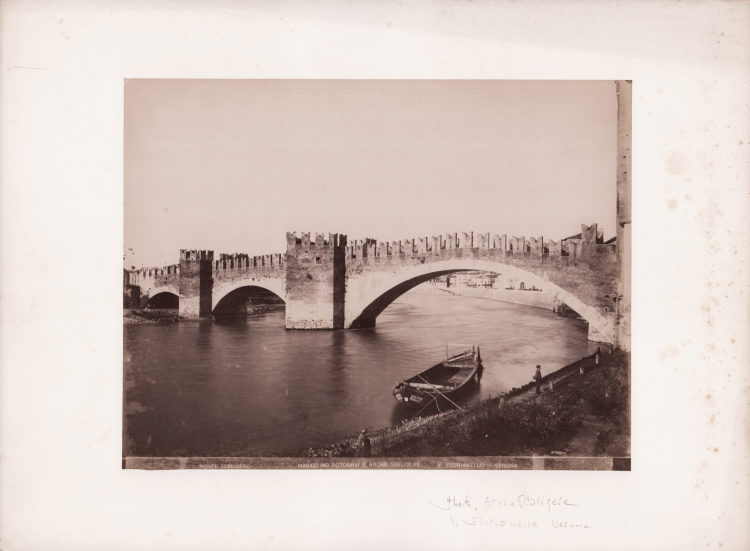
Albumen on paper, mounted on a contemporary support, circa 1875/90.
The photograph shows the Castelvecchio Bridge (also known as the Scaligero Bridge) in Verona, immortalized with a small boat moored on the banks of the Adige River. This is an important document of the monument; the bridge was blown up by retreating German troops in 1945 and was carefully rebuilt after the war, partly reusing original materials recovered from the river. The caption below provides information on the Magazzino Fotografico Archivio Scaligero and the photographer or distributor V. Fiorinello of Verona, active in the production of visual documentation and historical postcards of the city.
Vincenzo (or Vittorio) Florianello was an emblematic figure in the landscape and travel photography market in Verona in the late 19th century (circa 1880). His work is part of the publishing and commercial phenomenon of the pioneers of Italian monumental photography. Florianello founded a fully-fledged business called "Magazzino Fotografie Arche Scaligere". The term "magazzino" indicated the presence of a rich archive and a permanent print shop for travelers on the Grand Tour. His original photographic prints almost always featured a caption printed in negative along the bottom edge. This included the name of the monument, the studio sign, and the city ("Verona"), functioning both as an artist's signature and a modern copyright. Florianello primarily used albumen printing (obtained from egg white), applied to sheets of very thin paper then mounted on stiff backing cards. This process gave the photographs the warm sepia or purplish-brown tones typical of the era. To achieve the incredible clarity visible on the bridge and in the water, Florianello had to travel around Verona with bulky wooden bellows cameras and heavy tripods, making on-site impressions of large glass photographic plates (often wet-plate collodion or gelatin-bromide). In his shots, the human figure (like the small figure visible on the right bank near the boat) was never the subject. People were rarely included, only to give immediate geometric and monumental proportion to the grandeur of the architecture. Today, Florianello's works are not only collectibles on the antiques market, but also constitute a fundamental historical document preserved in Italian museums and photographic archives. They show Verona in the late nineteenth century, before the major modern urban developments and the partial wartime destruction of the twentieth century.
Vincenzo Florianello (attivo a Verona tra il 1875 e il 1890)
|
V. Florianello is one of the most mysterious and elusive figures in 19th-century Venetian photography, as his biography is closely tied to his strictly commercial identity. The very little historical information available is based on contemporary commercial registers and catalogues of his work. Archival data and stylistic analyses of his work place him permanently in Verona between 1875 and 1890. His name: Following the habits of 19th-century cataloguers, he is listed only as "V. Florianello," although it has not yet been possible to trace his full first name in civil registers (Vincenzo or Vittorio are suspected). Florianello did not operate as a purely art photographer, but opened a strategic commercial establishment, the "Magazzino Fotografie Arche Scaligere." He entered the thriving Veronese travel photography market, dominated at the time by figures such as Moritz Lotze (the esteemed German photographer who had introduced high-profile photography to Verona) and the Gozzer studio. Florianello decided to specialize exclusively in the industrial production of standard formats for resale to tourists. Contemporary sources indicate that his workshop/shop was located in the heart of Verona's historic center, not far from the Gothic monumental complex from which the business took its name.
|
Vincenzo Florianello (attivo a Verona tra il 1875 e il 1890)
|
V. Florianello is one of the most mysterious and elusive figures in 19th-century Venetian photography, as his biography is closely tied to his strictly commercial identity. The very little historical information available is based on contemporary commercial registers and catalogues of his work. Archival data and stylistic analyses of his work place him permanently in Verona between 1875 and 1890. His name: Following the habits of 19th-century cataloguers, he is listed only as "V. Florianello," although it has not yet been possible to trace his full first name in civil registers (Vincenzo or Vittorio are suspected). Florianello did not operate as a purely art photographer, but opened a strategic commercial establishment, the "Magazzino Fotografie Arche Scaligere." He entered the thriving Veronese travel photography market, dominated at the time by figures such as Moritz Lotze (the esteemed German photographer who had introduced high-profile photography to Verona) and the Gozzer studio. Florianello decided to specialize exclusively in the industrial production of standard formats for resale to tourists. Contemporary sources indicate that his workshop/shop was located in the heart of Verona's historic center, not far from the Gothic monumental complex from which the business took its name.
|