
- New
| Reference: | A54487 |
| Author | Fabrizio PADOVANI |
| Year: | 1601 |
| Zone: | Theory of climatic zones |
| Printed: | Bologna |
| Measures: | 145 x 225 mm |
| Reference: | A54487 |
| Author | Fabrizio PADOVANI |
| Year: | 1601 |
| Zone: | Theory of climatic zones |
| Printed: | Bologna |
| Measures: | 145 x 225 mm |
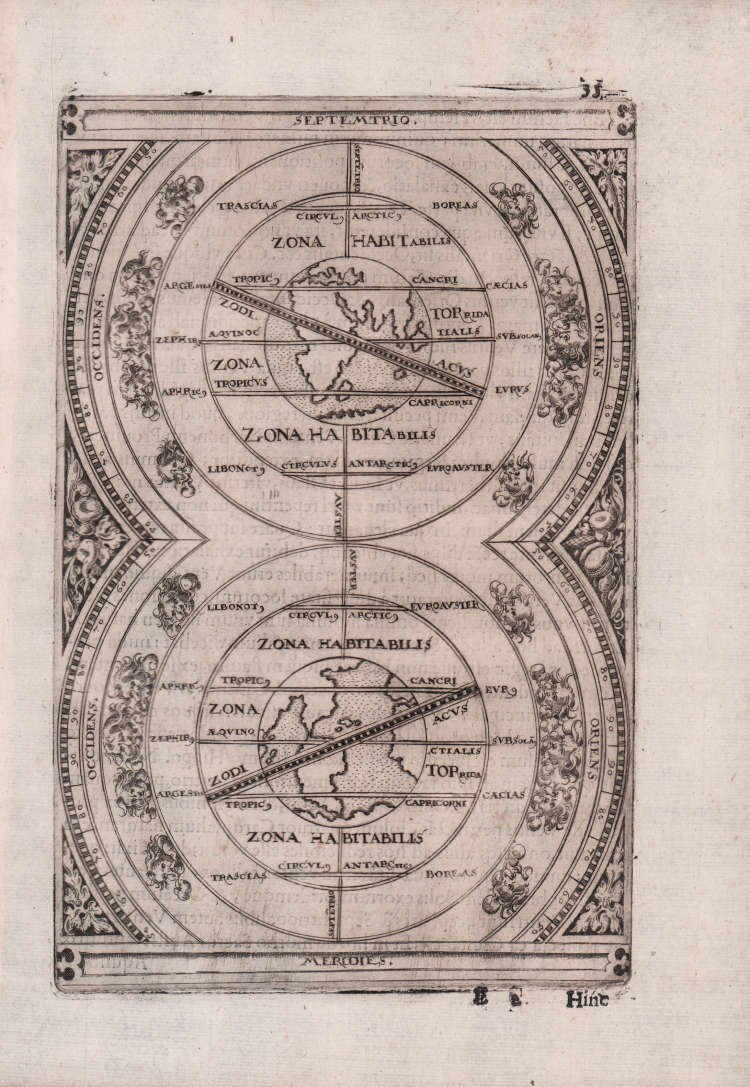
A Renaissance-era geographical and astronomical diagram, taken from the scientific treatise by Fabrizio Padovani titled *Tractatus duo Alter de Ventis Alter Perbrevis de Terraemotu Adiecto Indice copiosissimo*, published in Bologna in 1601.
It illustrates the theory of Earth's climatic zones in relation to the Sun's path along the Zodiac. The structure depicts the Earth divided into parallel bands—following the classical and Renaissance geographical tradition widely disseminated in treatises such as *De sphaera mundi* or the works of contemporary geographers and cosmographers, and inherited from ancient cosmography, particularly from Aristotle and Macrobius. The Earth is subdivided, according to climatic zone theory, into five major bands determined by latitude and the angle of the sun's rays:
*Zonae Habitabilis*: the temperate regions (in both the Northern and Southern Hemispheres) considered suitable for human life.
*Zona Torrida*: the equatorial band, historically believed to be too hot for habitation.
*Circulus Arcticus / Antarcticus*: the polar circles delimiting the cold zones.
The two hemispheres show the Earth intersected by the oblique band of the Zodiac, highlighting the relationship between the Sun's apparent movement and terrestrial climatic variations.
This text represents one of the earliest and most ambitious early modern studies dedicated entirely to meteorology, the nature of winds, and earthquakes, serving as a bridge between classical natural philosophy and new geographical discoveries.
Padovani, a physician and philosopher from Forlì, bases his work on the Aristotelian theory of exhalations. However, he incorporates accounts and information gathered by navigators traveling between continents, thereby transforming the study of winds into one of the first examples of global science. The diagonal band crossing the globes represents the ecliptic (the Zodiac); it serves to graphically illustrate how the Sun's apparent movement and the angle of its rays determine the differential heating of the Earth's surface, thereby generating air currents.
Padovani analyzes how each wind acquires hot, cold, dry, or moist properties depending on the geographical region and climatic zone of its origin. As a physician, Padovani devotes a substantial section to the impact of various winds on human health, noting how they spread disease or alter bodily humors according to latitude.
Etching, in excellent condition. Very rare.
Bibliografia
Riccardi pp. 230-231; Shirley 232.
Fabrizio PADOVANI (attivo tra la seconda metà del XVI secolo e i primi anni del XVII)
|
Padovani was an Italian philosopher, physician, and scientist active in Bologna between the 16th and 17th centuries. Although his major work remains renowned in the history of science, specific biographical details about his life are historically fragmentary, as he is remembered primarily for his writings and academic career. While often associated with the academic and scientific circles of Bologna—where he worked and published—Padovani was originally from Forlì. His family’s historical roots actually lay in Padua (the source of their surname); they had fled that city centuries earlier to escape persecution by the tyrant Ezzelino da Romano, subsequently settling in Romagna. In his writings and contemporary historical documents, he was formally designated as a *philosophus ac medicus* (philosopher and physician). At the time, the study of medicine was inextricably linked to natural philosophy and the understanding of the cosmos and terrestrial phenomena. In addition to practicing and earning acclaim in Italy, Padovani lived and worked as a physician in Germany for part of his life. This experience north of the Alps and his contacts with Central Europe profoundly influenced his scientific outlook. Moving beyond the medicine of the human body, Padovani demonstrated a keen interest in mechanics. In his treatise, he provided a detailed account of the practical application of air power, including illustrations of bellows, mills, foundries, and the technological instruments of the era.
|