
- New
| Reference: | A54016 |
| Author | Hans Sebald BEHAM |
| Year: | 1546 |
| Measures: | 75 x 50 mm |
| Reference: | A54016 |
| Author | Hans Sebald BEHAM |
| Year: | 1546 |
| Measures: | 75 x 50 mm |
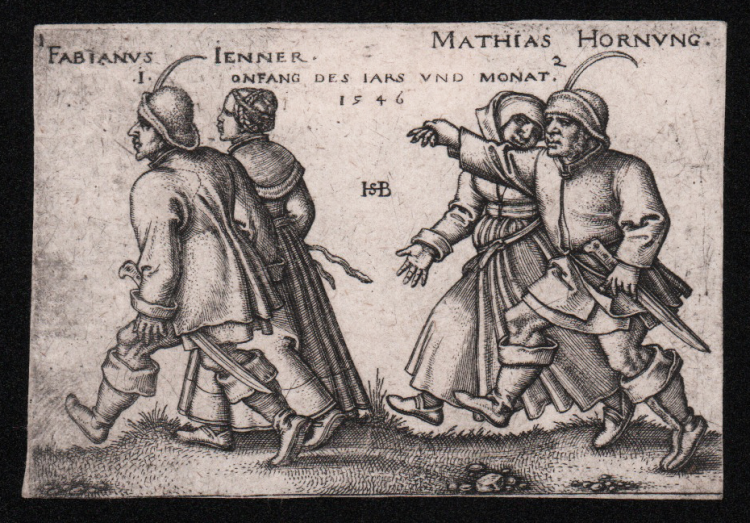
January and February, from the series The Peasants' Feast or The Twelve Months.
Engraving, 1546, signed with the artist's monogram "HSB" engraved in the center. Titled at the top: "FABIANVS IENNER .1. / IENNER / ONFANG DES IARS VND MONAT 1546" (January) and "MATHIAS HORNVNG .2." (February).
A very fine engraving from the famous series dedicated to the Twelve Months and rural festivities, executed by Sebald Beham in 1546. The work depicts the first two couples of peasants advancing in a dance or wedding procession, personifying the months of January (linked to the feast of Saint Fabian) and February (identified with the ancient term Hornung and linked to Saint Matthias). Beham, a leading figure among the so-called "Little Masters" (Kleinmeister) of the German Renaissance, stands out for his extraordinary ability to concentrate a monumental level of detail, dynamism, and expressiveness in very small-format works. The work offers an extraordinary anthropological insight into the 16th century, meticulously depicting the folk costumes, footwear, hairstyles, and typical knives (Bauernwehr) hanging from the subjects' belts.
Sebald Beham's peasant series represent a milestone in 16th-century Northern European graphic art. Moving away from purely sacred or mythological themes, the artist celebrates the vitality, energy, and sometimes crude irony of the rural world of Reformation Germany.
“From a series of ten engravings numbered consecutively in the plates and depicting a series of thirteen dancing couples and two musicians followed by a feast, a fight and other scenes associated with the feast. The first twelve dancing couples are identified as depictions of the months through accompanying inscriptions. The series was intended to be displayed as a frieze, with parts of figures, such as heals or skirts, stretching across two plates” (See G. Bartrum, 'German Renaissance Print', exh. cat., BM, London 1995).
A good impression on contemporary laid paper, trimmed to the platemark, in good condition.
Bibliografia
Pauli, Hans Sebald Beham: Ein Kritisches Verzeichniss seiner Kupferstiche Radirungen und Holzschnitte (177.II); The New Hollstein: German engravings, etchings and woodcuts 1400-1700 (182.II); Bartsch, Le Peintre graveur (VIII.178.154)
Hans Sebald BEHAM Nuremberg 1500 - Frankfurt 1550
|
Engraver, etcher, designer of woodcuts and stained glass, painter and illustrator. In contemporary documents and prints he was nearly always identified as Sebald Beham although since the 17th century (Sandrart) and into the early years of the 20th he has mistakenly been called Hans Sebald Beham on the basis of his monogram: HSP or HSB. This reflects S[ebald] Peham/Beham with the P (Nuremberg pronunciation) changing to B c. 1531, when he appears to have moved to Frankfurt. Sandrart’s biography of him is illustrated with a printed portrait similar to Sebald’s painted Self-portrait in his David panel in the Louvre; around the Sandrart portrait is an inscription identifying him as painter and engraver. Only one of Sebald’s panel paintings has survived (the Story of David, 1534; Paris, Louvre), though documents cited by Hampe and Vogler refer to him as a journeyman for painting in 1521 and as having his own journeyman—i.e. running a workshop—in 1525. Sebald is best known to posterity, however, for his prints, of which he produced a prodigious quantity: approximately 252 engravings, 18 etchings and 1500 woodcuts, including woodcut book illustrations. Biographical information is scanty: Sandrart alleged that he was trained by Barthel and opened a tavern, the bad reputation of which derived from his own dissolute life. Unquestionably, however, he was industrious and meticulous artistically. He began producing prints in quantity in 1519, though a few date to before then: a woodcut of Lust from a series of the Ten Commandments—a youthfully naive work produced in 1512 when Sebald was 12—and a sheet of sometimes awkwardly drawn pen-and-ink studies of male and female heads on red prepared paper (1518; Brunswick, Herzog Anton Ulrich-Mus.). His first engraving, dated 1518, is a diminutive Portrait of a Young Woman.
|
Hans Sebald BEHAM Nuremberg 1500 - Frankfurt 1550
|
Engraver, etcher, designer of woodcuts and stained glass, painter and illustrator. In contemporary documents and prints he was nearly always identified as Sebald Beham although since the 17th century (Sandrart) and into the early years of the 20th he has mistakenly been called Hans Sebald Beham on the basis of his monogram: HSP or HSB. This reflects S[ebald] Peham/Beham with the P (Nuremberg pronunciation) changing to B c. 1531, when he appears to have moved to Frankfurt. Sandrart’s biography of him is illustrated with a printed portrait similar to Sebald’s painted Self-portrait in his David panel in the Louvre; around the Sandrart portrait is an inscription identifying him as painter and engraver. Only one of Sebald’s panel paintings has survived (the Story of David, 1534; Paris, Louvre), though documents cited by Hampe and Vogler refer to him as a journeyman for painting in 1521 and as having his own journeyman—i.e. running a workshop—in 1525. Sebald is best known to posterity, however, for his prints, of which he produced a prodigious quantity: approximately 252 engravings, 18 etchings and 1500 woodcuts, including woodcut book illustrations. Biographical information is scanty: Sandrart alleged that he was trained by Barthel and opened a tavern, the bad reputation of which derived from his own dissolute life. Unquestionably, however, he was industrious and meticulous artistically. He began producing prints in quantity in 1519, though a few date to before then: a woodcut of Lust from a series of the Ten Commandments—a youthfully naive work produced in 1512 when Sebald was 12—and a sheet of sometimes awkwardly drawn pen-and-ink studies of male and female heads on red prepared paper (1518; Brunswick, Herzog Anton Ulrich-Mus.). His first engraving, dated 1518, is a diminutive Portrait of a Young Woman.
|