
| Reference: | A54373 |
| Author | Louis ROUHIER |
| Year: | 1667 |
| Printed: | Rome |
| Measures: | 475 x 345 mm |
| Reference: | A54373 |
| Author | Louis ROUHIER |
| Year: | 1667 |
| Printed: | Rome |
| Measures: | 475 x 345 mm |
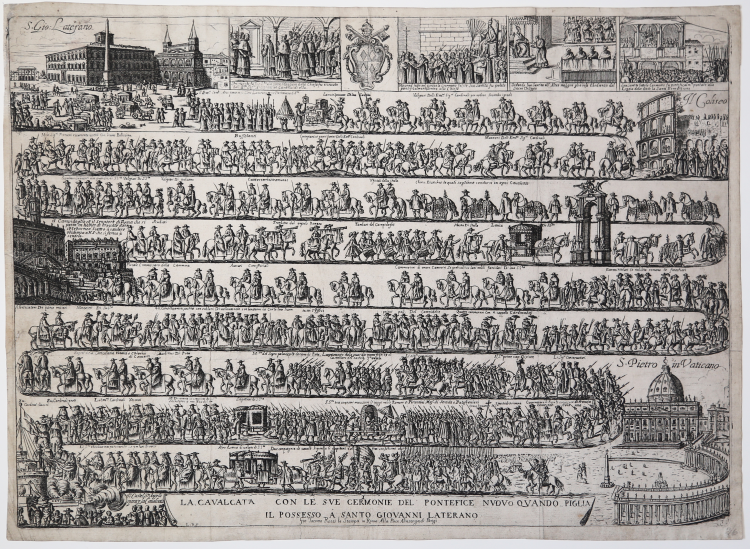
Ceremony of the "possession" of Clement IX, with a triumphal arch Campo Vaccino, Santa Maria Maggiore, San Giovanni dei Fiorentini.
Magnificent engraving depicting the ceremony of the taking of possession of Pope Clement IX (Giulio Rospigliosi, 1600-1669), held in Rome in June 1667.
The plate is signed with the monogram "L. R. F." by the French engraver Louis Rouhier, originally from Dijon but mainly active in Rome, for the publisher Giovan Giacomo de Rossi, whose imprint is located at the bottom: Gio Jacomo Rossi le Stampa in Roma Alla Pace Al Insegna di Parigi.
This is a second state of the plate, which was prepared for the election of Pope Alexander VII (Fabio Chigi, 1599-1667) in 1655. In this 1667 reprint, the portrait of Alexander VII - at the top – has been erased and replaced by the Rospigliosi coat of arms; there are signs of erasure beneath the new coat of arms.
The ceremony of "taking possession," immediately following the election of a pope, symbolized the "possession" of the city of Rome. For centuries, the ceremony was characterized by a cavalcade from St. Peter's in the Vatican to St. John Lateran, where the new pope received the gold and silver keys to the basilica. Later, the itinerary was shortened and the ritual simplified, and the "possession" took on a decidedly less ostentatious character. The papal procession traversed the entire length of Rome; it started from St. Peter's (bottom right), crossed the Borgo, and reached Castel Sant'Angelo; It passed near Piazza Navona and reached the Capitoline Hill (center left); then it crossed the Roman Forum, skirted the Colosseum on the left (top right), and arrived at San Giovanni in Laterano (higher left). The cavalcade passed through an area containing the most important testimonies of ancient Roman civilization, between the Capitoline Hill and the Colosseum. For the Church, in fact, the roots of the Papacy were sunk in Imperial Rome, and the Cavalcade of the Possessus is the clearest proof of this belief. Beginning with the pontificate of Alexander VI Borgia (d. 1503), the ceremony was increasingly directly inspired by Roman triumphs, in the climate of reference to antiquity typical of Renaissance Rome.
Magnificent work, rich in tones, printed on contemporary laid paper with a “fluer de lys in a circle with crown” watermark, with margins, in very good condition. An extremely rare print, known through the example in the Museum of Rome [inv. GS 116] and the one in the Ashby collection at the Vatican Library [Riserva.I.37(3)].
Bibliografia
Le Blanc, Manuel de l'amateur d'estampes, n.2; Nagler, Die Monogrammisten, n. 1327; Maurizio Fagiolo dell’Arco, Corpus delle Feste a Roma, La festa barocca, pp. 452-454; Simonetta Tozzi, Incisioni barocche di feste e avvenimenti, pp. 41-45, I.15.
Louis ROUHIER (attivo a Roma intorno al 1650)
|
An engraver from Dijon who had settled in Rome around 1650.
|
Louis ROUHIER (attivo a Roma intorno al 1650)
|
An engraver from Dijon who had settled in Rome around 1650.
|