
- New
| Reference: | S42733.13 |
| Author | Pompeo POZZI |
| Year: | 1870 ca. |
| Zone: | Milan |
| Measures: | 377 x 270 mm |
| Reference: | S42733.13 |
| Author | Pompeo POZZI |
| Year: | 1870 ca. |
| Zone: | Milan |
| Measures: | 377 x 270 mm |
Albumen on paper, mounted on a contemporary support, circa 1870/75.
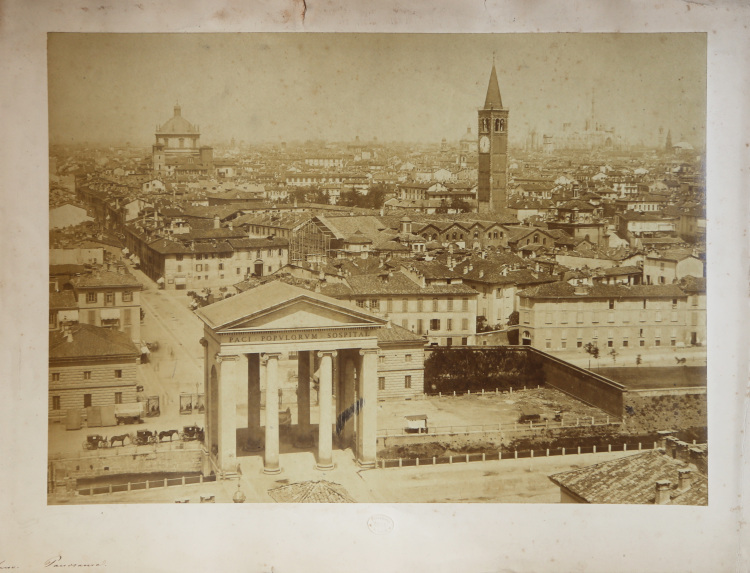
The photograph shows a panoramic view of Milan. The work constitutes a historical and urban planning document of exceptional importance for the history of the city of Milan. Taken from an elevated vantage point—most likely from the first structures near the bastions—the photograph documents the monumental and popular layout of the southern area of Milan before the radical demolitions and drainage works that occurred between the 19th and 20th centuries. In the foreground, the monumental neoclassical Porta Ticinese, a masterpiece by architect Luigi Cagnola, erected between 1801 and 1814, stands out with absolute geometric precision. The structure once served as a toll house, and the shot captures it still surrounded by its original pedestrian and roadways, with carriages and horses visible at its base. Immediately behind the arch, on the right, stands the majestic 14th-century bell tower of the Basilica of Sant'Eustorgio. In the background, the urban fabric unfolds in a maze of rooftops and courtyards of Milan's old working-class and mercantile past, offering a unique glimpse of the Cerchia dei Navigli and the still partially intact Spanish bastions. The photographer, Pompeo Pozzi, was one of the key figures in early Italian photography. A trained painter and photographic editor, his gallery studio in Milan was renowned for the impeccable technical quality of his urban views and art reproductions. His works are now held in Italy's most prestigious institutions, including the Civic Photographic Archive of the Castello Sforzesco.
Pompeo Pozzi, trained as a painter at the Brera Academy of Fine Arts, worked from 1848 in the shop inherited from his father, Luigi Valeriano, a publisher and print dealer. He soon developed a passion for photography, turning it into a solid profession and dedicating himself with extreme expertise to photographing monumental buildings and works of art. His shop was home to the art and photography magazine "L'Artista," edited by Luigi Sacchi in 1859. In 1862, Antonio Caimi, in his memoir, listed him as one of the finest artists in Lombardy. He received important commissions from the Municipality of Milan, for which he photographed buildings constructed by the Technical Offices, and from the Veneranda Fabbrica del Duomo, which commissioned him to conduct photographic campaigns documenting the ongoing work on the Cathedral. His photographs were purchased by a French diplomat and are now preserved at the Bibliothèque nationale de France and the École Nationale Supérieure des Beaux-Arts de Paris.
Pompeo POZZI (Milano 1817 - 1888)
|
Pompeo Pozzi, trained as a painter at the Brera Academy of Fine Arts, worked from 1848 in the shop inherited from his father, Luigi Valeriano, a publisher and print dealer. He soon developed a passion for photography, turning it into a solid profession and dedicating himself with extreme expertise to photographing monumental buildings and works of art. His shop was home to the art and photography magazine "L'Artista," edited by Luigi Sacchi in 1859. In 1862, Antonio Caimi, in his memoir, listed him as one of the finest artists in Lombardy. He received important commissions from the Municipality of Milan, for which he photographed buildings constructed by the Technical Offices, and from the Veneranda Fabbrica del Duomo, which commissioned him to conduct photographic campaigns documenting the ongoing work on the Cathedral. His photographs were purchased by a French diplomat and are now preserved at the Bibliothèque nationale de France and the École Nationale Supérieure des Beaux-Arts de Paris.
|
Pompeo POZZI (Milano 1817 - 1888)
|
Pompeo Pozzi, trained as a painter at the Brera Academy of Fine Arts, worked from 1848 in the shop inherited from his father, Luigi Valeriano, a publisher and print dealer. He soon developed a passion for photography, turning it into a solid profession and dedicating himself with extreme expertise to photographing monumental buildings and works of art. His shop was home to the art and photography magazine "L'Artista," edited by Luigi Sacchi in 1859. In 1862, Antonio Caimi, in his memoir, listed him as one of the finest artists in Lombardy. He received important commissions from the Municipality of Milan, for which he photographed buildings constructed by the Technical Offices, and from the Veneranda Fabbrica del Duomo, which commissioned him to conduct photographic campaigns documenting the ongoing work on the Cathedral. His photographs were purchased by a French diplomat and are now preserved at the Bibliothèque nationale de France and the École Nationale Supérieure des Beaux-Arts de Paris.
|