
| Reference: | S35720 |
| Author | Giovanni MAGGI |
| Year: | 1600 ca. |
| Zone: | Castel Sant'Angelo |
| Printed: | Rome |
| Measures: | 157 x 212 mm |
| Reference: | S35720 |
| Author | Giovanni MAGGI |
| Year: | 1600 ca. |
| Zone: | Castel Sant'Angelo |
| Printed: | Rome |
| Measures: | 157 x 212 mm |
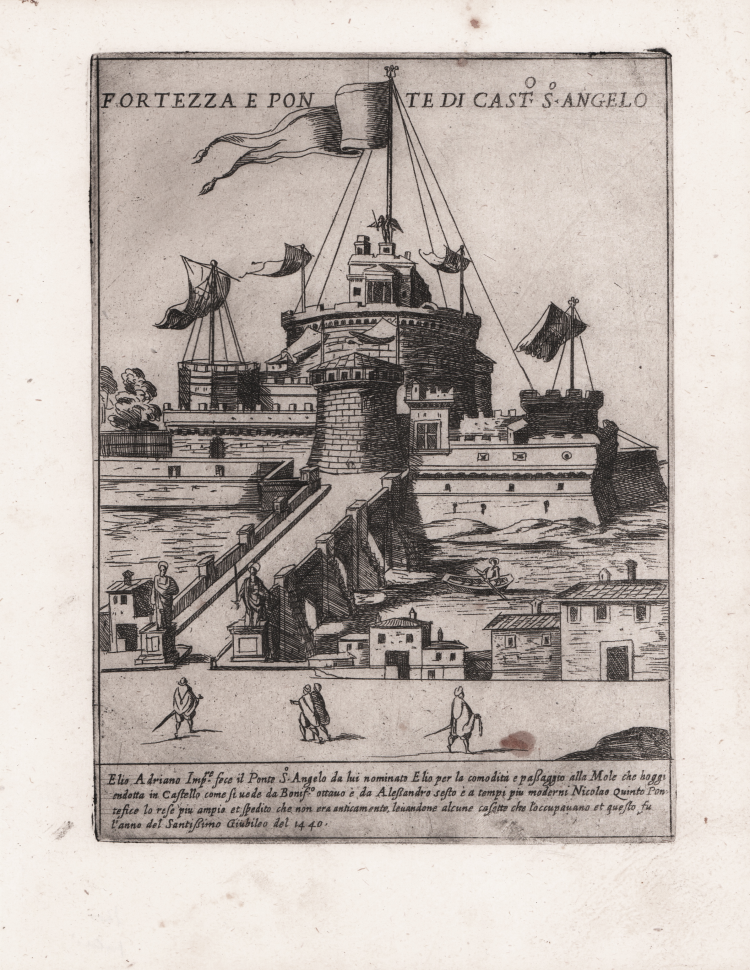
Etching, 1600, from the series: "Ornamenti di Fabriche Antichi et Moderni Dell'Alma Citta di Roma con le sue Dichiarazione fatti da Bartolommeo Rossi fiorentino…parte seconda" published in Rome by Andrea Vaccari in 1600.
The engraving is unusual among Roman views printed at the time, as its apparent genesis is that of a personal or professional work, as opposed to a print conceived solely to please pilgrims or tourists in Rome. Andrea Vaccari's stall at the Zecca Vecchia, a stone's throw from Castel Sant'Angelo, would have offered the printer a view of the monument depicted here.
The work contains 24 etchings, including the architectural frontispiece, created by Giovanni Maggi, whose name is listed at the bottom of the title page: "Ioannes maius Romanus delineauit anno Iubilei MDC". Each engraving is accompanied by a caption at the bottom, which either simply states the name and location of the monument, or else provides a historical description. This work is very rare.
Michael Bury discusses the engraving in his excellent The Print in Italy 1550-1620: "The Mausoleum of the Emperor Hadrian was, as the inscription [in Latin and in Italian] in the lower margin tells us, converted into a papal fortress in the Middle Ages. The great round tower of Pope Alexander VI (1492-1503) controlled the important Tiber crossing represented by the Ponte Sant'Angelo and guarded the entrance to the Borgo, the area of the city between St. Peter's and the river. This was probably the plate listed in the Vaccari stocklist of 1614: 'Castel di S. Angelo come si vista hoggidi, intagliato da Gio. Maggio' (Ehrle, 1908, p. 62, l. 291). shop 'at the sign of the golden Palm' ('in the name of the Palme d'Or') in the via de' Banchi Nuovi, opposite San Giuliano in Banchi at Monte Giordano. Compared to earlier comparable material representing monuments of ancient and modern Rome, this is a rather raw and perfunctory performance. It fits with the relative informality of what others at the time were publishing, such as the topographical etchings issued by Nicholas van Aelst. But although curiously isolated against a blank background and with a strong element of fantasy in the enormously exaggerated size of the papal banners flying from the towers, this does record rather accurately the appearance of the fortress, the bridge and the piazza del Ponte. The view of the fish market (Pescaria), the shops and especially of the place of execution (Luogo di Giustia) with its display of severed heads, provides a rare opportunity to see something of what these less imposing aspects of Roman life looked like” (M. Bury, The Print in Italy 1550-1620 pp. 140-1, n. 88).
Etching, printed on contemporary laid paper, wide margins, in excellent condition.
Bibliografia
Nagler G.K., Neues Allgemeines Künstler-Lexikon, V. 8 p. 183, n. 15; Le Blanc C., Manuel de L'amateur D'estampes, V. 2 p. 585, n. 85.
|
Painter and etcher. Active in Rome. He appears in 1605 in the Libro del Camerlengo of the Compagnia di S.Luca, Rome, in a list of those who have contributed ‘per lemosina dela candela’. He applied for admission to the Virtuosi del Pantheon, 9 January 1611.
1609 entered into a working agreement with Giovanni Orlandi at the Pasquino-engraved various churches for him.Plates listed in the Vaccari stocklist of 1614.
Important as an etcher of landscape.Also antiquities,including series:Libro di tutte le guglie,1600,and the ornamenti delle fabbriche antiche e moderne dell’alma città di Rome,1600.
Map of Rome, 1603. 1604 Bichierografia, commissioned from him c.1600 by Cardinale Del Monte.
|
|
Painter and etcher. Active in Rome. He appears in 1605 in the Libro del Camerlengo of the Compagnia di S.Luca, Rome, in a list of those who have contributed ‘per lemosina dela candela’. He applied for admission to the Virtuosi del Pantheon, 9 January 1611.
1609 entered into a working agreement with Giovanni Orlandi at the Pasquino-engraved various churches for him.Plates listed in the Vaccari stocklist of 1614.
Important as an etcher of landscape.Also antiquities,including series:Libro di tutte le guglie,1600,and the ornamenti delle fabbriche antiche e moderne dell’alma città di Rome,1600.
Map of Rome, 1603. 1604 Bichierografia, commissioned from him c.1600 by Cardinale Del Monte.
|