
| Reference: | A53862 |
| Author | Niccolò CARLETTI |
| Year: | 1776 |
| Zone: | Naples |
| Printed: | Naples |
| Measures: | 650 x 435 mm |
| Reference: | A53862 |
| Author | Niccolò CARLETTI |
| Year: | 1776 |
| Zone: | Naples |
| Printed: | Naples |
| Measures: | 650 x 435 mm |
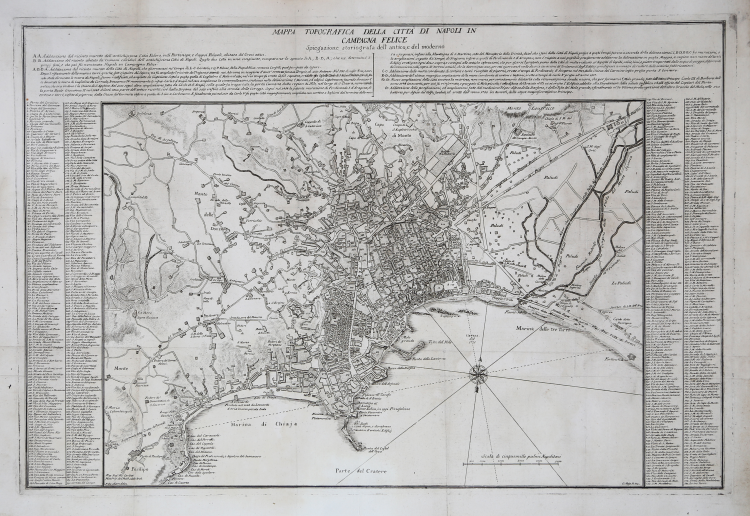
Smaller-scale reduction of the monumental map of the Duke of Noja (1775), reproduced by the architect and mathematician Niccolò Carletti the following year. The copperplate was designed by Filippo de Cham and engraved by Giuseppe Aloja.
The map is part of the historical-geographic treatise entitled " Topografia universale della città di Napoli". On the sides and at the top of the map is the detailed Spiegazione storiografa dell'antico e del moderno [Historical Explanation of the Ancient and the Modern] a descriptive text illustrating the evolution of the city's urban planning, ancient walls, and monuments.
The Duke of Noja map is a topographical map of the city of Naples and its surroundings, dating back to 1775. It constitutes an important iconographic source for the topographical and urban planning study of the area between the 17th and 19th centuries, enabling, among other things, the study of the genesis and original urban layout of the Vesuvian Villas of the Golden Mile. Upon the death of Giovanni Carafa, Duke of Noja, the topographical map of the city of Naples commissioned by him remained unfinished. The work was therefore entrusted to Giovanni Pignatelli, Prince of Monteroduni, assisted by the architect Gaetano Bronzuoli and Niccolò Carletti himself. The result was published in thirty-five plates at a scale of 1:3.808 in 1775. Not satisfied with the succinctness of the map's marginal notes, Carletti published an extension to the caption detailing each of the map's 580 markers, depicting the city's main monuments and sites.
Niccolò Carletti (Naples, November 8, 1723 – Naples, 1796) was an architect, mathematician, and surveyor. After studying mathematics, philosophy, and literature, Carletti went to Rome to study architecture and learn the profession, broadening his education to include principles of hydraulics, natural sciences, and law. A profound and broad academic background was required of him to be the architect of the city of Naples, and it served him well in the many roles entrusted to him, such as examiner of the Board of Land Registers and the Royal Military Academy of Naples, as well as an academic in Rome for the Society of Sciences and Fine Arts. From 1745 to 1754, he served as a volunteer military engineer, overseeing projects underway in the royal factories of Naples, as well as road construction, such as at Camporeale, and on the royal estate of Carditello.
Etching, printed on contemporary laid paper, with margins, in excellent condition.
Bibliografia
G. Pane - V. Valerio, La città di Napoli tra vedutismo e cartografia, Grimaldi, Napoli 1987, p. 307; C. de Seta - A. Buccaro (a cura di), Iconografia delle città in Campania. Napoli e i centri della provincia, Electa Napoli 2006, pp. 151-152.
Niccolò CARLETTI (Napoli 1723- 1796)
|
Niccolò Carletti (Naples, November 8, 1723 – Naples, 1796) was an architect, mathematician, and surveyor. He was probably born in Naples in 1723 to a family of Tuscan origins. After studying mathematics, philosophy, and literature, Carletti went to Rome to study architecture and learn the profession, broadening his education to include principles of hydraulics, natural sciences, and law. A profound and broad academic background was required of him to be the architect of the city of Naples, and it served him well in the many roles entrusted to him, such as examiner of the Board of Land Registers and the Royal Military Academy of Naples, as well as an academic in Rome for the Society of Sciences and Fine Arts. From 1745 to 1754, he served as a volunteer military engineer, overseeing projects underway in the royal factories of Naples, as well as road construction, such as at Camporeale, and on the royal estate of Carditello. He worked on the reconstruction of the island of Ventotene and the reclamation of the marshy area around Formicola. Upon the death of Giovanni Carafa, Duke of Noja, the topographical map of the city of Naples commissioned from him remained unfinished. The work was therefore entrusted to Giovanni Pignatelli, Prince of Monteroduni, assisted by the architect Gaetano Bronzuoli and Niccolò Carletti himself. The result was published in thirty-five plates at a scale of 1:3.808 in 1775. Not satisfied with the succinctness of the map's marginal notes, Carletti published an extension to the caption detailing each of the map's 580 references, depicting the city's main monuments and sites. His professional activity was accompanied by an intellectual pursuit that resulted in the drafting and subsequent publication of texts of fundamental importance to the study of architecture, hydraulics, and topography. His work as an architectural theorist was interrupted by death, when he had yet to publish two more works. The date of his death is also subject to uncertainty; it is generally believed to have occurred in Naples in 1796.
|
Niccolò CARLETTI (Napoli 1723- 1796)
|
Niccolò Carletti (Naples, November 8, 1723 – Naples, 1796) was an architect, mathematician, and surveyor. He was probably born in Naples in 1723 to a family of Tuscan origins. After studying mathematics, philosophy, and literature, Carletti went to Rome to study architecture and learn the profession, broadening his education to include principles of hydraulics, natural sciences, and law. A profound and broad academic background was required of him to be the architect of the city of Naples, and it served him well in the many roles entrusted to him, such as examiner of the Board of Land Registers and the Royal Military Academy of Naples, as well as an academic in Rome for the Society of Sciences and Fine Arts. From 1745 to 1754, he served as a volunteer military engineer, overseeing projects underway in the royal factories of Naples, as well as road construction, such as at Camporeale, and on the royal estate of Carditello. He worked on the reconstruction of the island of Ventotene and the reclamation of the marshy area around Formicola. Upon the death of Giovanni Carafa, Duke of Noja, the topographical map of the city of Naples commissioned from him remained unfinished. The work was therefore entrusted to Giovanni Pignatelli, Prince of Monteroduni, assisted by the architect Gaetano Bronzuoli and Niccolò Carletti himself. The result was published in thirty-five plates at a scale of 1:3.808 in 1775. Not satisfied with the succinctness of the map's marginal notes, Carletti published an extension to the caption detailing each of the map's 580 references, depicting the city's main monuments and sites. His professional activity was accompanied by an intellectual pursuit that resulted in the drafting and subsequent publication of texts of fundamental importance to the study of architecture, hydraulics, and topography. His work as an architectural theorist was interrupted by death, when he had yet to publish two more works. The date of his death is also subject to uncertainty; it is generally believed to have occurred in Naples in 1796.
|