
| Reference: | A53984 |
| Author | Carlo FEA |
| Year: | 1821 |
| Zone: | Rome |
| Printed: | Rome |
| Measures: | 385 x 270 mm |
| Reference: | A53984 |
| Author | Carlo FEA |
| Year: | 1821 |
| Zone: | Rome |
| Printed: | Rome |
| Measures: | 385 x 270 mm |
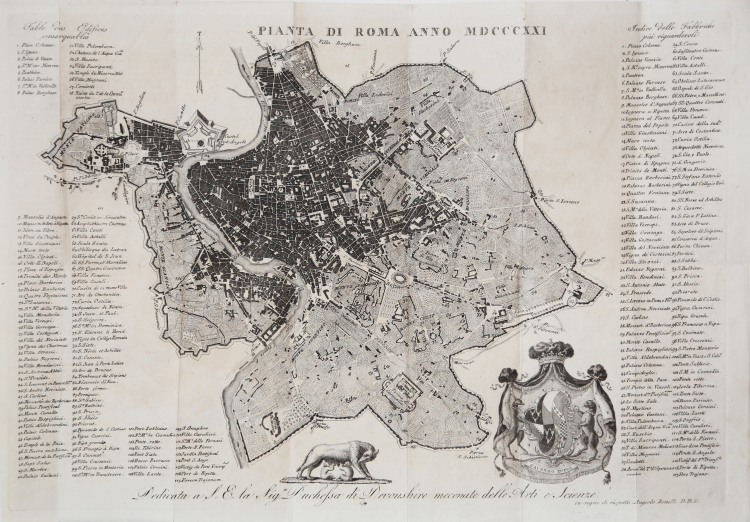
A historical map of Rome bearing a formal dedication to Elizabeth Foster, Duchess of Devonshire (Dedicata a S.E. la Sig.ra Duchessa di Devonshire, mecenate delle Arti e Scienze - Dedicated to Her Excellency the Duchess of Devonshire, Patron of the Arts and Sciences), a renowned figure of the time who supported important archaeological excavations in the Roman Forum. The dedication is signed by Angiolo Bonelli, a Roman banker and publisher.
At the bottom left is a depiction of the Capitoline Wolf suckling the twins Romulus and Remus. At the bottom right is a large coat of arms. The map's sides feature two dense columns of text that comprise an index of monuments, buildings, and notable sites, divided into the Indice delle Fabbriche (Index of Buildings) and the Tavola delle Edificazioni rimarchevoli (Table of Remarkable Buildings).
“In basso al centro la lupa con i gemelli, a destra stemma con scritta cavendo tutus. Sotto vi è la dedica a S. E. la sig.ra Duchessa si Devonshire mecenate delle arti e scienze in segno id rispetto Angiolo Bonelli D. D. D. 117 numeri di legenda in italiano e francese. Riporta l’emiciclo di Piazza del Popolo solo dal alto del Pincio” (cfr. Marigliani, p. 314).
The map is included in Carlo Fea's famous publication, Descrizione di Roma e de' contorni [...] abbellita delle più interessanti vedute... In Roma: dai torchi di Crispino Puccinelli, 1822.
Etching, usual paper folds, otherwise in perfect condition. Not described in Frutaz and Scaccia Scarafoni, it is published in Marigliani, who defines it as "very rare".
Bibliografia
C. Marigliani, Le piante di Roma nelle collezioni private, p. 314, n. 244.
Carlo FEA (Pigna 1753 - Roma 1836)
|
Carlo Domenico Francesco Ignazio Fea (Pigna, June 4, 1753 – Rome, March 18, 1836) was an Italian archaeologist and art collector.
A native of Buggio, a hamlet of Pigna (IM), he graduated in law from La Sapienza University, but soon became increasingly fascinated by archaeology. To obtain better opportunities for his research, he took holy orders in 1798; in his writings, however, he never described himself as an abbot, but always as a lawyer. In Rome, on the Esquiline Hill, in 1781 Fea discovered the statue of the Discobolus, reminiscent of the famous, lost bronze statue by Myron. He edited and commented on the Italian translation of Johann Joachim Winckelmann's "Geschichte der Kunst," as well as on some posthumous works by the scholar and antiquarian Giovanni Lodovico Bianconi, "Descrizione dei circhi, particolare di quello di Caracalla e dei giochi in esso celebrati," 1789. Among his original works are "Miscellanea filologica, critica, e antiquaria" and "Descrizione di Roma." For political reasons, he was forced to take refuge in Florence: upon returning to Rome in 1799, he was imprisoned on charges of Jacobinism by the army of the Bourbons of Naples, who had occupied Rome, putting an end to the Republic. Appointed director of the Capitoline Museum and Commissioner of Antiquities of Rome in May 1801, he was immediately released under Napoleonic rule and reappointed Commissioner of Antiquities, as well as librarian to Prince Chigi. He continued his work as Commissioner in the subsequent period, from the time of Pius VII until his death in 1836. He worked to streamline legislation on the trade in antiquities and archaeological excavations, and undertook excavations at the Pantheon and the Roman Forum. He was a key figure in the effort to return to Rome, beginning in 1809, the works seized by the French during the previous period (along with the famous sculptor Antonio Canova). In particular, he advocated for the relocation of the works to their original contexts, within churches and monuments, rather than their placement in European-inspired public museums, inspired by the French or English ones of the time.
|
Carlo FEA (Pigna 1753 - Roma 1836)
|
Carlo Domenico Francesco Ignazio Fea (Pigna, June 4, 1753 – Rome, March 18, 1836) was an Italian archaeologist and art collector.
A native of Buggio, a hamlet of Pigna (IM), he graduated in law from La Sapienza University, but soon became increasingly fascinated by archaeology. To obtain better opportunities for his research, he took holy orders in 1798; in his writings, however, he never described himself as an abbot, but always as a lawyer. In Rome, on the Esquiline Hill, in 1781 Fea discovered the statue of the Discobolus, reminiscent of the famous, lost bronze statue by Myron. He edited and commented on the Italian translation of Johann Joachim Winckelmann's "Geschichte der Kunst," as well as on some posthumous works by the scholar and antiquarian Giovanni Lodovico Bianconi, "Descrizione dei circhi, particolare di quello di Caracalla e dei giochi in esso celebrati," 1789. Among his original works are "Miscellanea filologica, critica, e antiquaria" and "Descrizione di Roma." For political reasons, he was forced to take refuge in Florence: upon returning to Rome in 1799, he was imprisoned on charges of Jacobinism by the army of the Bourbons of Naples, who had occupied Rome, putting an end to the Republic. Appointed director of the Capitoline Museum and Commissioner of Antiquities of Rome in May 1801, he was immediately released under Napoleonic rule and reappointed Commissioner of Antiquities, as well as librarian to Prince Chigi. He continued his work as Commissioner in the subsequent period, from the time of Pius VII until his death in 1836. He worked to streamline legislation on the trade in antiquities and archaeological excavations, and undertook excavations at the Pantheon and the Roman Forum. He was a key figure in the effort to return to Rome, beginning in 1809, the works seized by the French during the previous period (along with the famous sculptor Antonio Canova). In particular, he advocated for the relocation of the works to their original contexts, within churches and monuments, rather than their placement in European-inspired public museums, inspired by the French or English ones of the time.
|