
| Reference: | A52900 |
| Author | Marcantonio Dal Rè |
| Year: | 1740 ca. |
| Zone: | Liguria |
| Printed: | Milan |
| Measures: | 2005 x 930 mm |
| Reference: | A52900 |
| Author | Marcantonio Dal Rè |
| Year: | 1740 ca. |
| Zone: | Liguria |
| Printed: | Milan |
| Measures: | 2005 x 930 mm |
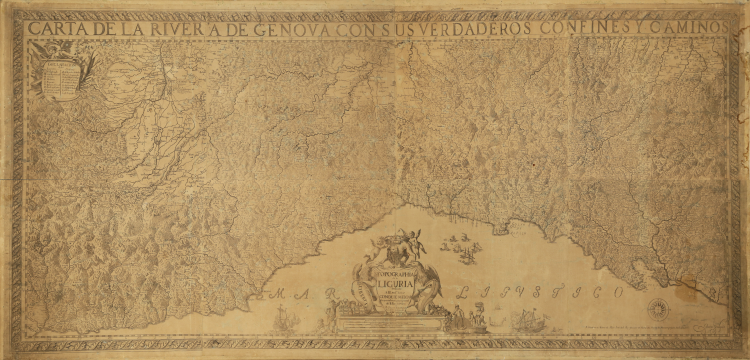
Misleading copy of Joseph Chafrion's legendary map of Liguria, printed by Marcantonio dal Re around 1740
The title runs the entire length of the drawing, which is inscribed in a decorative frame. At the bottom center, a rich and lively cartouche contains the dedication to the Count of Melgar and the graphic scales. At the bottom right, it reads "Si vendono in Milano da Marc. Ant. del Re Incisore in Rame alla Piazza de' Mercanti presso le scuole Palatine e Autor Sculpist". The orography is represented using the perspective system of mounds. The most important settlements are shown schematically in plan: the secondary ones with towers and houses. The roads are traced and the political boundaries indicated. Limits: north, Valenza; south, Ligurian Sea (from Nice to Motrone); west, Monviso; east, Mount Lugo. At the top left, the legend of the conventional symbols. Three graphic scales in miles of Genoa, Piedmont, and Italy.
This impressive, highly detailed map of Liguria reproduces the original 1685 work by Joseph Chafrion, who drew and engraved the map at the behest of the governor and captain general of the State of Milan, Don Giovanni Tommaso Enriquez de Cabrera, as Liguria represented a strategic link between Spain and the Duchy of Milan, a Spanish possession from 1535 to 1706. Chafrion's work represents a clear improvement over previous cartographic representations, becoming an essential cornerstone for the representation of the Ligurian territory in its entirety.
From an editorial perspective, Chafrion's map bears the inscription on the title block: Se venden en Milan en Casa de el Quinto à la Plaza de los Mercaderes; at the bottom right, Autor Sculpsit. In Marcantonio dal Re's copy, the editorial details on the cartouche disappear, replaced by an imprint at the bottom right: Si vendono in Milano da Marc. Ant. del Re Incisore in Rame alla Piazza de' Mercanti presso le scuole Palatine”. The dating of Dal Re's copy can be deduced from his biography; having moved from Bologna to Milan in 1726, he sold under the “insegna dell'Aquila imperiale in contrada S. Margherita”. In 1739, he moved to "Piazza Mercanti al Portico superiore delle Scuole Palatine" in the Loggia degli Osii, which he had rented at his request to the Vicar of Provision in order to have bright rooms suitable for his business. Therefore, from the imprint on his map of Liguria, it can be deduced that it is certainly after 1739.
Etching, printed on eight sheets, formerly laid on canvas and mounted on a wooden board, slightly browned paper, otherwise in good condition.
Bibliografia
Pietro Barozzi, La Carta de la Rivera de Genova di Joseph Chafrion (1685), in “La Sardegna nel mondo mediterraneo”; G. Ferro, La Liguria nelle Carte e nelle Vedute Antiche (1992); M. Quaini, Per la Storia della Cartografia a Genova e in Liguria. Formazione e ruolo degli ingegneri-geografi nella vita della Repubblica (1656-1717), pp. 230-231, fig. 5; M. Quaini, Cartographic Activities in the Republic of Genoa, Corsica, and Sardinia in the Renaissance, in “The History of Cartography, Volume 3: Cartography in the European Renaissance”, pp. 863-864.
Marcantonio Dal Rè (Bologna 1697 – Milano 1766)
|
Born in Bologna, he moved to Milan in 1723 or '24 and lived there until his death. He was a copperplate engraver, chalcographer and publisher of his own prints, which he was already selling in 1726 'all'insegna dell'Aquila imperiale in contrada S. Margherita'; he then moved in 1739 to 'P.zza Mercanti al Portico superiore delle Scuole Palatine' in the loggia degli Osii that he had obtained' rented following his request to the vicar of Providence to have bright rooms suitable for his activity. Here he also opened a free school of engraving and drawing in 1744, so much so that he believed he was entitled to stop paying rent because he occupied premises to be considered public use, and at his own expense he had made improvements including closing the openings in the loggia. Dal Rè's production was not only copious, but also varied, including prints commenting on the chronicle and history events of his time, from city ceremonies to events of wider importance; devotional subjects, portraits, maps, pictorial sonnets for theatre artists, cartoons for books and city plans. The battles fought by the Franco-Piemontese (1733-34) during the War of Polish Succession had Dal Re as a keen observer.
A large part of his engravings can be found in the Civica Raccolta delle stampe Achille Bertarelli in the Castello Sforzesco in Milan,.
|
Marcantonio Dal Rè (Bologna 1697 – Milano 1766)
|
Born in Bologna, he moved to Milan in 1723 or '24 and lived there until his death. He was a copperplate engraver, chalcographer and publisher of his own prints, which he was already selling in 1726 'all'insegna dell'Aquila imperiale in contrada S. Margherita'; he then moved in 1739 to 'P.zza Mercanti al Portico superiore delle Scuole Palatine' in the loggia degli Osii that he had obtained' rented following his request to the vicar of Providence to have bright rooms suitable for his activity. Here he also opened a free school of engraving and drawing in 1744, so much so that he believed he was entitled to stop paying rent because he occupied premises to be considered public use, and at his own expense he had made improvements including closing the openings in the loggia. Dal Rè's production was not only copious, but also varied, including prints commenting on the chronicle and history events of his time, from city ceremonies to events of wider importance; devotional subjects, portraits, maps, pictorial sonnets for theatre artists, cartoons for books and city plans. The battles fought by the Franco-Piemontese (1733-34) during the War of Polish Succession had Dal Re as a keen observer.
A large part of his engravings can be found in the Civica Raccolta delle stampe Achille Bertarelli in the Castello Sforzesco in Milan,.
|