
| Reference: | A53736 |
| Author | Giovanni Ambrogio BRAMBILLA |
| Year: | 1665 ca. |
| Zone: | Obelisks erected by Sixtus V |
| Printed: | Rome |
| Measures: | 360 x 520 mm |
| Reference: | A53736 |
| Author | Giovanni Ambrogio BRAMBILLA |
| Year: | 1665 ca. |
| Zone: | Obelisks erected by Sixtus V |
| Printed: | Rome |
| Measures: | 360 x 520 mm |
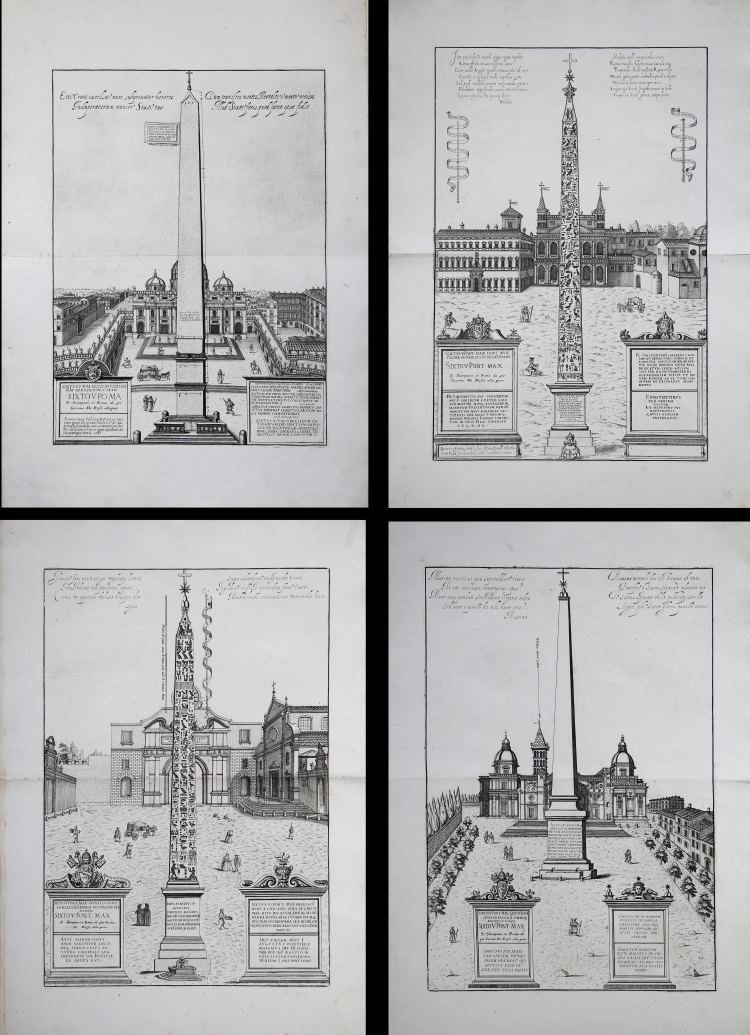
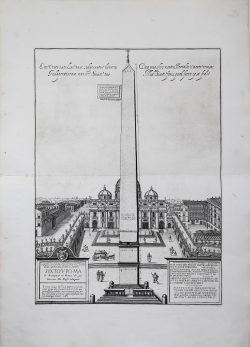
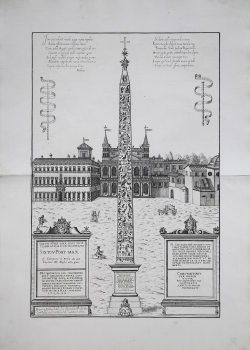
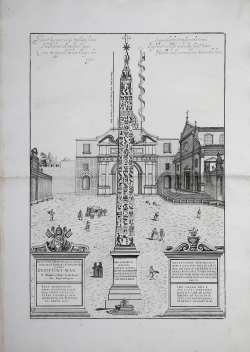
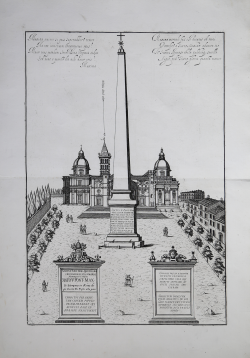
A complete series of four etchings commissioned by the publisher Nicolas Van Aelst, who commissioned Ambrogio Brambilla to engrave the plates, which were printed in 1589. Van Aelst's plates were subsequently purchased by the De Rossi printing house, which reprinted them, updating them to update the changes to the squares. This second edition of the plates dates to the period 1665–70.
Examples of the second state, with Gian Giacomo de Rossi's address replacing Nicolas van Aelst's and Ambrogio Brambilla's signature erased.
The four engravings were created to document the repositioning of four Egyptian obelisks, ordered by Pope Sixtus V, who systematically used the repositioning of ancient obelisks as a sign of the power of the Church and his papacy, and also as a cornerstone of the reorganization of the city he had undertaken, straightening streets, opening straight roads, and building and rebuilding palaces. His architect, Domenico Fontana, was also entrusted with the repositioning of all the obelisks.
The Vatican Obelisk (St. Peter's Square), moved to Alexandria, Egypt, was later brought to Rome by Caligula in 40 AD and placed on the spina of Nero's Circus. It remained in this position next to the ancient St. Peter's Basilica and is the only ancient obelisk in Rome that has never fallen. It was moved and placed in the center of St. Peter's Square on September 10, 1586, the first of four that Domenico Fontana had erected. This second issue by De Rossi documents the layout of the square, created by Gian Lorenzo Bernini under Alexander VII between 1657 and 1667. The final solution took into account liturgical and symbolic issues, as well as pre-existing architectural features. The space in front of the basilica was divided into two parts: the first, shaped like an inverted trapezoid, with the longer side along the façade, which, thanks to the particular perspective effect, assumed less imposing proportions; the second, oval in shape, with an imposing architraved colonnade surmounted by sculptures.
The Esquiline Obelisk (Piazza dell'Esquilino) was likely built during the time of Domitian, imitating Egyptian obelisks, and placed together with the Quirinal Obelisk at the entrance to the Mausoleum of Augustus. It was rediscovered here in 1527 and erected in 1587, again by order of Pope Sixtus V and designed by Domenico Fontana, opposite the apse of Santa Maria Maggiore, to mark the perspective focus towards the basilica of the new Via Sistina commissioned by the same Pope. This second issue by De Rossi sees the addition on the right of the Pauline Chapel commissioned by Paul V (1605-1621) in 1605, a mirror image of the one built by Sixtus V (1585-1590). The chapel, whose structure was completed in 1611, was completed in its decorative part in 1616. Also on the right, the first constructions absent from Van Aelst's first edition of 1589 can be seen.
The Lateran Obelisk (Piazza San Giovanni in Laterano) was brought to Rome at the behest of Emperor Constantius II in 357 and erected on the spina of the Circus Maximus, where the Flaminius Obelisk already stood. It was found in three pieces in 1587 and erected in 1588, not facing the basilica, but at the Loggia delle Benedizioni Lateranense, the final point of the road segment formed by the Via Merulana—opened by Sixtus V—in perspective continuity with the Basilica of Santa Maria Maggiore. This second issue by De Rossi features the addition on the right of the works promulgated by Pope Innocent X, who decided on the radical renovation of the basilica, entrusting the work to Borromini.
The Flaminian Obelisk (Piazza del Popolo) was brought to Rome in 10 AD by Augustus and placed on the spina of the Circus Maximus. It was rediscovered in 1587 and erected by Domenico Fontana in 1589. This second issue by De Rossi was amended with the modifications to the church of Santa Maria del Popolo ordered by Pope Alexander VII (Chigi), who—between 1655 and 1660—had the church restored, giving it a more "modern" appearance. He commissioned Gian Lorenzo Bernini to carry out this project, giving it the clear Baroque influence that can still be admired today.
Magnificent works, printed on contemporary laid paper, with wide margins, the usual horizontal central fold, and in excellent condition.
Bibliografia
C. Marigliani, Lo splendore di Roma nell’Arte incisoria del Cinquecento, pp. 151-173, IV, nn. 7, 9, 10, 27, 28; Le Blanc C., Manuel De L'amateur D'estampes, p. 509, n. 8; Nagler G.K., Die Monogrammisten, V, p. 413, n. 27; C. D’onofrio, 1965, P. 160; C. Witcombe, 2008, Pp. 362, 364, 367. A. Grelle Iusco, 1996, p. 172.
Giovanni Ambrogio BRAMBILLA (1575-90)
|
Painter and engraver from Milan.14 January 1575 he was resident in Rome. In 1579 he was proposed as a member of the Congregazione dei Virtuosi del Pantheon; admitted 14 June 1579.
6 November 1548 he is described as ‘Ambrosius Brambilla mediolanensis picture in Urbe’.
Plates engraved by him listed Vaccari’s 1614 stocklist, including devotional and genre subjects as well as portraits and costume prints. He did board games, notable events, ceremonies and topographical prints. He worked for Panzera, Van Aelst and Claudio Duchetti among others.
|
Giovanni Ambrogio BRAMBILLA (1575-90)
|
Painter and engraver from Milan.14 January 1575 he was resident in Rome. In 1579 he was proposed as a member of the Congregazione dei Virtuosi del Pantheon; admitted 14 June 1579.
6 November 1548 he is described as ‘Ambrosius Brambilla mediolanensis picture in Urbe’.
Plates engraved by him listed Vaccari’s 1614 stocklist, including devotional and genre subjects as well as portraits and costume prints. He did board games, notable events, ceremonies and topographical prints. He worked for Panzera, Van Aelst and Claudio Duchetti among others.
|