
| Reference: | S28068 |
| Author | Jacques CALLOT |
| Year: | 1615 |
| Measures: | 300 x 224 mm |
| Reference: | S28068 |
| Author | Jacques CALLOT |
| Year: | 1615 |
| Measures: | 300 x 224 mm |
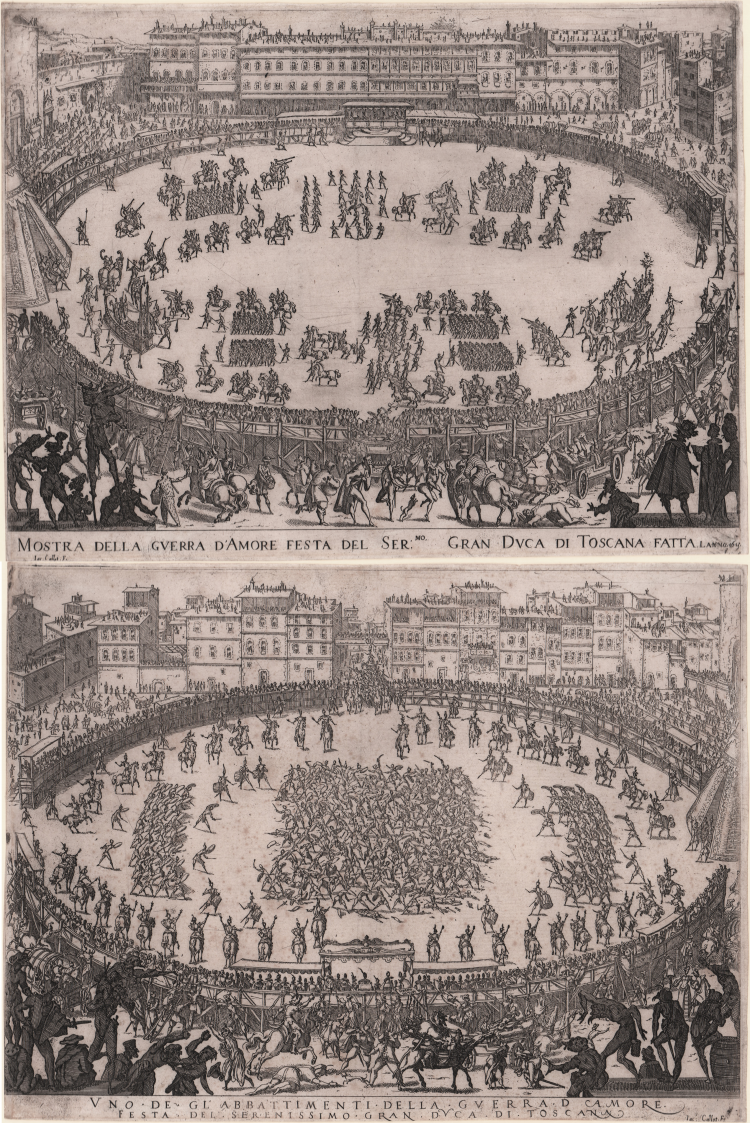
Pair of etchings with engraving, 1615, signed and dated in the plate at the bottom.
Examples in the second state of three, classified by Lieure as “very rare”.
Beautiful impressions, printed on contemporary laid paper with watermark "bear" (Lieure 16, indicated as typical of these works), trimmed to the platemark or with thin margins, in excellent condition.
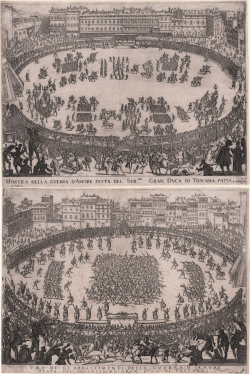
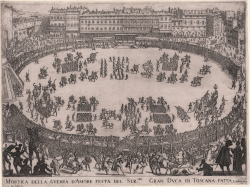
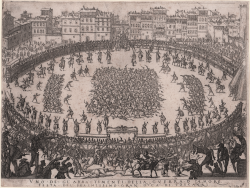
The works depict the feast of carnival organized in Piazza Santa Croce in Florence in February 1615. Translate the artistic genius of Giulio Parigi, architect of the court of the Medici, founder and organizer of festivals and glitzy events at court and were published with the verses of the poet Andrea Salvadori in Guerra d'amore Festa del Serenissimo Gran Duca di Toscana, Cosimo Secundo, fatta in Firenze il Carnevale del 1615.
The theme of the festival was the competition between Cosimo and Lorenzo II de 'Medici, who play the two main actors. The main characters are portrayed in a temporary arena set up in the square, the location of a battle between the two factions. The story is accompanied by a dispute between Venus and Mars, with the triumph of Venus who sings a song in honor of peace and love. Although based on preparatory drawings by Giulio Parigi, the two compositions were designed and prepared by Callot through their preparatory drawings.
The numerous figures in the two plates later provided an inspiration and were taken to the Dances of Sfessania (Lieure 379-402) and in the Three Pants (Lieure 288-290).
In the first half of the 17th century, Jacques Callot renewed the language of graphic art by developing and enhancing the potential of etching. Born in Nancy in 1592, he completed his artistic training in Italy, staying in Rome between 1608 and 1611, were he learned to engrave with a burin and established his first contacts with the engraver community. His patron, between 1612 and 1620, was Cosimo II de' Medici, at whose court he earned great renown both as an engraver of refined skill and as a judge of taste and intelligence. The years of his Florentine sojourn were filled with works that cemented his fame. After Cosimo II's death in 1621, Callot returned to Nancy, where he received new illustrious patrons, including the Duke of Lorraine and the Infanta of Spain. His fame was finally cemented with the commission, received through Richelieu, to engrave The Siege of La Rochelle and the Île de Ré for the King of France, Louis XIII. In 1630, he began collaborating with the publisher Israel Henriet in Paris, who edited many of his works. For his inexhaustible inventiveness in subject matter, his technical expertise, and his attention to detail and the minuscule, Callot's work stands as a decisive benchmark for the entire development of European engraving.
Rare and important works.
Bibliografia
G. G. Bertelà & A. P. Tofani, Feste e Apparati Medicei da Cosimo I a Cosimo II pp. 142-149 & 226; Lieure 170, 171; H. Diane Russell, Jacques Callot prints & Related Drawings pp. 60-62, 49-52; Reed & Wallace, Italian Etchers of the Renaissance & Barocque pp. 222, 112.
Jacques CALLOT (Nancy 1592 - 1635)
|
He was a baroque graphics artist, draftsman and printmaker from the Duchy of Lorraine (an independant state on the North-Eastern border with France). He made etchings that chronicled the people and the life of his period (soldiers, clowns, drunkards, wanderers, beggars, and various outcasts). These images of people are often contrasted by spectacular landscapes (see, for instance, "The Temptation of St. Anthony"). His skill in shading and his use of different tones were remarkable for the period and he is often compared to Albrecht Dürer.
|
Jacques CALLOT (Nancy 1592 - 1635)
|
He was a baroque graphics artist, draftsman and printmaker from the Duchy of Lorraine (an independant state on the North-Eastern border with France). He made etchings that chronicled the people and the life of his period (soldiers, clowns, drunkards, wanderers, beggars, and various outcasts). These images of people are often contrasted by spectacular landscapes (see, for instance, "The Temptation of St. Anthony"). His skill in shading and his use of different tones were remarkable for the period and he is often compared to Albrecht Dürer.
|