
| Reference: | S30087 |
| Author | Jacques CALLOT |
| Year: | 1625 |
| Measures: | 368 x 563 mm |
| Reference: | S30087 |
| Author | Jacques CALLOT |
| Year: | 1625 |
| Measures: | 368 x 563 mm |
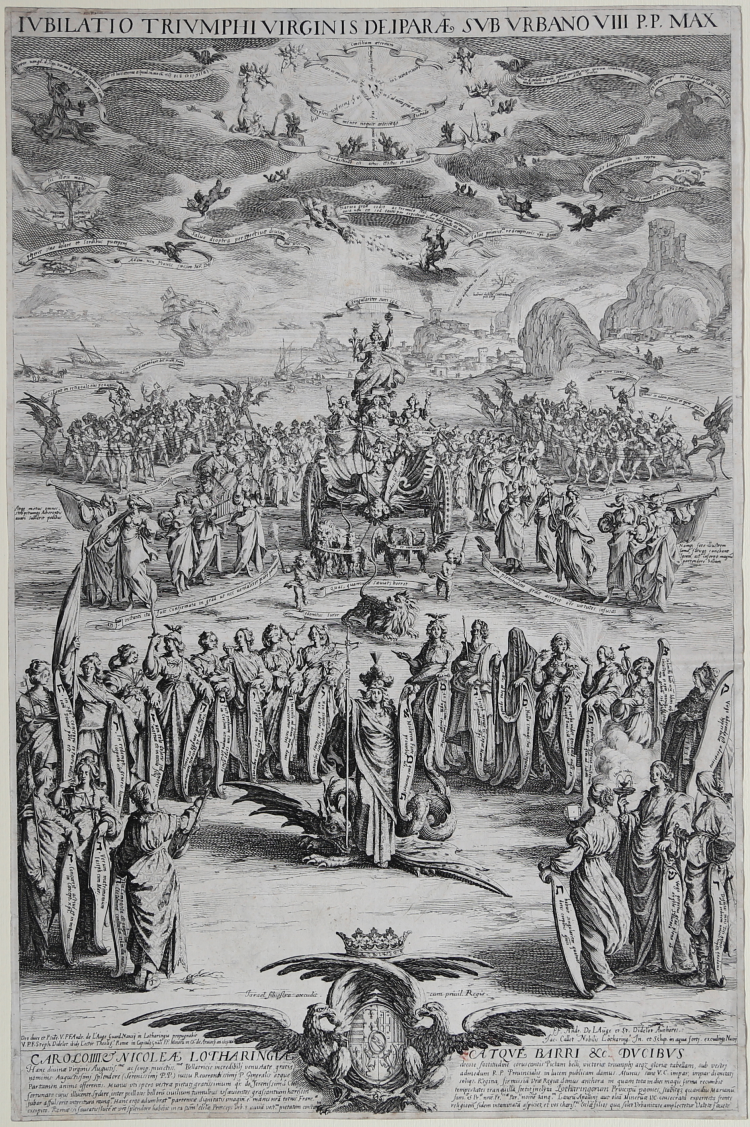
Thesis: the triumph of the Virgin; allegorical figures holding inscribed shields in the lesser part, surrounding an armed woman trampling a dragon; in the centre, the Virgin on a carriage, wearing a triple crown, holding a lily and a sphere, surrounded by figures playing music, with groups of the damned on each side; fortified cities and ships in the background; cherubs, allegorical figures, inscribed banderoles and shining heart in the sky; coat of arms at the bottom.
Etching, 1625, lettered with inscriptions, dedication to Charles IV and Nicole of Lorraine, production and publication detail: 'Iac. Callot Nobilis Lotharing In. et Sclup. in aqua fortj. excuditq Naceij'.
Example of the rhird state, with Silvestre imprint.
A fine impression, printed with tone on contemporary laid papere, trimmed to the platemark, very good condition.
The work was commissioned to Callot for a theological thesis supported in 1625 in Rome by the friar Etienne Didelot. Dedicated to Charles IV and the Duchess Nicole, the work is described in the plate as the image of war, of victory, of triumph and of the glory of the Virgin.
The great composition can be divided into many small scenes, all explained by Latin inscriptions, having only one common denominator: Marian devotion. The work conveys the figure of a strong, dominant woman, sometimes depicted with the allegory of Rome Triumphant, still associated with the iconography of the Immaculate Conception. According to some scholars, the work represents the highest testimony of the Marian cult in the Confraternity of the Franciscans, which was expressed at most during the holy years.
Numerous preparatory drawings for the work are preserved at the Nancy museum.
In the first half of the 17th century, Jacques Callot renewed the language of graphic art by developing and enhancing the potential of etching. Born in Nancy in 1592, he completed his artistic training in Italy, staying in Rome between 1608 and 1611, were he learned to engrave with a burin and established his first contacts with the engraver community. His patron, between 1612 and 1620, was Cosimo II de' Medici, at whose court he earned great renown both as an engraver of refined skill and as a judge of taste and intelligence. The years of his Florentine sojourn were filled with works that cemented his fame. After Cosimo II's death in 1621, Callot returned to Nancy, where he received new illustrious patrons, including the Duke of Lorraine and the Infanta of Spain. His fame was finally cemented with the commission, received through Richelieu, to engrave The Siege of La Rochelle and the Île de Ré for the King of France, Louis XIII. In 1630, he began collaborating with the publisher Israel Henriet in Paris, who edited many of his works. For his inexhaustible inventiveness in subject matter, his technical expertise, and his attention to detail and the minuscule, Callot's work stands as a decisive benchmark for the entire development of European engraving.
Bibliografia
Meaume 1860 100.II; Lieure 1927 562.III; Mostra di Nancy, 694.
Jacques CALLOT (Nancy 1592 - 1635)
|
He was a baroque graphics artist, draftsman and printmaker from the Duchy of Lorraine (an independant state on the North-Eastern border with France). He made etchings that chronicled the people and the life of his period (soldiers, clowns, drunkards, wanderers, beggars, and various outcasts). These images of people are often contrasted by spectacular landscapes (see, for instance, "The Temptation of St. Anthony"). His skill in shading and his use of different tones were remarkable for the period and he is often compared to Albrecht Dürer.
|
Jacques CALLOT (Nancy 1592 - 1635)
|
He was a baroque graphics artist, draftsman and printmaker from the Duchy of Lorraine (an independant state on the North-Eastern border with France). He made etchings that chronicled the people and the life of his period (soldiers, clowns, drunkards, wanderers, beggars, and various outcasts). These images of people are often contrasted by spectacular landscapes (see, for instance, "The Temptation of St. Anthony"). His skill in shading and his use of different tones were remarkable for the period and he is often compared to Albrecht Dürer.
|