
- New
| Reference: | A54372 |
| Author | Cerchia di Ugo da Carpi |
| Year: | 1550 ca. |
| Measures: | 360 x 255 mm |
| Reference: | A54372 |
| Author | Cerchia di Ugo da Carpi |
| Year: | 1550 ca. |
| Measures: | 360 x 255 mm |
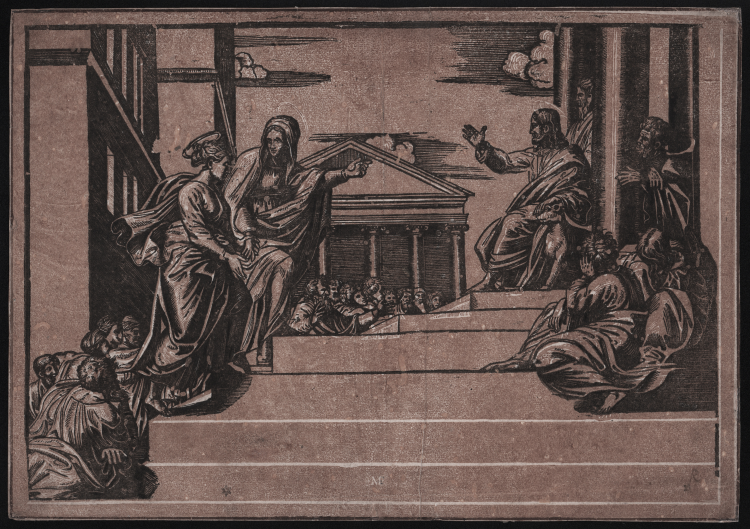
Chiaroscuro woodcut printed from two blocks (black and ochre), signed in the block with an "M" in the tone block.
An impression in the first of two states, before the removal of the "M" monogram.
This two-block chiaroscuro woodcut, depicting Martha leading Mary Magdalene to Christ in the Temple, faithfully reproduces an engraving by Marcantonio Raimondi datable to c. 1520–25 (B.XIV.51.45, state i; Shoemaker and Broun 1981; A. Lindsell in *Marcantonio Raimondi, Raphael and the image multiplied*). The design relates to a lost fresco by Giulio Romano, painted above an entrance in the Massimi Chapel of the church of Santissima Trinità dei Monti in Rome. The fresco's elevated position explains the “seen from below” perspective adopted in the print, placing the viewer in a position to look upwards from the base of the temple steps. The model for Marcantonio's engraving may have been Giulio Romano's preparatory drawing - executed in pen and watercolor with heightening - now held at Chatsworth (Chatsworth inv. 63).
The Martha Leading Mary Magdalene to Christ chiaroscuro woodcut shares the same dimensions as Marcantonio's engraving, and the composition is so similar that it is likely the design was transferred directly onto the woodblock from an impression of the engraving itself. The woodcut is well executed and preserves the narrative clarity of Marcantonio's work; however, the cutter failed to reproduce the tonal range and nuances of the original engraving. The unmodulated lines lend the figures a stiff, static appearance and result in a schematic distribution of light and shadow.
An "M" is visible on the temple steps, incised into the tone block. Adam Bartsch hypothesized that this letter represented the printmaker's initial and, on this basis, cautiously attributed the work to Georg Matheus (active c. 1550–72). Matheus, a woodcut cutter from Augsburg, signed two chiaroscuro woodcuts - Diana and Actaeon* (B.XII.106.1) and The Flight into Egypt (B.IX.426.1), both executed using three blocks after designs by Luca Penni. The rather conventional cutting and the elementary two-block structure of Martha Leading Mary Magdalene to Christ lack the complexity and refinement of these works securely attributed to Matheus. William Trotter has questioned this attribution, as has Achim Gnann, who hesitates to attribute the woodcut on stylistic grounds given its reliance on another print (Trotter 1974; Gnann 2013). It is more likely that the "M" refers to an unidentified cutter, or perhaps to Marcantonio as the source of the print's design.
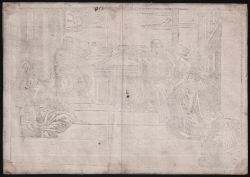
In several respects, this chiaroscuro print reveals an awareness of Ugo da Carpi’s practice. Not only did Ugo base four of his chiaroscuro woodcuts on engravings by Marcantonio and Agostino Veneziano, but he also employed - in three of his prints - a framing device that finds a parallel in the work under discussion. According to Takahatake, some impressions are printed on Italian paper bearing the "Crowned Eagle in a Circle" watermark (watermark g. 13; Städel 33945). Another early impression, featuring the same watermark and a green-toned color palette, is preserved in the Escorial album [28-1-19], where it is mounted alongside twelve chiaroscuro woodcuts by Ugo, Antonio da Trento, and Niccolò Vicentino. The inclusion of this print in the Escorial album confirms its dating to the 16th century. Another impression of Martha Leading Mary Magdalene to Christ, held in a private collection in Belgium, bears on its verso an offset (ink transfer) from the darker block of Antonio da Trento’s Martyrdom of Two Saints. Given the professional partnership between Ugo and Antonio and the shared publishing history of their blocks, this further supports the attribution to an Italian woodcut artist, possibly active within Ugo’s circle.
A magnificent impression, printed on contemporary laid paper with an illegible watermark (appearing to be an eagle beneath a six-pointed star); slight vertical paper creases caused by printing pressure; some wormholes present in the blocks have been retouched with ochre or, in places, black ink; minor marginal losses that have been expertly restored; framed by a brown ink line; overall in excellent condition.
Collector’s mark of a previously unidentified collection (Lugt 3757) plus another not recorded by Lugt.
Bibliografia
Naoko Takahatake, The Chiaroscuro Woodcut in Renaissance Italy, exhibition catalogue, Los Angeles County Museum of Art, 2018, pp. 10-31, p. 26; Bartsch A., Le peintre graveur, Vienne, 1803-1821, v. XII, p. 37, n. 2; Stiber Morenus L./ Takahatake N., Atlante delle xilografie italiane del Rinascimento, ALU.1035.1; Strauss 7; Hollstein 71 (di II); Real colección de estampas de San Lorenzo de El Escorial. Madrid: Patrimonio Nacional, D.L. 1992 , v. 8, 3524; Casanovas, Aurora. Catálogo de la Colección de Grabados de la Biblioteca de El Escorial. En: Anales y Boletín de los Museos de Arte de Barcelona, Vol. XVI, 1963-1964, p. 280.
Cerchia di Ugo da Carpi (Carpi 1480 circa – Bologna 1532)
|
Vasari, the sixteenth-century biographer of Italian artists, claimed that Ugo (about 1450-1525) invented the chiaroscuro (light and shade) woodcut. His claim to the invention of this process has long been contested. Hans Burgkmair and Lucas Cranach were known to have made chiaroscuro prints in the north before 1510, whereas there is no definite evidence of Ugo’s work in this technique until 1516, when he appealed to the Venetian senate for protection from his imitators. Carpi was active in Venice and Rome. Many of his chiaroscuro prints are after drawings by Raphael and Parmigianino. None of his paintings survives.
|