
| Reference: | s35936 |
| Author | Giuseppe VASI |
| Year: | 1761 |
| Zone: | Palazzo Borromeo o Palazzina di Pio IV |
| Printed: | Rome |
| Measures: | 340 x 215 mm |
| Reference: | s35936 |
| Author | Giuseppe VASI |
| Year: | 1761 |
| Zone: | Palazzo Borromeo o Palazzina di Pio IV |
| Printed: | Rome |
| Measures: | 340 x 215 mm |
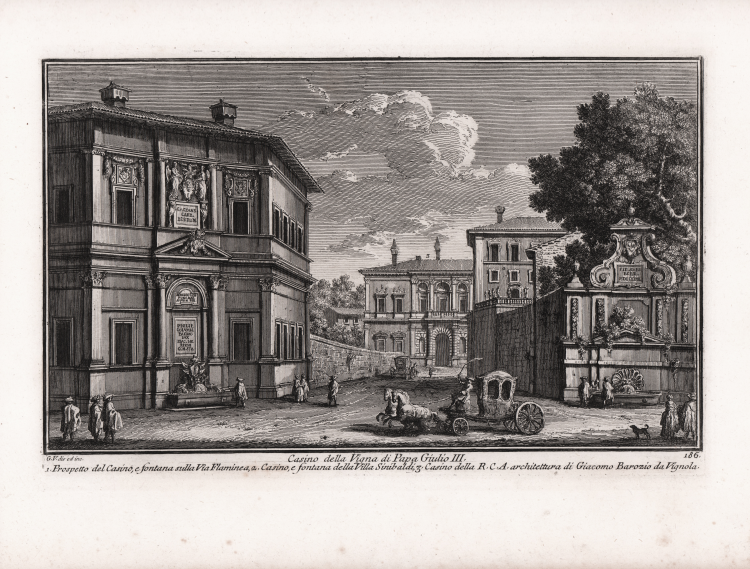
In this 1761 etching Giuseppe Vasi called Casino della Vigna di Papa Giulio III the building which is now usually referred to as Palazzina di Pio IV (left part of the etching), whereas the building in the background is known as Villa Giulia after Pope Julius III, for whom the whole complex was designed.
The villa had a quay on the River Tiber, where the Pope and his retinue landed when they reached the site by boat from the Vatican (it is lost); the access by land on Via Flaminia, near Tempio di S. Andrea, a chapel built by the Pope, was marked by a fountain which was incorporated into Palazzina di Pio IV from where an avenue led to Villa Giulia, the main building. Today, the Villa is internationally famous as the home of the National Etruscan Museum of Villa Giulia.
The building on the left is known today as Palazzo Borromeo and is perfectly preserved. Since 1929, it has housed the official embassy of Italy to the Holy See. The Renaissance facade designed by Pirro Ligorio can still be seen today at the intersection of Via Flaminia and Via delle Belle Arti. The fountain is still nestled against the chamfered corner of Palazzo Borromeo; however, its appearance is much sparser and plainer compared to the lavish scenery of the eighteenth century. The watering trough on the right, known as the Arcosolium of Benedict XIV, underwent the most drastic change. To make room for the modern widening of Via Flaminia and the tram tracks, the structure was dismantled and reassembled against the retaining wall behind it, losing its original function as a resting and watering station for animals.
View taken from the monumental work Delle magnificenze di Roma antica e moderna.
Published in 10 volumes from 1747 to 1761, the work features 238 copper engravings, each engraving with a narrative text that provides historical and documentary information.
Known by most simply as the "master" of Giovanni Battista Piranesi, Giuseppe Vasi reveals in this monumental work the fullness of his graphic creativity.
The 10 books that compose it each have a title page with a different title and date: Libro primo che contiene le porte e mura; Libro secondo, che contiene le piazze principali di Roma con obelischi, colonne, ed altri ornamenti; Libro terzo, che contiene le basiliche e chiese antiche di Roma; Libro quarto che contiene i palazzi e le vie più celebri; Libro quinto che contiene i ponti e gli edifizj sul Libro sesto che contiene la chiese parrocchiali; Libro settimo che contiene i conventi e case dei chierici regolari; Libro ottavo che contiene i monasteri e conservatorj di donne; Libro nono che contiene i collegj, spedali, e luoghi pii; decimo che contiene le ville e giardini più rimarchevoli.
The Magnificences provide a complete and at the same time unconventional panorama of the City: thus, together with the usual, celebrated shots taken from the best tradition of vedutistica, one also finds an unusual Rome, one that, at times, no longer exists. The author had worked on this work, of central importance in Roman publishing in the middle of the eighteenth century, for almost twenty years, producing a monumental guide to the “Urbe” where, alongside the usual and famous shots taken from the best tradition of vedutistica, he also immortalized unusual views that have since disappeared with the change of the city. The text that accompanies the views in the first volume is by Giuseppe Bianchini, in the second by Orazio Orlandi and in the remaining ones by Vasi himself.
Starting from the edition of 1786, the work of Vasi, was updated by his son Mariano, who published it under the title Raccolta delle più belle vedute antiche, e moderne di Roma, showing only the name of his father as author. This new edition presented many plates of the first edition, and some new ones. The publication of Mariano Vasi was also printed several times, always with the addition of new plates.
From the first edition of Vasi’s Delle Magnificenze di Roma Antica e Moderna.
This in the plate n. 186, book X.
In his plate Vasi calls Casino della Vigna (di Papa Giulio III) the building which is now usually referred to as Palazzina di Pio IV (left part of the etching), whereas the building in the background is named Villa Giulia after Pope Julius III, for whom the whole complex was designed. The villa had three casinos: one on the Tiber, where the Pope and his retinue landed (it is lost); a second one on Via Flaminia (Palazzina di Pio IV) and the largest one further inland (Villa Giulia). The small casino along Via Flaminia was acquired by Pope Pius IV who donated it to his nephew Cardinal Carlo Borromeo.
The view is taken from the green dot in the small late XIXth century map here below. In the description below the plate Vasi made reference to: 1) Façade of the Casino and fountain; 2) Casino and fountain of Villa Sinibaldi; 3) Casino belonging to the Camera Apostolica built by Giacomo Barozzi il Vignola (Villa Giulia). The building is now used as the Italian Embassy to the Holy See.
Etching, printed on contemporary laid paper, in very good condition.
|
Scalabroni 289
|
Giuseppe VASI (Corleone, 27 Agosto 1710 - Roma, 16 Aprile 1782)
|
Italian engraver and painter. After completing a classical education, he trained as a printmaker in Palermo, possibly at the Collegio Carolino, which was founded by the Jesuit Order in 1728 and at which the etcher Francesco Ciché ( fl before 1707; d Palermo, 1742) was a teacher. Vasi was already an accomplished engraver when, in 1736, he contributed to the illustration of La reggia in trionfo by Pietro La Placa, which described the festivities held in Palermo to mark the coronation of Charles VII of Naples (the future Charles III of Spain). That same year Vasi moved to Rome, where, as a Neapolitan subject, he was immediately afforded the protection of the ambassador, Cardinal Troiano Aquaviva d’Aragona (1694–1747). In Rome he met other artists who worked for the same patron: Sebastiano Conca, Luigi Vanvitelli and Ferdinando Fuga. It is against this background that Vasi’s work in Rome, when he was in residence at the Palazzo Farnese, should be considered: his monopoly as the engraver of the Roman records of the monarch, the plates for the festivals of the ‘Chinea’ and the triumphal arches erected in front of the Palatine gardens on the occasion of temporal sovereignty over Rome
|
|
Scalabroni 289
|
Giuseppe VASI (Corleone, 27 Agosto 1710 - Roma, 16 Aprile 1782)
|
Italian engraver and painter. After completing a classical education, he trained as a printmaker in Palermo, possibly at the Collegio Carolino, which was founded by the Jesuit Order in 1728 and at which the etcher Francesco Ciché ( fl before 1707; d Palermo, 1742) was a teacher. Vasi was already an accomplished engraver when, in 1736, he contributed to the illustration of La reggia in trionfo by Pietro La Placa, which described the festivities held in Palermo to mark the coronation of Charles VII of Naples (the future Charles III of Spain). That same year Vasi moved to Rome, where, as a Neapolitan subject, he was immediately afforded the protection of the ambassador, Cardinal Troiano Aquaviva d’Aragona (1694–1747). In Rome he met other artists who worked for the same patron: Sebastiano Conca, Luigi Vanvitelli and Ferdinando Fuga. It is against this background that Vasi’s work in Rome, when he was in residence at the Palazzo Farnese, should be considered: his monopoly as the engraver of the Roman records of the monarch, the plates for the festivals of the ‘Chinea’ and the triumphal arches erected in front of the Palatine gardens on the occasion of temporal sovereignty over Rome
|