
- New
| Reference: | A54262 |
| Author | Giuseppe VASI |
| Year: | 1752 |
| Zone: | Loreto |
| Printed: | Rome |
| Measures: | 975 x 650 mm |
| Reference: | A54262 |
| Author | Giuseppe VASI |
| Year: | 1752 |
| Zone: | Loreto |
| Printed: | Rome |
| Measures: | 975 x 650 mm |
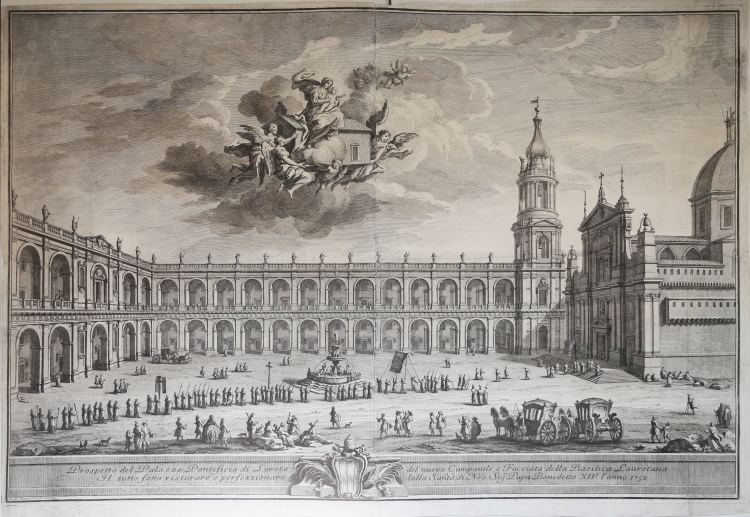
Etching, 1752, signed and dated on the plate at the bottom.
A beautiful work, two plates printed on two sheets of contemporary laid paper joined at the center, with thin margins. Restored tears are visible on the verso. Overall, in good condition.
This majestic work was commissioned from Giuseppe Vasi directly by the Holy House, which tasked him with depicting the Sanctuary with the modifications made by Luigi Vanvitelli, completed in 1751.
The print depicts the Apostolic Palace and the bell tower of the Basilica of Loreto. Above, the Madonna of Loreto and Child are carried by angels over the Holy House. The background is dominated by the double portico of the Papal Palace and, to the right, the façade of the Basilica of Loreto. In the foreground, the procession approaches the Basilica.
The bell tower of the Basilica of Loreto was commissioned by Pope Benedict XIV (1740-1758) from the architect Luigi Vanvitelli. In 1751, the architect oversaw the completion of the Bramante-style loggia of the Apostolic Palace and the portico, annexing the new bell tower. Below the image, an inscription celebrates the new construction: "Prospetto del Palazzo pontificio di Loreto/ del nuovo Campanile, e facciata della Basilica Lauretana/ il tutto fatto ristorare, e perfezionare/ dalla San.tà di N.ro Sig.re Papa Benedetto XIV l'anno 1752."
The etching, designed and engraved on copper by Giuseppe Vasi, was published by the Holy House during the construction of the bell tower; 300 copies were put on sale in early 1773, but sales did not go as expected, and after three years, 160 copies remained unsold.
According to ancient tradition, now confirmed by historical and archaeological research, the Holy House is the very house in Nazareth where Mary was born, educated, and received the angelic annunciation. The house consisted of a masonry chamber with three stone walls enclosing a cave dug into the rock. The cave is still venerated in Nazareth, in the Basilica of the Annunciation, while the three stone walls, according to tradition, were transported to Loreto in 1294 when the Crusaders were expelled from Palestine. Documents and archaeological excavations confirm the hypothesis that the walls of the Holy House were transported to Loreto by ship, at the initiative of the noble Angeli family, who ruled Epirus. From the mid-1400s, to protect these humble stone walls and accommodate the growing crowds of pilgrims visiting the sacred relic, work began in Loreto on the construction of the magnificent sanctuary. The marble cladding that envelops the walls of the Holy House, commissioned by Pope Julius II and created to a design by Bramante (1507), is considered one of the greatest sculptural masterpieces of Renaissance art. Since then, great artists have succeeded one another over the centuries to embellish the sanctuary, whose fame has rapidly spread throughout the world, becoming a favorite destination for millions of pilgrims: from Cristoforo Roncalli, known as Pomarancio, who painted the Treasure Room and the dome, to Francesco Selva who decorated the Atrium of the Sacristy, while Tiburzio Vergelli built the majestic baptistery. To complete the work, in 1600, Carlo Maderno created the fountain that adorns the sanctuary square, while in the 18th century, Luigi Vanvitelli built the bell tower that stands on the left side of the basilica.
Bibliografia
Scalabroni L., Giuseppe Vasi, n. 418, p. 119; Floriano Grimaldi, Il libro lauretano (secoli XV-XIII), Loreto 1994, pag. 241.
Giuseppe VASI (Corleone, 27 Agosto 1710 - Roma, 16 Aprile 1782)
|
Italian engraver and painter. After completing a classical education, he trained as a printmaker in Palermo, possibly at the Collegio Carolino, which was founded by the Jesuit Order in 1728 and at which the etcher Francesco Ciché ( fl before 1707; d Palermo, 1742) was a teacher. Vasi was already an accomplished engraver when, in 1736, he contributed to the illustration of La reggia in trionfo by Pietro La Placa, which described the festivities held in Palermo to mark the coronation of Charles VII of Naples (the future Charles III of Spain). That same year Vasi moved to Rome, where, as a Neapolitan subject, he was immediately afforded the protection of the ambassador, Cardinal Troiano Aquaviva d’Aragona (1694–1747). In Rome he met other artists who worked for the same patron: Sebastiano Conca, Luigi Vanvitelli and Ferdinando Fuga. It is against this background that Vasi’s work in Rome, when he was in residence at the Palazzo Farnese, should be considered: his monopoly as the engraver of the Roman records of the monarch, the plates for the festivals of the ‘Chinea’ and the triumphal arches erected in front of the Palatine gardens on the occasion of temporal sovereignty over Rome
|
Giuseppe VASI (Corleone, 27 Agosto 1710 - Roma, 16 Aprile 1782)
|
Italian engraver and painter. After completing a classical education, he trained as a printmaker in Palermo, possibly at the Collegio Carolino, which was founded by the Jesuit Order in 1728 and at which the etcher Francesco Ciché ( fl before 1707; d Palermo, 1742) was a teacher. Vasi was already an accomplished engraver when, in 1736, he contributed to the illustration of La reggia in trionfo by Pietro La Placa, which described the festivities held in Palermo to mark the coronation of Charles VII of Naples (the future Charles III of Spain). That same year Vasi moved to Rome, where, as a Neapolitan subject, he was immediately afforded the protection of the ambassador, Cardinal Troiano Aquaviva d’Aragona (1694–1747). In Rome he met other artists who worked for the same patron: Sebastiano Conca, Luigi Vanvitelli and Ferdinando Fuga. It is against this background that Vasi’s work in Rome, when he was in residence at the Palazzo Farnese, should be considered: his monopoly as the engraver of the Roman records of the monarch, the plates for the festivals of the ‘Chinea’ and the triumphal arches erected in front of the Palatine gardens on the occasion of temporal sovereignty over Rome
|