
| Reference: | S42733.32 |
| Author | Eugenio Interguglielmi |
| Year: | 1885 ca. |
| Measures: | 260 x 205 mm |
| Reference: | S42733.32 |
| Author | Eugenio Interguglielmi |
| Year: | 1885 ca. |
| Measures: | 260 x 205 mm |
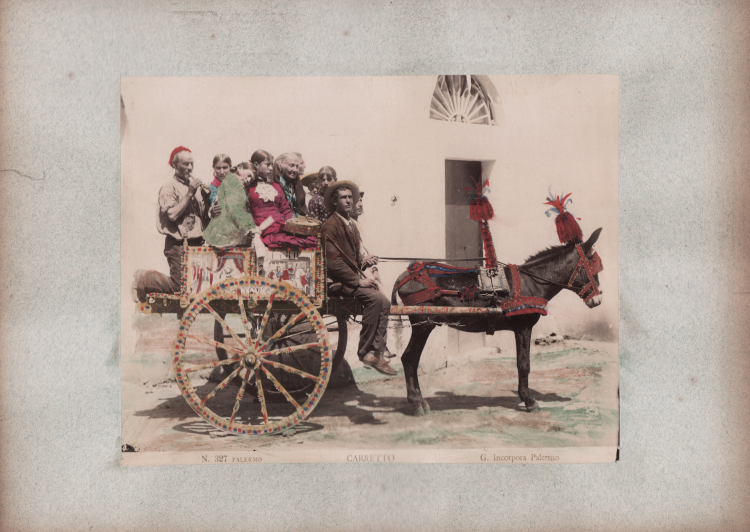
Albumen on paper, colored and applied to a contemporary support, circa 1885/90. The image bears the name of Giuseppe Incorpora's historic photography studio (Palermo) at the bottom, although the original shot has historically been attributed to another great master of 19th-century Sicilian photography, Eugenio Interguglielmi (1850-1911) [see Eugenio Interguglielmi Fotografo di usi, costumi di scena di vita in Sicilia, by Giovanni Fanelli – 2019 – p. 33].
It shows a traditional, crowded Sicilian cart pulled by a mule; this specific shot is an albumen print then hand-colored to bring out the typical bright colors of the island's folklore. The wheels and sides of the cart feature classic Sicilian geometric and narrative decorations, accompanied by the bright red and feathered trappings on the animal's head and back.
Eugenio Interguglielmi (Palermo, 26 febbraio 1850 – Palermo, 1911) è stato un fotografo italiano, allievo di Giuseppe Incorpora e dallo zio Stefano Bugliarelli che fu senz'altro il primo ad aprire uno studio stabile in città fin dal 1842. Intergluglielmi fu chiamato il "ritrattista della Belle Epoque" palermitana per i nomi prestigiosi della nobiltà e dell'alta borghesia che si facevano ritrarre nella sua bottega. Perfino Sua Altezza Imperiale, il gran duca di Russia Costantino Costantinovich, e il duca imperiale Vladimir Aleksandrovič Romanov, furono suoi clienti. Il figlio Eugenio jr. (1876-1948) fu ben presto associato allo studio del padre che nel 1900 si trasferì vicino a quello degli Incorpora. In questa nuova sede, gli Intergugliemi aprirono ben tre loggiati e nelle varie esposizioni alle quali presero parte ricevettero premi e medaglie, nonché il titolo di Fotografi della Real Casa. Il padre Eugenio non si dedicò soltanto al ritratto ma si interessò anche alle feste popolari, alle vedute della campagna siciliana, ai monumenti e ai costumi. In effetti, il suo interesse per la parte documentaria risultò assai importante e si mostrò nella sua complessità in particolare verso i monumenti e le opere d'arte tant'è vero che fu l'unico siciliano a prendere parte all'Esposizione Nazionale di Palermo del 1891-1892, insieme ad Incorpora e a Seffer. Occasione che gli consentirà di entrare in contatto con gli Alinari ed altri grandi fotografi dell'epoca. Espose vedute di monumenti siciliani, realizzati appositamente per l'Esposizione, che l'editore Fratelli Treves pubblicò nel loro periodico edito appositamente per la mostra.
Eugenio Interguglielmi (Palermo 1850 - 1911)
|
Eugenio Interguglielmi (Palermo, February 26, 1850 – Palermo, 1911) was an Italian photographer, a descendant of the painter and decorator Elia Interguglielmi. His family was already known in the 18th century for producing sculptors, painters, and architects. He began photography in 1863 in Palermo, learning from Giuseppe Incorpora and his uncle Stefano Bugliarelli, who was undoubtedly the first to open a permanent studio in the city, starting in 1842, although very little information is available. It was his uncle himself who, some time later, once he had completed his apprenticeship, financed the opening of a studio for Eugenio in the center of Palermo, on Via Vittorio Emanuele, near his uncle's. The results and profits began to flow, so much so that Interglugliemi was called the "portraitist of Palermo's Belle Époque" due to the prestigious names of the nobility and upper middle class who had their portraits painted in his workshop. Even His Imperial Highness, the Grand Duke of Russia Constantine Constantinovich, and the Imperial Duke Vladimir Alexandrovich Romanov, were his clients. His son Eugenio Jr. (1876-1948) soon joined his father's studio, which in 1900 moved near the Incorpora family's. In this new location, the Interglugliemis opened three loggias and at the various exhibitions in which they participated, they received prizes and medals, as well as the title of Photographers of the Royal House. His father Eugenio not only devoted himself to portraiture but also took an interest in popular festivals, views of the Sicilian countryside, monuments, and costumes. Indeed, his interest in documentary photography was very significant and manifested itself in its complexity, particularly in monuments and works of art. Indeed, he was the only Sicilian to participate in the National Exhibition of Palermo in 1891-1892, along with Incorpora and Seffer. This opportunity allowed him to come into contact with the Alinari brothers and other great photographers of the time. He exhibited views of Sicilian monuments, created specifically for the Exhibition, which the publisher Fratelli Treves published in their periodical, published specifically for the exhibition. Scholar Michele Di Dio has noted how, starting from that very exhibition, his interest in nascent industrial architecture was so evident that Interguglielmi associated the Palermo-born photographer Benedetto Bronzetti (1870-1944), who specialized in this type of photography, with its studio. His daughter Celestina (1880-1957) married Bronzetti, and from the marriage was born Eugenio Bronzetti (1906-1997), another notable photographer in Sicilian photography. After Eugenio's death in 1911 (some texts date it to 1909), the business passed to his son Eugenio Jr., who, in addition to portraiture, also dedicated himself to views of the city and its surroundings, increasing his activity. However, he also saw the loggias destroyed by the Allied bombings of 1943, as well as much of the Interguglielmi historical archive. After Eugenio Jr., the studio was taken over by his son Roberto (1912-1999), who ceased the activity in 1981. After Roberto's death, the business was taken over by one of his heirs, Cristiano Mattina, son of his daughter Maria Concetta, who took on the responsibility of preserving the remaining materials.
|
Eugenio Interguglielmi (Palermo 1850 - 1911)
|
Eugenio Interguglielmi (Palermo, February 26, 1850 – Palermo, 1911) was an Italian photographer, a descendant of the painter and decorator Elia Interguglielmi. His family was already known in the 18th century for producing sculptors, painters, and architects. He began photography in 1863 in Palermo, learning from Giuseppe Incorpora and his uncle Stefano Bugliarelli, who was undoubtedly the first to open a permanent studio in the city, starting in 1842, although very little information is available. It was his uncle himself who, some time later, once he had completed his apprenticeship, financed the opening of a studio for Eugenio in the center of Palermo, on Via Vittorio Emanuele, near his uncle's. The results and profits began to flow, so much so that Interglugliemi was called the "portraitist of Palermo's Belle Époque" due to the prestigious names of the nobility and upper middle class who had their portraits painted in his workshop. Even His Imperial Highness, the Grand Duke of Russia Constantine Constantinovich, and the Imperial Duke Vladimir Alexandrovich Romanov, were his clients. His son Eugenio Jr. (1876-1948) soon joined his father's studio, which in 1900 moved near the Incorpora family's. In this new location, the Interglugliemis opened three loggias and at the various exhibitions in which they participated, they received prizes and medals, as well as the title of Photographers of the Royal House. His father Eugenio not only devoted himself to portraiture but also took an interest in popular festivals, views of the Sicilian countryside, monuments, and costumes. Indeed, his interest in documentary photography was very significant and manifested itself in its complexity, particularly in monuments and works of art. Indeed, he was the only Sicilian to participate in the National Exhibition of Palermo in 1891-1892, along with Incorpora and Seffer. This opportunity allowed him to come into contact with the Alinari brothers and other great photographers of the time. He exhibited views of Sicilian monuments, created specifically for the Exhibition, which the publisher Fratelli Treves published in their periodical, published specifically for the exhibition. Scholar Michele Di Dio has noted how, starting from that very exhibition, his interest in nascent industrial architecture was so evident that Interguglielmi associated the Palermo-born photographer Benedetto Bronzetti (1870-1944), who specialized in this type of photography, with its studio. His daughter Celestina (1880-1957) married Bronzetti, and from the marriage was born Eugenio Bronzetti (1906-1997), another notable photographer in Sicilian photography. After Eugenio's death in 1911 (some texts date it to 1909), the business passed to his son Eugenio Jr., who, in addition to portraiture, also dedicated himself to views of the city and its surroundings, increasing his activity. However, he also saw the loggias destroyed by the Allied bombings of 1943, as well as much of the Interguglielmi historical archive. After Eugenio Jr., the studio was taken over by his son Roberto (1912-1999), who ceased the activity in 1981. After Roberto's death, the business was taken over by one of his heirs, Cristiano Mattina, son of his daughter Maria Concetta, who took on the responsibility of preserving the remaining materials.
|