
| Reference: | S42733.24 |
| Author | Giacomo Brogi |
| Year: | 1870 ca. |
| Measures: | 247 x 195 mm |
| Reference: | S42733.24 |
| Author | Giacomo Brogi |
| Year: | 1870 ca. |
| Measures: | 247 x 195 mm |
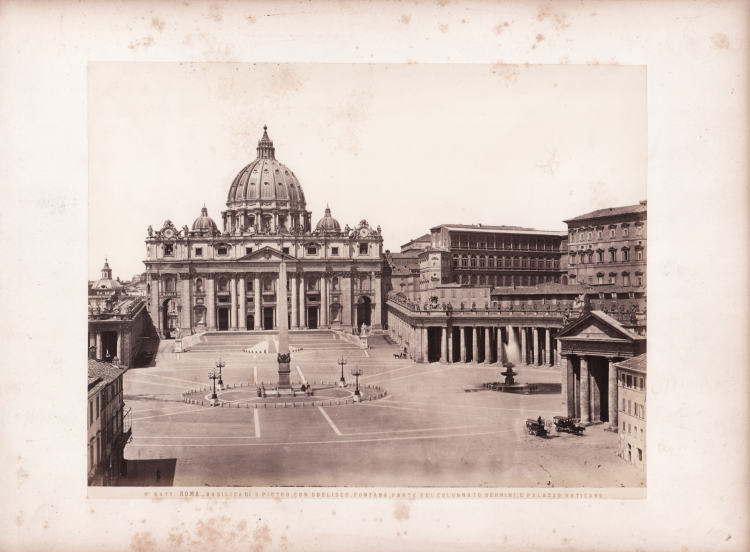
Albumen on paper, mounted on a contemporary support, circa 1870/75. Unsigned, the photograph bears the serial number: no. 6471, followed by the inscription ""ROMA - Basilica di S. Pietro con obelisco, fontana, parte del colonnato Bernini, e Palazzo Vaticano". The shot, described in period records as a panoramic view taken from above, is part of the extensive photographic campaign that the Brogi company of Florence dedicated to the city of Rome and its main sacred monuments starting in the 1870s. Many of the original negatives and commercial catalogs of the Brogi company were collected in the Alinari Archives at the beginning of the 20th century, which is why the two historical references are closely linked.
This famous view was immortalized by the Florentine photographer Giacomo Brogi during his extensive documentary campaigns in the Papal States and the newly founded capital of Italy. The zenithal shot, captured from an elevated position on the side of the now-extinct Spina di Borgo, highlights Bernini's architectural design and the majesty of Maderno's façade before the radical urban transformations of the twentieth century. The sharp details show vintage carriages and pedestrians crossing the immense square.
Giacomo Brogi (Florence, April 6, 1822 – Florence, November 29, 1881) began his career as a photographer around 1856, founding his own firm around 1864: "Edizioni Brogi Firenze," specializing in portraiture and later in fine art photography, particularly sculpture reproductions and panoramic views. He carried out several photographic campaigns throughout Italy and organized a major one in the Middle East, particularly photographing the Holy Places, for which he was awarded a silver medal by Pope Pius IX. The Brogi firm participated in the Vienna Exhibition in 1873, the Milan Exhibition in 1881, and in the Universal Exhibition in Florence in 1889, exhibiting works out of competition under the sole title of sponsorship. Upon his death, management of the business passed to his son Carlo (1850-1925), one of the founders of the Italian Photographic Society and a prominent figure in the fight for the rights of photographers, while his other son, Alfredo, took over the administration. The firm ceased operations around 1950, and a few years later the Brogi estate became part of the Alinari Archive.
Giacomo Brogi (Firenze 1822 -1881)
|
Giacomo Brogi (Florence, April 6, 1822 – Florence, November 29, 1881) was an Italian photographer.
At the age of 11, he began working for the publisher Batelli and attended Perfetti's engraving school. Later, in 1846, the year of his marriage to Enrichetta Baldelli, he began working with the copperplate engraver Achille Paris as a retoucher. He began his career as a photographer around 1856, founding his own firm around 1864: "Edizioni Brogi Firenze", specializing in portraiture and later in fine art photography, particularly sculpture reproductions and panoramic views. He carried out several photographic campaigns throughout Italy and organized a major one in the Middle East, particularly photographing the Holy Places. For this latter work, he was awarded a silver medal by Pope Pius IX. The Brogi firm participated in the Vienna Exhibition in 1873, the Milan Exhibition in 1881, and in the Universal Exhibition in Florence in 1889, exhibiting works out of competition under the sole title of sponsorship. Upon his death, management of the business passed to his son Carlo (1850-1925), one of the founders of the Italian Photographic Society and a prominent figure in the fight for the rights of photographers, while his other son, Alfredo, took over the administration. With Carlo's death, the inheritance passed to his daughter Eugenia and her husband Laurati, who died the following year in 1926. Little is known about the period that followed; we know that in 1940, his son Giorgio Laurati attempted to revive the photographic establishment, thanks in part to the work of Gino Malenotti, then renowned for his skill in photographing statues, and to the Hungarian scholar Jenō Làny for his work on the works of Donatello, which used Malenotti's images. The firm ceased operations around 1950, and a few years later, the Brogi estate became part of the Alinari Archive.
|
Giacomo Brogi (Firenze 1822 -1881)
|
Giacomo Brogi (Florence, April 6, 1822 – Florence, November 29, 1881) was an Italian photographer.
At the age of 11, he began working for the publisher Batelli and attended Perfetti's engraving school. Later, in 1846, the year of his marriage to Enrichetta Baldelli, he began working with the copperplate engraver Achille Paris as a retoucher. He began his career as a photographer around 1856, founding his own firm around 1864: "Edizioni Brogi Firenze", specializing in portraiture and later in fine art photography, particularly sculpture reproductions and panoramic views. He carried out several photographic campaigns throughout Italy and organized a major one in the Middle East, particularly photographing the Holy Places. For this latter work, he was awarded a silver medal by Pope Pius IX. The Brogi firm participated in the Vienna Exhibition in 1873, the Milan Exhibition in 1881, and in the Universal Exhibition in Florence in 1889, exhibiting works out of competition under the sole title of sponsorship. Upon his death, management of the business passed to his son Carlo (1850-1925), one of the founders of the Italian Photographic Society and a prominent figure in the fight for the rights of photographers, while his other son, Alfredo, took over the administration. With Carlo's death, the inheritance passed to his daughter Eugenia and her husband Laurati, who died the following year in 1926. Little is known about the period that followed; we know that in 1940, his son Giorgio Laurati attempted to revive the photographic establishment, thanks in part to the work of Gino Malenotti, then renowned for his skill in photographing statues, and to the Hungarian scholar Jenō Làny for his work on the works of Donatello, which used Malenotti's images. The firm ceased operations around 1950, and a few years later, the Brogi estate became part of the Alinari Archive.
|