
- New
| Reference: | S42732.1 |
| Author | Fratelli d'Alessandri |
| Year: | 1920 ca. |
| Measures: | 245 x 190 mm |
| Reference: | S42732.1 |
| Author | Fratelli d'Alessandri |
| Year: | 1920 ca. |
| Measures: | 245 x 190 mm |
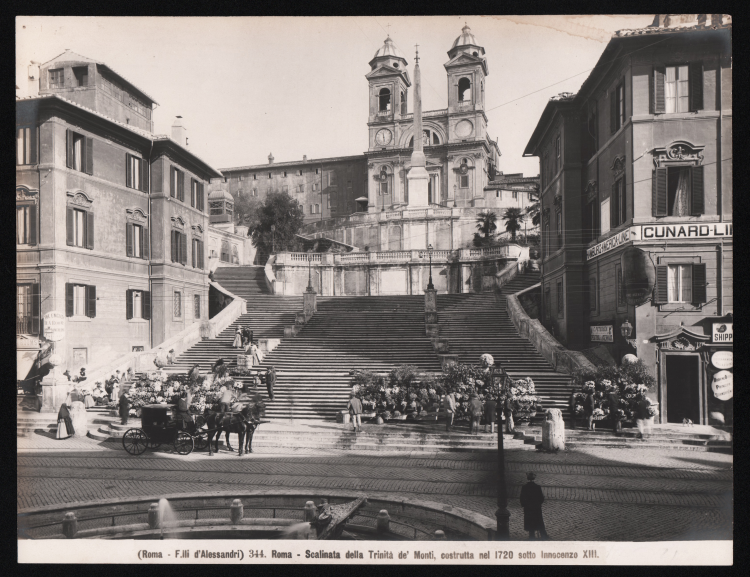
Gelatin silver print, circa 1920, signed by the Fratelli D'Alessandri studio.
The key detail for dating the photograph is the Cunard Line sign: the large billboard advertising the famous British shipping company on the façade of the building on the right (Palazzo d'Asti). The agency for selling transatlantic tickets opened there in the years immediately preceding World War I and remained very active throughout the 1920s, the golden age of the great crossings to the Americas. Furthermore, Piazza di Spagna already features the slender poles for public electric lighting, installed in Rome to gradually replace the old gas lanterns between the late 19th and early 20th centuries. On the left side of the square, a horse-drawn carriage (the historic Roman "botticelle") can be seen, while the clothing of the passers-by, with bowler hats and long coats, is typical of the post-war period.
Although the Fratelli D'Alessandri studio was founded in the mid-19th century (initially using pioneering techniques such as wet-plate collodion), the firm remained active until 1930 through the founders' children and grandchildren. This shot is part of their late catalog of "commercial views," produced in postcard format to satisfy the international tourism boom of the 1920s.
Antonio D'Alessandri (L'Aquila, 1818 – Rome, 1893) and Paolo Francesco D'Alessandri (L'Aquila, 1824 – Rome, 1889) were two Italian photographers, contemporaries of the Alinari brothers, who were active primarily in Rome. Known for their wet-plate collodion technique, they worked primarily with clients belonging to the "Roman nobility" and high-ranking Vatican prelates. The two photographers who photographed the Breach of Porta Pia, the capture of Rome, are considered Italy's first war photojournalists. Photographs from their collections are also held at the International Museum of Photography and Film at George Eastman House in Rochester, New York, the oldest museum in the world dedicated to photography. Having arrived in Rome from their native L'Aquila, the two brothers, having established their residence in the capital, initially devoted themselves to touring Europe, seeking out technical and scientific innovations to exploit for economic gain. Thus, in the early 1850s, they began to develop an interest in photography, especially in practicing the new printing method known as "collodion," which made it easier and quicker to achieve marketable results. The D'Alessandri brothers are among the very first Roman photographers, along with Tommaso Cuccioni, Giacomo Caneva, James Anderson, and Lorenzo Suscipj, all considered the founders of the Roman School of Photography..
Fratelli d'Alessandri (attivi a Roma tra il 1855 e il 1930)
|
Antonio D'Alessandri (L'Aquila, 1818 – Rome, 1893) and Paolo Francesco D'Alessandri (L'Aquila, 1824 – Rome, 1889) were two Italian photographers, contemporaries of the Alinari brothers, who were active primarily in Rome. Known for their wet-plate collodion technique, they worked primarily with clients belonging to the "Roman nobility" and high-ranking Vatican prelates. The two photographers who photographed the Breach of Porta Pia, the capture of Rome, are considered Italy's first war photojournalists. Photographs from their collections are also held at the International Museum of Photography and Film at George Eastman House in Rochester, New York, the oldest museum in the world dedicated to photography. Having arrived in Rome from their native L'Aquila, the two brothers, having established their residence in the capital, initially devoted themselves to touring Europe, seeking out technical and scientific innovations to exploit for economic gain. Thus, in the early 1850s, they began to develop an interest in photography, especially in practicing the new printing method known as "collodion," which made it easier and quicker to achieve marketable results. The D'Alessandri brothers are among the very first Roman photographers, along with Tommaso Cuccioni, Giacomo Caneva, James Anderson, and Lorenzo Suscipj, all considered the founders of the Roman School of Photography.
The D'Alessandri brothers' laboratory was certainly the first professional studio opened in the capital; at that time, Don Antonio, as a Catholic priest, was forced to request a specific dispensation to freely practice photography, a dispensation that the ecclesiastical authorities granted him on the condition that he not display his clerical garb at work.
Don Antonio's clerical background, combined with his undisputed technical and artistic talent, favored the success of the venture. The two brothers were the first to obtain permission to enter the Vatican and photograph Pope Pius IX and his court. The fame of the two photographers quickly spread among the Roman nobility and the highest prelates. The exiled sovereigns of Naples were added to their list of distinguished clients, and requests soon came from abroad as well. The constant search for new opportunities led the D'Alessandri brothers, in 1862, to photograph the camps of the papal Zouaves and later, in 1867, on the battlefield of Mentana, where they were among the first in Italy to act as true war reporters. In 1870, they were at Porta Pia to photograph the victorious Italian Bersaglieri, posing on the ruins of the breach. This last "reportage" provoked a hostile reaction from the Vatican authorities, who revoked all the rights previously granted to the D'Alessandris. The conflicts with the ecclesiastical authorities reached the point that Don Antonio preferred to abandon the priesthood forever. In reality, the studio of the two Abruzzese brothers was now well-established and no longer needed any privileges. The work accomplished over the years had been enormous and would continue for over twenty years under the direction of the two founders. The visual documentation that the D'Alessandri studio collected of the city of Rome is fundamental to the history of the capital. Thanks to those photographs, a nineteenth-century Rome can be reconstructed, otherwise lost today: buildings and streets, entire neighborhoods now vanished; members of the Roman nobility portrayed in the most refined poses befitting their rank, commoners at work, images of social and religious life: overall, a detailed and precious iconography of the last twenty years of Papal Rome and the first twenty years of Rome as the capital of Italy. It should also be remembered that in 1887, Rome's Civil Engineering Department commissioned the D'Alessandris to undertake a photographic campaign to document the state of the Tiber River before and after the construction of its embankments. It was the major Roman Photography Exhibition, held in 1952, curated by Silvio Negro, that highlighted the central role the D'Alessandris played in preserving Rome's historical memory and introduced their work to a wider audience. After the deaths of the two founders, the studio's work continued for several more years, until 1930, by Tito (Rome, 1864-1942) and Renato, son and grandson of Paolo Francesco.
|
Fratelli d'Alessandri (attivi a Roma tra il 1855 e il 1930)
|
Antonio D'Alessandri (L'Aquila, 1818 – Rome, 1893) and Paolo Francesco D'Alessandri (L'Aquila, 1824 – Rome, 1889) were two Italian photographers, contemporaries of the Alinari brothers, who were active primarily in Rome. Known for their wet-plate collodion technique, they worked primarily with clients belonging to the "Roman nobility" and high-ranking Vatican prelates. The two photographers who photographed the Breach of Porta Pia, the capture of Rome, are considered Italy's first war photojournalists. Photographs from their collections are also held at the International Museum of Photography and Film at George Eastman House in Rochester, New York, the oldest museum in the world dedicated to photography. Having arrived in Rome from their native L'Aquila, the two brothers, having established their residence in the capital, initially devoted themselves to touring Europe, seeking out technical and scientific innovations to exploit for economic gain. Thus, in the early 1850s, they began to develop an interest in photography, especially in practicing the new printing method known as "collodion," which made it easier and quicker to achieve marketable results. The D'Alessandri brothers are among the very first Roman photographers, along with Tommaso Cuccioni, Giacomo Caneva, James Anderson, and Lorenzo Suscipj, all considered the founders of the Roman School of Photography.
The D'Alessandri brothers' laboratory was certainly the first professional studio opened in the capital; at that time, Don Antonio, as a Catholic priest, was forced to request a specific dispensation to freely practice photography, a dispensation that the ecclesiastical authorities granted him on the condition that he not display his clerical garb at work.
Don Antonio's clerical background, combined with his undisputed technical and artistic talent, favored the success of the venture. The two brothers were the first to obtain permission to enter the Vatican and photograph Pope Pius IX and his court. The fame of the two photographers quickly spread among the Roman nobility and the highest prelates. The exiled sovereigns of Naples were added to their list of distinguished clients, and requests soon came from abroad as well. The constant search for new opportunities led the D'Alessandri brothers, in 1862, to photograph the camps of the papal Zouaves and later, in 1867, on the battlefield of Mentana, where they were among the first in Italy to act as true war reporters. In 1870, they were at Porta Pia to photograph the victorious Italian Bersaglieri, posing on the ruins of the breach. This last "reportage" provoked a hostile reaction from the Vatican authorities, who revoked all the rights previously granted to the D'Alessandris. The conflicts with the ecclesiastical authorities reached the point that Don Antonio preferred to abandon the priesthood forever. In reality, the studio of the two Abruzzese brothers was now well-established and no longer needed any privileges. The work accomplished over the years had been enormous and would continue for over twenty years under the direction of the two founders. The visual documentation that the D'Alessandri studio collected of the city of Rome is fundamental to the history of the capital. Thanks to those photographs, a nineteenth-century Rome can be reconstructed, otherwise lost today: buildings and streets, entire neighborhoods now vanished; members of the Roman nobility portrayed in the most refined poses befitting their rank, commoners at work, images of social and religious life: overall, a detailed and precious iconography of the last twenty years of Papal Rome and the first twenty years of Rome as the capital of Italy. It should also be remembered that in 1887, Rome's Civil Engineering Department commissioned the D'Alessandris to undertake a photographic campaign to document the state of the Tiber River before and after the construction of its embankments. It was the major Roman Photography Exhibition, held in 1952, curated by Silvio Negro, that highlighted the central role the D'Alessandris played in preserving Rome's historical memory and introduced their work to a wider audience. After the deaths of the two founders, the studio's work continued for several more years, until 1930, by Tito (Rome, 1864-1942) and Renato, son and grandson of Paolo Francesco.
|