
- New
| Reference: | S30362.4 |
| Author | Francesco CIAPPEI |
| Year: | 1875 ca. |
| Zone: | Genova |
| Measures: | 270 x 215 mm |
| Reference: | S30362.4 |
| Author | Francesco CIAPPEI |
| Year: | 1875 ca. |
| Zone: | Genova |
| Measures: | 270 x 215 mm |
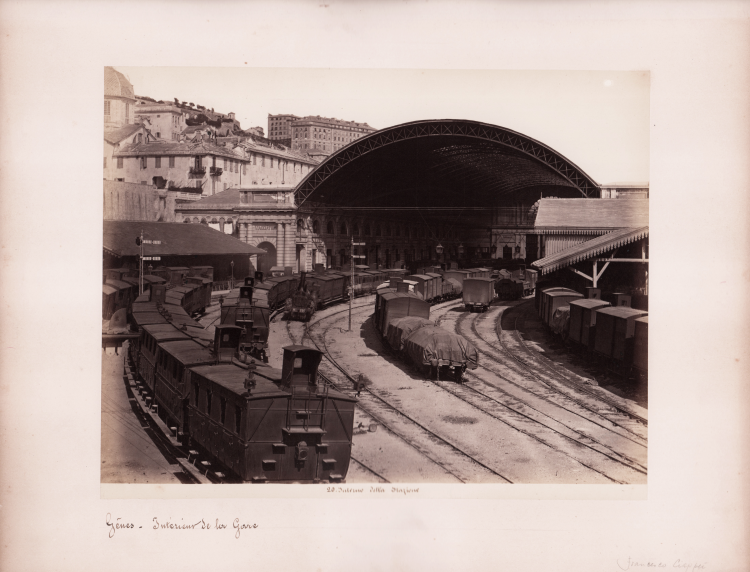
Albumen on paper, mounted on a contemporary support, circa 1875/80.
The photograph shows the Genoa Piazza Principe station, inaugurated in 1860, in its early years of operation. The interior of the railway yard is visible, with its characteristic large arched iron and glass canopy, flanked by the end tracks and the historic steam trains of the era. In the background, the buildings and hills of the surrounding Genoa neighborhood appear.
Francesco Ciappei (Genoa, circa 1840 – 1900) was an Italian photographer, considered one of the pioneers of photography in Italy and one of the most important of his time. He was active from around 1857 until 1900. Born in Genoa, he began carrying out his first photographic experiments at a very young age, starting his activity around the age of 17. He opened his own studio in his hometown, first in Piazza Valoria (sometimes referred to as Piazza Veneroso, from the section of the open space to which that name was given), acquiring the studio of another famous photographer, Alessandro Pavia, of whom he was probably a student. Subsequently, he opened his own photographic laboratory, at numbers 11-13 of via Carlo Felice, in the rooms of the sumptuous Centurione palace, to move later in life to Salita delle Battistine 16. Despite having also created numerous portraits, Ciappei concentrated mainly on landscape photography, dedicating himself in particular to the Riviera, «with an inviting style so much so that he can be considered the creator of a stereotype of tourist photography in Liguria». In 1884 and 1887 he was awarded by King Umberto I of Savoy and Prince Tommaso of Savoy-Genoa at the photographic exhibition in Florence, in the second of which he presented a series of portraits in miniature format, works in which he specialized. In 1892, on the occasion of the commemorations for the four hundredth anniversary of the discovery of America, he was the photographer of the international meeting of warships in the port of Genoa.
Francesco CIAPPEI (Genova 1840 - 1900 circa)
|
Francesco Ciappei (Genoa, circa 1840 – 1900) was an Italian photographer, considered one of the pioneers of photography in Italy and one of the most important of his time. He was active from around 1857 until 1900. Born in Genoa, he began carrying out his first photographic experiments at a very young age, starting his activity around the age of 17. He opened his own studio in his hometown, first in Piazza Valoria (sometimes referred to as Piazza Veneroso, from the section of the open space to which that name was given), acquiring the studio of another famous photographer, Alessandro Pavia, of whom he was probably a student. Subsequently, he opened his own photographic laboratory, at numbers 11-13 of via Carlo Felice, in the rooms of the sumptuous Centurione palace, to move later in life to Salita delle Battistine 16. Despite having also created numerous portraits, Ciappei concentrated mainly on landscape photography, dedicating himself in particular to the Riviera, «with an inviting style so much so that he can be considered the creator of a stereotype of tourist photography in Liguria». In 1884 and 1887 he was awarded by King Umberto I of Savoy and Prince Tommaso of Savoy-Genoa at the photographic exhibition in Florence, in the second of which he presented a series of portraits in miniature format, works in which he specialized. In 1892, on the occasion of the commemorations for the four hundredth anniversary of the discovery of America, he was the photographer of the international meeting of warships in the port of Genoa.
|
Francesco CIAPPEI (Genova 1840 - 1900 circa)
|
Francesco Ciappei (Genoa, circa 1840 – 1900) was an Italian photographer, considered one of the pioneers of photography in Italy and one of the most important of his time. He was active from around 1857 until 1900. Born in Genoa, he began carrying out his first photographic experiments at a very young age, starting his activity around the age of 17. He opened his own studio in his hometown, first in Piazza Valoria (sometimes referred to as Piazza Veneroso, from the section of the open space to which that name was given), acquiring the studio of another famous photographer, Alessandro Pavia, of whom he was probably a student. Subsequently, he opened his own photographic laboratory, at numbers 11-13 of via Carlo Felice, in the rooms of the sumptuous Centurione palace, to move later in life to Salita delle Battistine 16. Despite having also created numerous portraits, Ciappei concentrated mainly on landscape photography, dedicating himself in particular to the Riviera, «with an inviting style so much so that he can be considered the creator of a stereotype of tourist photography in Liguria». In 1884 and 1887 he was awarded by King Umberto I of Savoy and Prince Tommaso of Savoy-Genoa at the photographic exhibition in Florence, in the second of which he presented a series of portraits in miniature format, works in which he specialized. In 1892, on the occasion of the commemorations for the four hundredth anniversary of the discovery of America, he was the photographer of the international meeting of warships in the port of Genoa.
|