
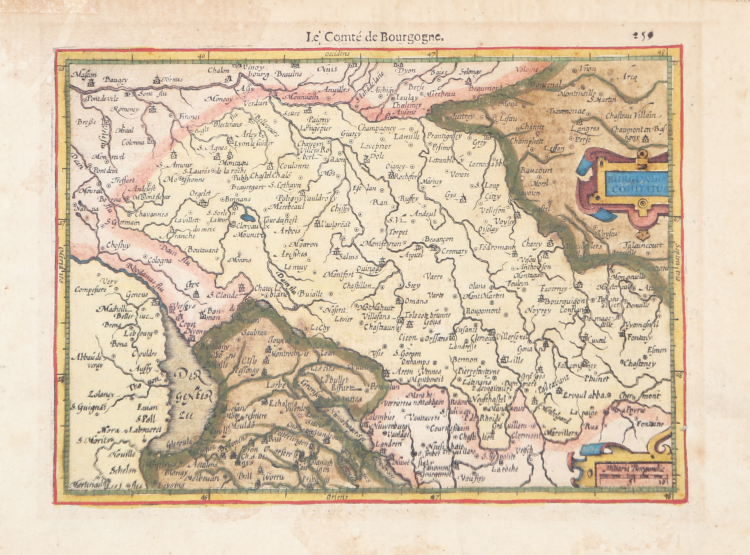
| Reference: | S4455 |
| Author | Jodocus HONDIUS |
| Year: | 1628 ca. |
| Zone: | Burgundy |
| Printed: | Amsterdam |
| Measures: | 195 x 150 mm |
| Reference: | S4455 |
| Author | Jodocus HONDIUS |
| Year: | 1628 ca. |
| Zone: | Burgundy |
| Printed: | Amsterdam |
| Measures: | 195 x 150 mm |
A miniature map taken from Atlas minor, Das ist: Eine kurtze, jedoch gründliche Beschreibung der gantzen Weldt. Engraved by Abraham Goos or Pieter van den Keere, first issued by Johannes Janssonius in 1628.
Mercator's Atlas Minor was conceived by Jodocus Hondius in 1607 as a reduced-sized edition of the popular folio-sized Mercator Atlas. The Atlas Minor was intended to be larger than a pocket atlas, yet smaller than the folio atlas, and were priced accordingly to reach a new market.
There were three different editions of the Atlas Minor published by different authors, each with a new set of copperplates. Jodocus Hondius published the first edition from 1607-1621, and subsequently sold the copperplates to parties in England between 1621-1625, after which an English edition was published using many of the original plates in 1635-39. Johannes Jansson wanted to compete in the small atlas market as well, and had new copperplates engraved by Pieter van den Keere and Abraham Goos for his own edition published in multiple languages between 1628-51. The third and final edition was published by Jan Evertsz. Cloppenburch (or Cloppenburg) between 1630-1734 (some without text), with new maps engraved primarily by Pieter van den Keere.
"Shortly after the publication of the big folio-atlases the need was apparantly felt for a smaller-sized atlas, one that would be handier, and, above all, cheaper, so that a larger public might have access to the use of maps. The publication of the Atlas Minor appeared to be a great success for Hondius; the first Latin edition was in great demand. The copperplates of the first atlases minor were most almost certainly engraved by Jodocus Hondius himself. After 1621, the copperplates of the Atlas Minor were sold to a London editor. Firstly, they appeared in Purchas his Pilgrinies, printed in 1625 by William Stansby for Henry Featherstone. Next they were used for the translation of the Mercator-atlas, printed in small folio under the title Historia mundi, or Mercators atlas, by Thomas Cotes for Michael Sparke and Samuel Cartwight in 1635". (cf. Koeman II Me 191).
"As with the Theatrum of Abraham Ortelius, Jodocus Hondius planned a reduced size version of Gerard Mercator's folio atlas. Just one year after his first edition he published his Latin text Atlas Minor in collaboration with Jan Jansz. and Cormelis Claesz. The arrangement between these three is not understood clearly but Hondius is believed to have been the owner of the copperplates. Cartographically this is taken directly from the folio maps by Hondius in 1606 [..]. with the inevitable loss of detail due to the reduction” (cf. Burden, The Mapping of North America, 153).
Johannes Janssonius (1588-1664) was the son of a printer, publisher and bookseller from Arnhem with the same name. In 1612 he married Elizabeth Hondius, daughter of Jodocus Hondius I, and in the same year set up his own publishing house in Amsterdam. When Jodocus I died that same year he began helping Hondius’ widow with the continued publication of the Mercator – Hondius atlas. Both Hondius’ widow, Colette, as well as Hondius’ eldest son, Jodocus II, died in 1629; Janssonius therefore joined forces with Hondius’ younger son, Henricus, to revise the Mercator-Hondius atlas, the ‘Atlas Novus’, from 1638.
Copperlate, very good condition. From the German edition of Atlas minor, printed in Amsterdam 1648.
Bibliografia
Koeman IIIB, 352:33.
Jodocus HONDIUS (Amsterdam 1563 - 1612)
|
Jodocus Hondius (1563-1612) was a foremost map engraver of his day; he worked for many Dutch publishers, and was employed by the English map and print-sellers, Sudbury and Humble, to engrave the maps for John Speed’s The Theatre of The Empire of Great Britaine, published in 1612. In 1604, Hondius bought the copperplates of Mercator’s Atlas at the auction of Gerard Jr.’s effects. He added another forty maps, including new maps of the Continents and important regional maps of the Americas, before publishing a new edition of the Atlas, in 1606, in competition with Ortelius’ Theatrum. As many of the maps were more up-to-date, the Mercator-Hondius Atlas effectively superseded Ortelius’ Theatrum. On his death in 1612 his widow, Coletta van den Keere continued the business; from 1619 onwards their son Henry (II) (1597-1651) took over. From 1633 publication was carried on in co-operation with Jan Jansson Jr., Henry’s brother-in-law.
|
Jodocus HONDIUS (Amsterdam 1563 - 1612)
|
Jodocus Hondius (1563-1612) was a foremost map engraver of his day; he worked for many Dutch publishers, and was employed by the English map and print-sellers, Sudbury and Humble, to engrave the maps for John Speed’s The Theatre of The Empire of Great Britaine, published in 1612. In 1604, Hondius bought the copperplates of Mercator’s Atlas at the auction of Gerard Jr.’s effects. He added another forty maps, including new maps of the Continents and important regional maps of the Americas, before publishing a new edition of the Atlas, in 1606, in competition with Ortelius’ Theatrum. As many of the maps were more up-to-date, the Mercator-Hondius Atlas effectively superseded Ortelius’ Theatrum. On his death in 1612 his widow, Coletta van den Keere continued the business; from 1619 onwards their son Henry (II) (1597-1651) took over. From 1633 publication was carried on in co-operation with Jan Jansson Jr., Henry’s brother-in-law.
|