

| Reference: | S24519 |
| Author | Valerio SPADA |
| Year: | 1650 |
| Zone: | Florence |
| Printed: | Florence |
| Measures: | 1205 x 415 mm |
| Reference: | S24519 |
| Author | Valerio SPADA |
| Year: | 1650 |
| Zone: | Florence |
| Printed: | Florence |
| Measures: | 1205 x 415 mm |
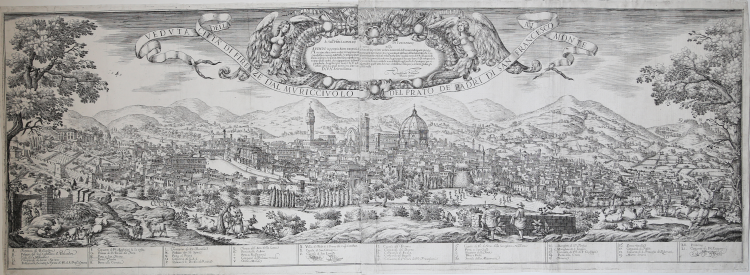
At the top center in a ribbon the title: VEDUTA DELLA CITTÀ DI FIRENZE DAL MURICCIUOLO DEL PRATO DÈ PADRI DI SAN FRANCESCO AL MONTE. in the cartouche supported by angels and decorated with foliage and symbols of war the dedication: AL SER:mo P[RI]N[CI]PE LEOPOLDO DI TOSCANA Seren: P[ri]n[ci]pe AVENDO io p[er] proprio diletto intrapreso à delineare la presente veduta della Città di Firenze, nella quale più che in ogni altra, a mio credere si scuoprono minutamente non meno i più riguardevoli edifizzi della stessa Città, che un grandissimo numero delle Ville, che le stanno sparse dintorno, mi son risoluto a stamparla sotto l’eccelso nome di V. A. Di qui mi fò animo a sperare, che q[ue].a mia debol fatica esposta à raggi della sua generosa beneficenza sia p[er] ricevere il suo vero lume, il q[ua]le rompendo le troppo spesse ombre, che v’appariscono della mia ignoranza sia per renderla men difettosa agli occhi di chiunque è per riguardarla. Supplico pertanto la V. A. ad aggradire quest’atto del mio umilissimo ossequio, e a farmi godere gli effetti della sua gran protezione, sotto la quale resto Di V. A. Serenissima Umilissimo Servitore Valerio Spada. Along the lower edge, an alphanumeric legend arranged in ten columns with forty-four references (A-Z) (1-21) to notable places and monuments.
A famous and sought-after view of Florence, describing the entire city from the Belvedere alla Zecca, including the hills and the town of Fiesole. It depicts the city from the low wall of the meadow of the fathers of San Francesco al Monte, a church located just below today's Piazzale Michelangelo. In the foreground, pastoral and genre scenes loom, behind which the panorama of Florence looms, dominated by Brunelleschi's dome.
This is one of the most fascinating perspectives in the history of graphic depictions of Florence. Also characteristic of the entire representation are the finesse of the line and the absolute mastery of perspective vision, as well as the precision of the legend, placed on the lower edge, which matches precise numerical references traced on the drawing with the indications of the main monuments of the depicted city.
Etching, half of the XVII century, signed on upper plate, in the cartouche.
Magnificent work, printed on contemporary laid paper (two royal sheets joined together), light paper fold, trimmed to platemark or with thin margins, a perfectly executed repair on lower part, otherwise in excellent condition.
Valerio Spada was pupil of Lorenzo Lippi, in Florence, thus becoming a fine engraver and calligrapher, a thing which gained him the appreciation of Cosimo III de Medici.
The panorama is noteworthy due to its bucolic details in the foreground, including figures, vineyards and olive grove. The work is dedicated to H.R.H Prince Leopoldo; the dedication is enclosed in the cartouche on upper part, together with the title, formed with the dei Medici coat of arms held by two angels.
Bibliografia
Mori-Boffitto 62; Phyllis Deaborn Massar, The Prints of Valerio Spada, in “Print Quarterly” Vol. III, Num. 3 (1986) pp. 217-238 e Vol. IV, Num. 1 (1987), pp. 19-39.
Valerio SPADA (Colle di Val d'Elsa 1613-1688)
|
He was a famous calligrapher, but also a skilled draftsman and engraver on copper and etcher. He established himself as a draftsman and designer of the court, and he produced, among other things, the final scene (The Garden of Venus) of the work of Giambattista Moniglia The Hercules in Thebes, represented at the Pergola in 1661, on the occasion of the wedding of Cosimo III de 'Medici and Marguerite Louise d'Orléans.
|
Valerio SPADA (Colle di Val d'Elsa 1613-1688)
|
He was a famous calligrapher, but also a skilled draftsman and engraver on copper and etcher. He established himself as a draftsman and designer of the court, and he produced, among other things, the final scene (The Garden of Venus) of the work of Giambattista Moniglia The Hercules in Thebes, represented at the Pergola in 1661, on the occasion of the wedding of Cosimo III de 'Medici and Marguerite Louise d'Orléans.
|