
| Reference: | S30360.4 |
| Author | Domenico ANDERSON |
| Year: | 1899 ca. |
| Measures: | 255 x 200 mm |
| Reference: | S30360.4 |
| Author | Domenico ANDERSON |
| Year: | 1899 ca. |
| Measures: | 255 x 200 mm |
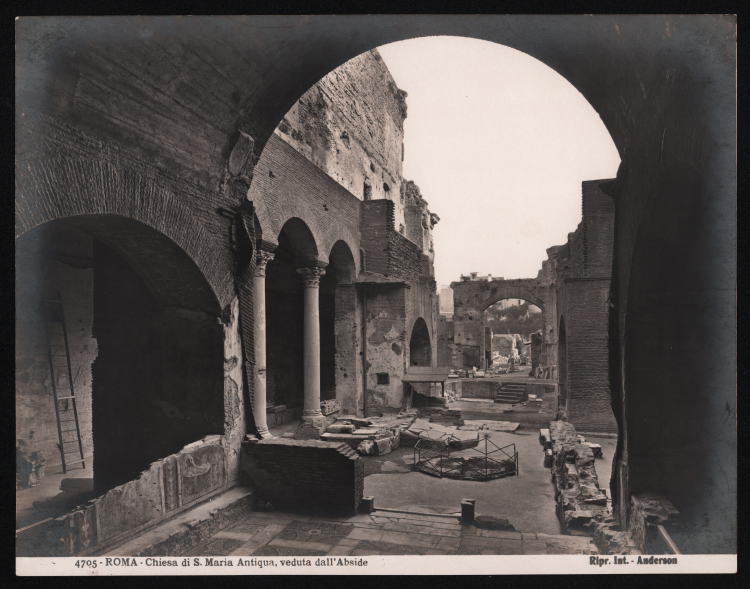
Silver gelatin, circa 1899/1902. The photograph bears the serial number: no. 4705 and the title ""ROMA - Chiesa di S. Maria Antiqua, veduta dall'Abside", signed by the historic Roman photography studio Anderson, founded by James Anderson (1813-1877), then led by his son Domenico.
This shot is of fundamental importance because it documents the very early stages of the archaeological excavation carried out between 1899 and 1902 by archaeologist Giacomo Boni. To bring this extraordinary early medieval basilica back to light, submerged by an earthquake in 847 AD, the Baroque church of Santa Maria Liberatrice al Foro Romano above it was demolished.
Domenico Anderson (Rome, 1854 – Rome, 1938), son of the photographer James, with whom he had collaborated since a young age, continued his father's work in Rome, dedicating himself to landscape photography and art reproduction. He presented his works at the First Italian Exhibition of Photography held in Florence in 1887, at the International Exhibition of Photography in Milan in 1894, at the one held in Florence by the Italian Photographic Society in 1899, and at the Universal Exhibition in Paris in 1900. From the beginning of the new century, he conducted campaigns to document the historical and artistic heritage in Italy and abroad. In 1915, he won the coveted Grand Prix award at the San Francisco International Exhibition. In 1930, the firm was incorporated as "Società Anonima D. Anderson." He conducted photographic campaigns throughout Italy and produced valuable documentation on the country's historical and artistic heritage and landscapes. He also traveled abroad, particularly to Spain and England. His sons Alessandro, Giorgio and Guglielmo continued their father's work until 1963, when the entire archive, consisting of over 30,000 glass plate negatives, became part of the Fratelli Alinari collection in Florence.
Domenico ANDERSON (Roma 1854 - 1938)
|
Domenico Anderson (Rome, 1854 – Rome, 1938) was a British-born Italian photographer.
Son of photographer James Anderson, with whom he collaborated from a young age, he continued his father's work in Rome, dedicating himself to landscapes and art reproductions. He presented his works at the First Italian Exhibition of Photography held in Florence in 1887, at the International Exhibition of Photography in Milan in 1894, at the one held in Florence by the Italian Photographic Society in 1899, and at the Universal Exhibition in Paris in 1900. In 1894, he was commissioned by the German Emperor Wilhelm II to reproduce the reliefs of the Antonine Column in photography for the first time: the photographs were published in the volume "Die Markussäule auf Piazza Colonna in Rom", published in 1896. In 1898, he began a long-lasting collaboration with the German art historian Ernest Steinmann, for whom he carried out the important photographic campaign on the frescoes of the Sistine Chapel. From the beginning of the new century, he conducted campaigns to document the historical and artistic heritage in Italy and abroad. In 1915, he received the coveted Grand Prix award at the San Francisco International Exhibition. In 1930, the firm was incorporated as "Società Anonima D. Anderson." He conducted photographic campaigns throughout Italy and produced valuable documentation of the country's historical and artistic heritage and landscapes. He also traveled abroad, particularly to Spain and England. He also dedicated himself to photographing sculptures. His sons Alessandro, Giorgio, and Guglielmo continued their father's work until 1963, when the entire archive, consisting of over 30,000 glass plate negatives, became part of the Fratelli Alinari collection in Florence.
|
Domenico ANDERSON (Roma 1854 - 1938)
|
Domenico Anderson (Rome, 1854 – Rome, 1938) was a British-born Italian photographer.
Son of photographer James Anderson, with whom he collaborated from a young age, he continued his father's work in Rome, dedicating himself to landscapes and art reproductions. He presented his works at the First Italian Exhibition of Photography held in Florence in 1887, at the International Exhibition of Photography in Milan in 1894, at the one held in Florence by the Italian Photographic Society in 1899, and at the Universal Exhibition in Paris in 1900. In 1894, he was commissioned by the German Emperor Wilhelm II to reproduce the reliefs of the Antonine Column in photography for the first time: the photographs were published in the volume "Die Markussäule auf Piazza Colonna in Rom", published in 1896. In 1898, he began a long-lasting collaboration with the German art historian Ernest Steinmann, for whom he carried out the important photographic campaign on the frescoes of the Sistine Chapel. From the beginning of the new century, he conducted campaigns to document the historical and artistic heritage in Italy and abroad. In 1915, he received the coveted Grand Prix award at the San Francisco International Exhibition. In 1930, the firm was incorporated as "Società Anonima D. Anderson." He conducted photographic campaigns throughout Italy and produced valuable documentation of the country's historical and artistic heritage and landscapes. He also traveled abroad, particularly to Spain and England. He also dedicated himself to photographing sculptures. His sons Alessandro, Giorgio, and Guglielmo continued their father's work until 1963, when the entire archive, consisting of over 30,000 glass plate negatives, became part of the Fratelli Alinari collection in Florence.
|