
- New
| Reference: | A54151 |
| Author | Giovanni Girolamo FREZZA |
| Year: | 1704 |
| Printed: | Rome |
| Measures: | 215 x 340 mm |
| Reference: | A54151 |
| Author | Giovanni Girolamo FREZZA |
| Year: | 1704 |
| Printed: | Rome |
| Measures: | 215 x 340 mm |
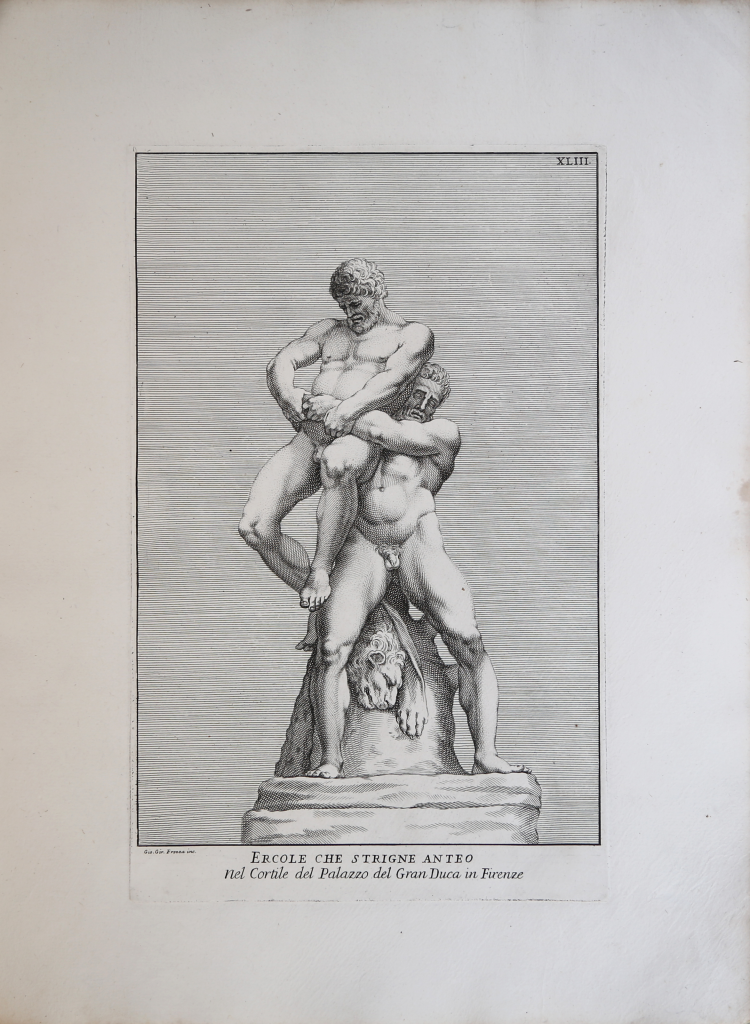
The painting depicts the statue of Hercules and Antaeus on display at the Pitti Palace.
The sculpted group depicts Hercules wrestling against Antaeus, son of Gaia, the personification of Mother Earth, and of Poseidon, god of the sea. The giant Antaeus is depicted in Florentine marble with the more common dimensions of the hero, Hercules. Antaeus, the King of Libya, challenged strangers to wrestling matches, the result of which was already certain. The giant drew his invincibility from a portent: simple contact with the Mother Earth, which restored his strength and energy. Hercules overcame this test by lifting the giant from the ground, holding him in a lethal grip. The iconographic design of the Florentine sculpture, showing a wrestler held by the shoulders by his adversary, was widely used in Greek vessel production from the late 6th century B.C. The subject is inspired by the practice of bare hand fighting, “Pankration”, which was already an Olympic discipline in 648 B.C.
The basic sculpture, without restored part, was placed in the Belvedere Courtyard in Rome as early as 1509. It was taken to Pitti Palace in 1564, and the missing parts were added during restoration work.
Etching, printed on contemporary laid paper, with margins, in perfect condition.
Plate taken from the famous Raccolta di statue antiche e moderne: data in luce sotto i gloriosi auspicj della ... Papa Clemente XI. / da Domenico de Rossi; illustrata colle sposizioni a ciascheduna immagine di Pavolo Alessandro Maffei. In Roma nella Stamperia alla Pace con Privilegio del Sommo Pont. e licenza dè Superiori l'anno MDCCIV.
In 1704, the largest collection ever assembled of prints depicting ancient Roman statues was published in Rome, a work that would remain a milestone in the genre. Compared to its most important predecessor, the Segmenta nobilium signorium et statuarum by the French painter and engraver François Perrier (1638), the Raccolta, published by Domenico De Rossi, with an erudite commentary by Paolo Alessandro Maffei (1653-1716), was distinguished above all by the presence, alongside the Nobilia Opera, of famous modern sculptures from the 16th and 17th centuries, preserved both in Rome and Florence.
The engravers who worked on the copper engravings were almost all French, and the undertaking was considered a collective effort led primarily by the publisher, the most important in Baroque Rome. Not all the names involved, however, were of the same caliber and prestige, and above all, they were not all active in the same years: two of the lesser-known engravers, Claude Randon (died 1679) and François Andriot (d. 1704), had worked together, on behalf of Charles Errand, director of the Académie de France à Rome, on Giovanni Pietro Bellori's Vite de' pittori, scultori e architetti moderni, published in Rome in 1672. The involvement of these two engravers suggests that the Raccolta arose from an undertaking started, but then abandoned, in the 1670s by Charles Errard, with the collaboration, presumably, of Bellori himself.
Among the artists who worked for the De Rossi printing house for this luxurious repertoire of statuary, the name of François de Poilly also appears (six plates), who, unlike Andriot and Randon, was a highly successful and extraordinarily prolific engraver who died in Paris in 1693. Randon and Poilly, therefore, had certainly been dead for some time when Domenico De Rossi published the Raccolta, and it is possible that Andriot had also already died, or was no longer in Rome. Among the other engravers whose signatures appear on the plates of the Raccolta, are some of the protagonists of the printmaking active in Rome at the beginning of the century: Francesco Aquila (fifty-two plates), Nicolas Dorigny (thirty-one plates), the Flemish Robert van Audenaerde (1663-1743; twenty-four plates) and Giovanni Girolamo Frezza (1671-post 1748; two plates).
Bibliografia
Stefano Pierguidi, La Raccolta di statue antiche e moderne della calcografia De Rossi e un'impresa incompiuta di Charles Errard, in “Les cahiers d'histoire de l'art” 14, pp. 106-113.
Giovanni Girolamo FREZZA (Orvinio 1671 - dopo il 1748)
|
Architect, draughtsman and engraver. Born in Canemorto (now Orvinio-Rieti), died in Rome. Student of Arnold van Westerhout in Rome, later linked with Frey in making prints after Maratti.
|
Giovanni Girolamo FREZZA (Orvinio 1671 - dopo il 1748)
|
Architect, draughtsman and engraver. Born in Canemorto (now Orvinio-Rieti), died in Rome. Student of Arnold van Westerhout in Rome, later linked with Frey in making prints after Maratti.
|