
- New
| Reference: | S30363.11 |
| Author | Carlo PONTI |
| Year: | 1870 ca. |
| Zone: | Venice |
| Measures: | 380 x 290 mm |
| Reference: | S30363.11 |
| Author | Carlo PONTI |
| Year: | 1870 ca. |
| Zone: | Venice |
| Measures: | 380 x 290 mm |
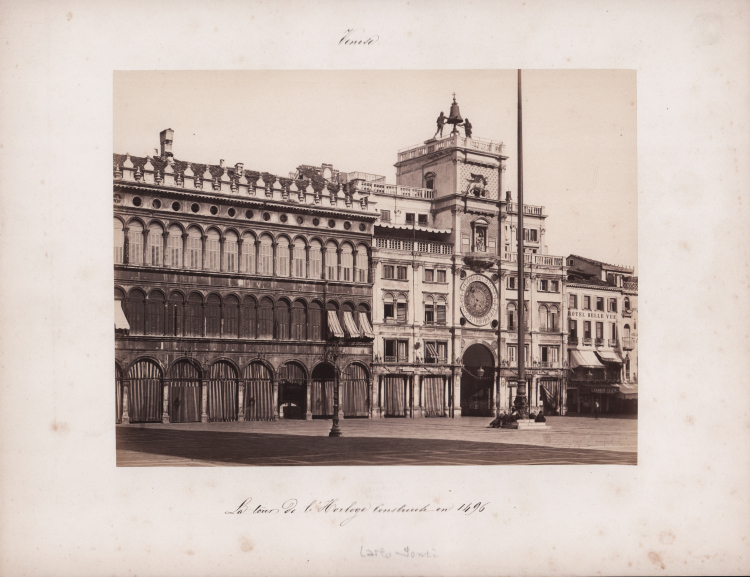
Albumen on paper, laid down on original cardboard, circa 1870/75.
Photograph depicting the Clock Tower in St. Mark's Square in Venice, flanked by the Procuratie Vecchie.
Carlo Ponti, (1820 – 1893), was a photographer and optician native of Milan but a Swiss citizen. He settled in Paris, where he remained for eight years to train as an optician at the Cauchoix optical workshops, licensee of the Daguerre patent, then moved to Venice. An optics and photography atelier opens in the lagoon city. Between 1854 and 1875 he documented all of northern Italy, without forgetting Rome, taking care of and publishing both his own images and those of other photographers, including those of a very famous photographer in Venice at the time: Carlo Naya. In 1855 he published the catalog of photographic views of Venice: 160 images, each with its own caption, all introduced by a text that retraced the architectural events. In the same year he took part in the Universal Exhibition in Paris, receiving an award. In 1852 he opened two shops in Riva degli Schiavoni, directed by his brother Giuseppe, and in 1863 the one in Piazza San Marco. In this shop he usually sells photographs by other Venetian photographers, often using his company's brand. In 1862 he achieved great success at the Great Exhibition in London with a new viewer for photographic prints of his invention: the alethoscope. Later, he also invented new lenses for the camera and the megalethoscope, a device for creating effects that simulated day and night as in the diorama. In 1866, first in Venice, he could boast the title of photographer of His Majesty the King of Italy.
Carlo PONTI (Milano ? 1820 - Venezia 1893)
|
Carlo Ponti, born Carlo Antonio Daniele Ponti (Sagno, November 6, 1820 – Venice, November 16, 1893), was a Swiss photographer and optician. Son of Antonio and Marianna Nobile, he was born in Sagno, which later became a hamlet of the municipality of Breggia. His birth date of 1820 is reported in the Historical Dictionary of Switzerland, while other sources place Ponti's birth between 1821 and 1824. A more recent study states that Ponti was born in Milan on November 7, 1820, according to the marriage register of the Church of San Zaccaria in Venice in 1863 on the occasion of his second marriage, compiled by the parish priest, Giambattista Domeneghini and verified in the parish registers of the Church of Santa Maria del Carmine in Milan, which record his birth and baptismal certificates. It is certain that his parents were Swiss and his father was a painter by profession. Furthermore, the Austrian/Venetian family register, drawn up by the interested party himself in 1850, 1857, and 1869, contains the words "Native of Milan but Swiss subject" (iure sangunis). He settled in Paris, where he remained for eight years to train as an optician at the Cauchoix optical workshops, licensee of the Daguerre patent, before moving to Venice. In the lagoon city, he opened an optical and photography studio. As far as is known, in 1857 he married Isabella Maria Spinelli, Donato's daughter, but the marriage did not last long due to his wife's death in Sagno on January 17, 1861. Two years later, on January 24, 1863, he married the Venetian Elena Maria Angelina Radonovich, approximately twenty years his junior, as witnessed by photographer Ferdinando Callegari. He did not neglect his work, as between 1854 and 1875 he documented all of northern Italy, including Rome, curating and publishing both his own images and those of other photographers, including those of a very famous photographer in Venice at the time: Carlo Naya. In 1855, he published a catalogue of photographic views of Venice: 160 images, each with its own caption, all introduced by a text that recounted the architectural history of the city. That same year, he took part in the Universal Exhibition in Paris, winning an award. In 1852, he opened two shops on Riva degli Schiavoni, managed by his brother Giuseppe, and in 1863, one in Piazza San Marco. In this shop, he regularly sold photographs by other Venetian photographers, often using his own company logo. In 1862, he achieved great success at the Great Exhibition in London with a new viewer for photographic prints he had invented: the alethoscope. He later invented new camera lenses and the megalethoscope, a device for creating effects that simulated day and night, as in a diorama. In 1866, he was the first in Venice to be awarded the title of photographer to His Majesty the King of Italy. He died at the Civil Hospital of Venice on November 16, blind and semi-forgotten. The local press did not report the date of his funeral, and his remains, initially buried in a common field, were later placed in the ossuary of the Cemetery of San Michele in Venice.
|
Carlo PONTI (Milano ? 1820 - Venezia 1893)
|
Carlo Ponti, born Carlo Antonio Daniele Ponti (Sagno, November 6, 1820 – Venice, November 16, 1893), was a Swiss photographer and optician. Son of Antonio and Marianna Nobile, he was born in Sagno, which later became a hamlet of the municipality of Breggia. His birth date of 1820 is reported in the Historical Dictionary of Switzerland, while other sources place Ponti's birth between 1821 and 1824. A more recent study states that Ponti was born in Milan on November 7, 1820, according to the marriage register of the Church of San Zaccaria in Venice in 1863 on the occasion of his second marriage, compiled by the parish priest, Giambattista Domeneghini and verified in the parish registers of the Church of Santa Maria del Carmine in Milan, which record his birth and baptismal certificates. It is certain that his parents were Swiss and his father was a painter by profession. Furthermore, the Austrian/Venetian family register, drawn up by the interested party himself in 1850, 1857, and 1869, contains the words "Native of Milan but Swiss subject" (iure sangunis). He settled in Paris, where he remained for eight years to train as an optician at the Cauchoix optical workshops, licensee of the Daguerre patent, before moving to Venice. In the lagoon city, he opened an optical and photography studio. As far as is known, in 1857 he married Isabella Maria Spinelli, Donato's daughter, but the marriage did not last long due to his wife's death in Sagno on January 17, 1861. Two years later, on January 24, 1863, he married the Venetian Elena Maria Angelina Radonovich, approximately twenty years his junior, as witnessed by photographer Ferdinando Callegari. He did not neglect his work, as between 1854 and 1875 he documented all of northern Italy, including Rome, curating and publishing both his own images and those of other photographers, including those of a very famous photographer in Venice at the time: Carlo Naya. In 1855, he published a catalogue of photographic views of Venice: 160 images, each with its own caption, all introduced by a text that recounted the architectural history of the city. That same year, he took part in the Universal Exhibition in Paris, winning an award. In 1852, he opened two shops on Riva degli Schiavoni, managed by his brother Giuseppe, and in 1863, one in Piazza San Marco. In this shop, he regularly sold photographs by other Venetian photographers, often using his own company logo. In 1862, he achieved great success at the Great Exhibition in London with a new viewer for photographic prints he had invented: the alethoscope. He later invented new camera lenses and the megalethoscope, a device for creating effects that simulated day and night, as in a diorama. In 1866, he was the first in Venice to be awarded the title of photographer to His Majesty the King of Italy. He died at the Civil Hospital of Venice on November 16, blind and semi-forgotten. The local press did not report the date of his funeral, and his remains, initially buried in a common field, were later placed in the ossuary of the Cemetery of San Michele in Venice.
|