
| Reference: | S50952 |
| Author | Richard EARLOM |
| Year: | 1778 ca. |
| Printed: | London |
| Measures: | 405 x 545 mm |
| Reference: | S50952 |
| Author | Richard EARLOM |
| Year: | 1778 ca. |
| Printed: | London |
| Measures: | 405 x 545 mm |
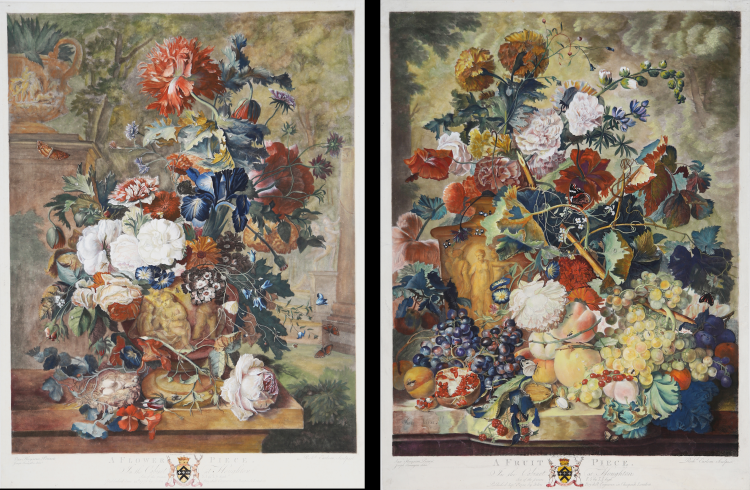
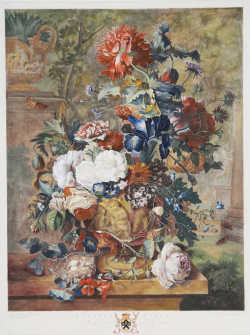
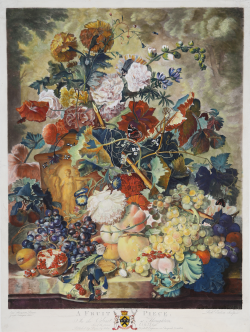
A rich bouquet of flowers in a vase with classical reliefs, placed on a marble ledge in a park, beside it on the left is a small nest with bird's eggs, classical sculpure in the distance on the far right and a wide vase on a pedestal on the left.
Lettered within image, "Jan Van Huysum fecit 1722", and below image with artists' and publisher's names and date, title and further line: "In the Cabinet at Houghton", size of the painting and publication line: "Published June 25th. 1778 by John Boydell engraver in Cheapside London".
With:
A rich bouquet of flowers in a vase with classical reliefs; before it lie grapes, peaches, nuts and other fruits, all placed on a marble ledge.
Lettered within image, "Jan Van Huysum fecit 1723", and below image with artists' and publisher's names and date, and publication line: "Published Sepr 1st. 1781 by John Boydell engraver in Cheapside London."
Pair of mezzotint with stipple and etching, with fine colouring, after Jan van Huysum (1682-1749).
Final state of the engravings, with the coat of arms of Sir Robert Walpole (original owner of the paintings, now in the Hermitage collection in St. Petersburg) at the bottom, printed in 1778 and 1781 respectively.
Jan van Huysum took the popular genre of floral still life to new heights in the 18th century. Instead of the usual dark background, he used a combination of light colors with a park-like landscape, so that the flowers appear to be outdoors, above a balustrade.
The works are reproduced with extreme fidelity to nature, not missing a single detail, dewdrop, or insect. Richard Earlom (1743–1822) was one of the leading British printmakers in the mezzotint style of his time and one of the many talented printmakers who worked on John Boydell's mammoth project to reproduce Sir Robert Walpole's collection of paintings at Houghton. Earlom was one of the few engravers technically skilled enough to do justice to Van Huysum's work.
Magnificent proofs, printed on contemporary laid paper and finely hand-colored. A small, restored tear at the bottom of "A Fruit Piece", minor abrasions, otherwise in excellent condition.
Biliografia
Wessely, Richard Earlom, Verzeichniss seiner Radirungen und Schabkunstblätter n. 144 & 145; Rubinstein, Richard Earlom (1743-1822) and Boydell's Houghton Gallery, n. 59 & 60; Hollstein, Dutch and Flemish etchings, engravings and woodcuts c.1450-1700 [after Huysum], n. 6 & 7; Peter Mitchell, European Flower Painters, pp. 142-149.
Two sheets of 405x545
Richard EARLOM (Londra, 14 maggio 1743 – Londra, 9 ottobre 1822)
|
Richard Earlom (baptised 14 May 1743 – 9 October 1822) was an English mezzotinter.
Earlom was born and died in London. His natural faculty for art appears to have been first called into exercise by his admiration for the lord mayor's state coach, which had just been decorated by Giovanni Battista Cipriani. He tried to copy the paintings, and was sent to study under Cipriani. He displayed great skill as a draughtsman, and at the same time acquired without assistance the art of mezzotint. In 1765, Earlom was employed by Alderman Boydell, a publisher and promoter of the fine arts, to make a series of drawings from the pictures at Houghton Hall; and these he engraved in mezzotint. His best works are perhaps the fruit and flower pieces after the Dutch artists Van Os and Jan van Huysum. Among his historical and figure subjects are Agrippina, after Benjamin West; Love in Bondage, after Guido Reni; the Royal Academy, the Embassy of Hyderbeck to meet Lord Cornwallis, Colonel Mordant's Cock Fight and a Tiger Hunt, all after Johan Zoffany, and Lord Heathfield, after Sir Joshua Reynolds. Earlom was commissioned by John Boydell to copy all 200 drawings of Claude Lorraine's record of his paintings as prints, which were published from 1774 to 1777, when a collected edition in two volumes was published as Liber Veritatis. Or, A Collection of Two Hundred Prints, After the Original Designs of Claude le Lorrain, in the Collection of His Grace the Duke of Devonshire, Executed by Richard Earlom, in the Manner and Taste of the Drawings.... with the inscription on the reverses, a "descriptive catalogue of each print" and the current owner, where it was known. A further volume of 100 prints after other Claude drawings from various British collections was added in 1819, also using "Liber Veritas" as its title. The title Liber Veritatis was invented for these reproductions, but is now used for the originals as well. These were then in a rebound book at Devonshire House in London; they are now in the British Museum. The prints used etching for Claude's pen lines, and mezzotint for the ink washes, giving a good impression of the originals. All used brown ink on white paper, so disregarding the blue of half the original pages. The prints were a huge success, reprinted and the plates reworked to give increasingly detailed reproductions. They were recommended by drawing teachers as models for copying, and influenced the technique of English watercolour artists in particular, for example Francis Towne.
|
Richard EARLOM (Londra, 14 maggio 1743 – Londra, 9 ottobre 1822)
|
Richard Earlom (baptised 14 May 1743 – 9 October 1822) was an English mezzotinter.
Earlom was born and died in London. His natural faculty for art appears to have been first called into exercise by his admiration for the lord mayor's state coach, which had just been decorated by Giovanni Battista Cipriani. He tried to copy the paintings, and was sent to study under Cipriani. He displayed great skill as a draughtsman, and at the same time acquired without assistance the art of mezzotint. In 1765, Earlom was employed by Alderman Boydell, a publisher and promoter of the fine arts, to make a series of drawings from the pictures at Houghton Hall; and these he engraved in mezzotint. His best works are perhaps the fruit and flower pieces after the Dutch artists Van Os and Jan van Huysum. Among his historical and figure subjects are Agrippina, after Benjamin West; Love in Bondage, after Guido Reni; the Royal Academy, the Embassy of Hyderbeck to meet Lord Cornwallis, Colonel Mordant's Cock Fight and a Tiger Hunt, all after Johan Zoffany, and Lord Heathfield, after Sir Joshua Reynolds. Earlom was commissioned by John Boydell to copy all 200 drawings of Claude Lorraine's record of his paintings as prints, which were published from 1774 to 1777, when a collected edition in two volumes was published as Liber Veritatis. Or, A Collection of Two Hundred Prints, After the Original Designs of Claude le Lorrain, in the Collection of His Grace the Duke of Devonshire, Executed by Richard Earlom, in the Manner and Taste of the Drawings.... with the inscription on the reverses, a "descriptive catalogue of each print" and the current owner, where it was known. A further volume of 100 prints after other Claude drawings from various British collections was added in 1819, also using "Liber Veritas" as its title. The title Liber Veritatis was invented for these reproductions, but is now used for the originals as well. These were then in a rebound book at Devonshire House in London; they are now in the British Museum. The prints used etching for Claude's pen lines, and mezzotint for the ink washes, giving a good impression of the originals. All used brown ink on white paper, so disregarding the blue of half the original pages. The prints were a huge success, reprinted and the plates reworked to give increasingly detailed reproductions. They were recommended by drawing teachers as models for copying, and influenced the technique of English watercolour artists in particular, for example Francis Towne.
|