
- New
| Reference: | S48308.14 |
| Author | Augusto OLIVIERI |
| Year: | 1883 ca. |
| Zone: | Pantheon |
| Printed: | Rome |
| Measures: | 255 x 200 mm |
| Reference: | S48308.14 |
| Author | Augusto OLIVIERI |
| Year: | 1883 ca. |
| Zone: | Pantheon |
| Printed: | Rome |
| Measures: | 255 x 200 mm |
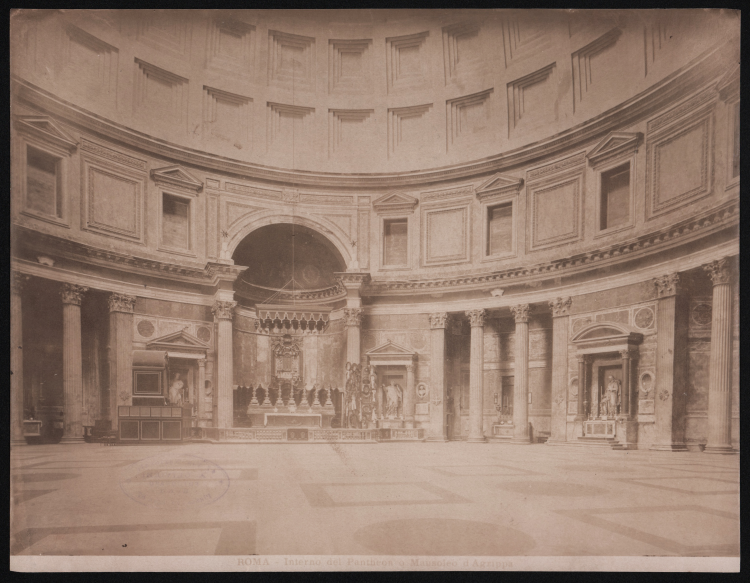
Albumen on paper, circa 1879/1883.
The shot captures the interior of the Pantheon in Rome. The monument's large circular hall with the main altar area and the characteristic coffered ceiling of the dome. The period "ROMA - Interno del Pantheon di Agrippa" appears in the lower margin.
The photograph bears the stamp of the photographer Augusto Olivieri, active in Rome in 1879/80, on the verso (see Becchetti, La fotografia a Roma, 1983, p. 330). The stamp refers to the location at Piazza di Spagna 87.
Augusto Olivieri was an Italian photographer active in the second half of the 19th century (particularly between 1870 and 1880). He worked primarily in Rome, where he initially took over Fellino Mengarelli's studio at Via Santa Maria in Via 7a. Later, his stamps on the photographs testify to his relocation to prestigious locations such as Piazza di Spagna 87 and Via Nazionale 67. Biographical information on Augusto Olivieri is limited and closely linked to the history of post-unification Roman photography. As was the case for many 19th-century professionals, his "biography" has been reconstructed by art historians mainly through contemporary commercial registers, stamps placed on photo cards (carte de visite), and historical archive folders. Olivieri worked in Rome in the delicate and fervent decade following the breach of Porta Pia (1870). With the proclamation of Rome as Capital, the city underwent a radical urban transformation and a population boom. In this context, the Roman photography market was booming: on the one hand, there was a strong demand for portraiture from the new ruling class and the ministerial bourgeoisie; on the other, the market for urban views intended for tourists on the Grand Tour was growing. His period prints and photographic positives are considered historical cultural assets. They document the Rome of the time; one of his best-known images portrays the Piazza del Popolo during the funeral procession of Vittorio Emanuele II.
Augusto OLIVIERI (attivo fra il 1879 e il 1880)
|
Augusto Olivieri was an Italian photographer active in the second half of the 19th century (particularly between 1870 and 1880). He worked primarily in Rome, where he initially took over Fellino Mengarelli's studio at Via Santa Maria in Via 7a. Later, his stamps on the photographs testify to his relocation to prestigious locations such as Piazza di Spagna 87 and Via Nazionale 67. Biographical information on Augusto Olivieri is limited and closely linked to the history of post-unification Roman photography. As was the case for many 19th-century professionals, his "biography" has been reconstructed by art historians mainly through contemporary commercial registers, stamps placed on photo cards (carte de visite), and historical archive folders. Olivieri worked in Rome in the delicate and fervent decade following the breach of Porta Pia (1870). With the proclamation of Rome as Capital, the city underwent a radical urban transformation and a population boom. In this context, the Roman photography market was booming: on the one hand, there was a strong demand for portraiture from the new ruling class and the ministerial bourgeoisie; on the other, the market for urban views intended for tourists on the Grand Tour was growing. His period prints and photographic positives are considered historical cultural assets. They document the Rome of the time; one of his best-known images portrays the Piazza del Popolo during the funeral procession of Vittorio Emanuele II.
|
Augusto OLIVIERI (attivo fra il 1879 e il 1880)
|
Augusto Olivieri was an Italian photographer active in the second half of the 19th century (particularly between 1870 and 1880). He worked primarily in Rome, where he initially took over Fellino Mengarelli's studio at Via Santa Maria in Via 7a. Later, his stamps on the photographs testify to his relocation to prestigious locations such as Piazza di Spagna 87 and Via Nazionale 67. Biographical information on Augusto Olivieri is limited and closely linked to the history of post-unification Roman photography. As was the case for many 19th-century professionals, his "biography" has been reconstructed by art historians mainly through contemporary commercial registers, stamps placed on photo cards (carte de visite), and historical archive folders. Olivieri worked in Rome in the delicate and fervent decade following the breach of Porta Pia (1870). With the proclamation of Rome as Capital, the city underwent a radical urban transformation and a population boom. In this context, the Roman photography market was booming: on the one hand, there was a strong demand for portraiture from the new ruling class and the ministerial bourgeoisie; on the other, the market for urban views intended for tourists on the Grand Tour was growing. His period prints and photographic positives are considered historical cultural assets. They document the Rome of the time; one of his best-known images portrays the Piazza del Popolo during the funeral procession of Vittorio Emanuele II.
|