
| Reference: | A53741 |
| Author | Alessandro SPECCHI |
| Year: | 1697 |
| Zone: | Casale di Carroceto [Aprilia] |
| Printed: | Rome |
| Measures: | 697 x 590 mm |
| Reference: | A53741 |
| Author | Alessandro SPECCHI |
| Year: | 1697 |
| Zone: | Casale di Carroceto [Aprilia] |
| Printed: | Rome |
| Measures: | 697 x 590 mm |
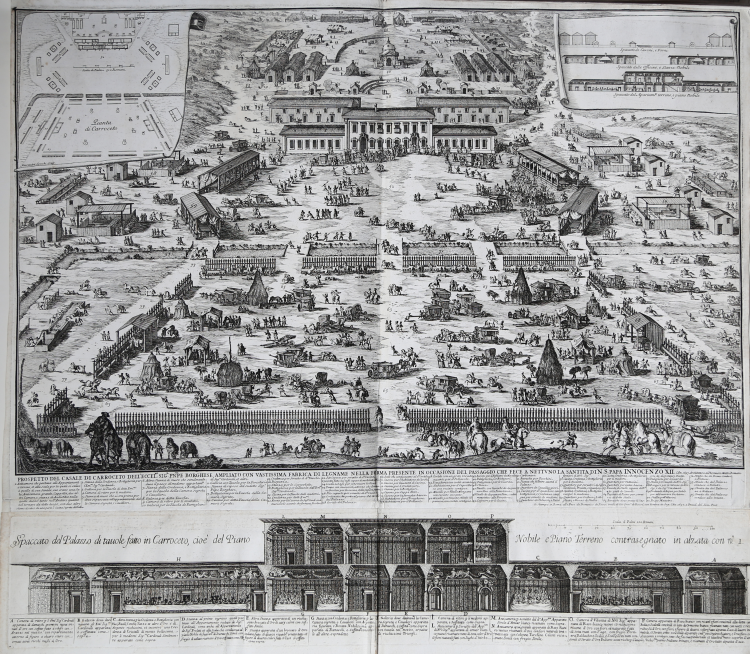
Prospetto Del Casale Di Carroceto Dell'Eccel.mo Sig Pnpe Borghese, Ampliato Con Vastissima Fabrica Di Legname Nella Forma Presente In Occasione Del Passaggio Che Fece A Nettvno La Santità Di N. S. Papa Innocenzo XII; Spaccato del Palazzo di tauole fatto in Carroceto, cioè del Piano Nobile e Piano Terreno contrasegnato in alzata con n. 1 / Architettura di Thomasso Mattei Romano; Alessandro Specchi Sculp. - In Roma: Si stampa alla Pace da Domenico de Rossi erede di Gio Giac de Rossi con licenzia de Sup e Priuil del Som. Pont, 1697.
Etching, 1697, engraved by Alessandro Specchi from a design by architect Tommaso Mattei, signed and dated on the plate at the bottom. A magnificent work, printed on contemporary laid paper, with typical paper folds, in excellent condition.
A rare work depicting the expansion of the farmhouse owned by Prince Giovan Battista Borghese on the occasion of the historic visit of Pope Innocent XII on April 22, 1697. Prince Borghese, owner of that barren countryside, to honor his visit created a veritable city from scratch in wood and papier-mâché, arousing the admiration of his illustrious guests.
The farmhouse of Carroceto stands in the present-day city of Aprilia; in memory of that passage, only the Church of Sant'Antonio remains, located on Via Nettunense at the gates of the modern-day city center. It still preserves ancient traces of that event: tombstones and a papal coat of arms.
As recounted in several anonymous chronicles of the time, on that day in 1697, the Pope, on his way to Anzio for the inauguration of the new Neronian port he had fortified, stopped halfway at the Carroceto estate, then owned by Prince Giovanna Battista Borghese, who had purchased it from the Colonna family. To the astonishment of the entire papal court, the crude farmhouse had been replaced by "a large, royal palace of painted panels", the construction of which had destroyed an entire forest. The astonishing, ephemeral palace of wood and canvas incorporated the farmhouse and consisted of a two-story central body with nine bays of windows, with two doors—one false and one real—surmounted by the papal coat of arms; on the sides were two single-story wings with seven bays. The building served as a geometrically ordered encampment, capable of housing and feeding the entire convoy, including the animals. Designed by the Borghese architect Tommaso Mattei, a pupil of Fontana, and with the significant contribution of Domenico Botta, magister ludi, of the guest princes, shelters were set up for the servants, light cavalry, and guards; shelters for four hundred and thirty horses, supplied with fodder and straw, as well as a specially installed watering trough. In the square, ovens, snowfields, wine cellars, two fountains with white and red wine, kitchens, cupboards, and separate wine cellars were set up.
The work is printed with two copper plates: the first (472 x 694 mm) depicts the event in all its beauty; the second (118 x 697 mm, added at the bottom) provides a perspective of the building.
Below the two images appear two legends for the depicted locations, marked respectively by progressive Arabic numerals and capital letters, which also appear within the illustrated section. On the left, within a cartouche is the plan of the complex; on the right, another cartouche shows cross-sections of various buildings.
“Uno dei più spettacolari apparati effimeri del secolo viene allestito, per ordine di Giovan Battista Borghese (1639-1717), in occasione del passaggio a Carroceto (una piccola località dove possiede un casale e una cappella) del Pontefice in viaggio verso Anzio. Figlio di Paolo Borghese e donna Olimpia Aldobrandini (poi Pamphilj), il Borghese è noto per avere molto arricchito il Palazzo Borghese a Roma. Il grande dispendio di energie e di capitali (il Palazzo, con annessi e connessi, viene a costare circa 20.000 scudi, mentre le opere portuali che Innocenzo XII deve approvare sono valutate 15.000 scudi) non sono compensate da una grande attenzione del Pontefice (vi sosta per tre ore il 21 aprile e poche ore nel viaggio di ritorno verso Roma). Daria Borghese che ha studiato l'opera (1994) suppone che il grande stanziamento economico riservato al Palazzo si spieghi come dimostrazione di potenza verso il Papa, forse anche per "sistemare" il giovane Paolo Borghese. Innocenzo XII aveva esortato il Principe a "una parchissima spesa per tale ricevimento, cioè si contenesse in un piccolo rinfresco". Tra parentesi, con la bolla Romanum decet pontificam, il 22 giugno 1690 Innocenzo XII aveva cercato di sanare la piaga del nepotismo. L'architetto del grandioso apparato è Tommaso Mattei (circa 1648-1726), allievo di Carlo Fontana (operoso al porto d' Anzio), che aveva già lavorato all' "Uccelliera" nel giardino di Villa Borghese. Il suo lavoro consiste nell' ingrandimento del casale esistente con apparati effimeri, nella costruzione di due edifici retrostanti e di un cortile a forma d' anfiteatro che ingloba la chiesetta di Sant' Antonio da Padova” (cfr. Maurizio Fagiolo dell’Arco, Corpus delle Feste a Roma, La festa barocca, p. 570).
Alessandro SPECCHI (Roma, 1668 - Roma, 1729)
|
Italian architect, urban planner and engraver. He studied architecture in the studio of Carlo Fontana and assisted in the construction of Fontana’s chapel of St Fabian (c. 1706) in S Sebastiano fuori le Mura in Rome. From at least 1684 he produced sets of architectural engravings. Many of these were published by Giovanni Giacomo de’ Rossi and his son Domenico de’ Rossi ( fl 1684–1721), including 52 engravings for Quarto libro del nuovo teatro di palazzi di Roma (Rome, 1699); some of the original plates are housed in the Calcografia Nazionale in Rome. Domenico de’ Rossi’s Studio d’architettura civile (1702–21) provides an architectural record of the city of Rome in 286 plates engraved by Specchi.
|
Alessandro SPECCHI (Roma, 1668 - Roma, 1729)
|
Italian architect, urban planner and engraver. He studied architecture in the studio of Carlo Fontana and assisted in the construction of Fontana’s chapel of St Fabian (c. 1706) in S Sebastiano fuori le Mura in Rome. From at least 1684 he produced sets of architectural engravings. Many of these were published by Giovanni Giacomo de’ Rossi and his son Domenico de’ Rossi ( fl 1684–1721), including 52 engravings for Quarto libro del nuovo teatro di palazzi di Roma (Rome, 1699); some of the original plates are housed in the Calcografia Nazionale in Rome. Domenico de’ Rossi’s Studio d’architettura civile (1702–21) provides an architectural record of the city of Rome in 286 plates engraved by Specchi.
|