
- New
| Reference: | A53993 |
| Author | Giambattista BRUSTOLON |
| Year: | 1765 ca. |
| Measures: | 460 x 325 mm |
| Reference: | A53993 |
| Author | Giambattista BRUSTOLON |
| Year: | 1765 ca. |
| Measures: | 460 x 325 mm |
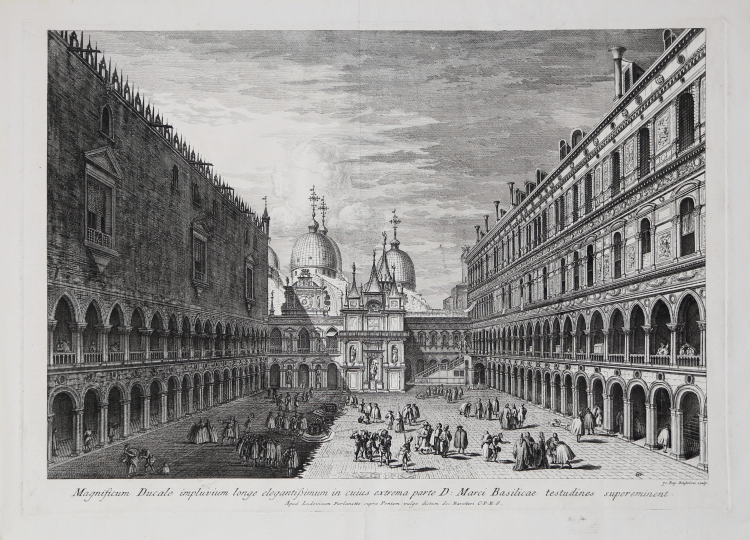
View of the courtyard of the Doge's Palace, signed by Giovan Battista Brustolon.
Etching, circa 1765, from a print by Michele Marieschi.
Example of the first of two, before the number 4 added.
The view belongs to the series Prospectuum Aedium, Viarumque Insigniorum Urbis Venetiarum [...], a collection published in 1763 that includes the title page and twelve views copied, enlarged, and with minor modifications, from Visentini's series of thirty-eight etchings after paintings by Canaletto, published in 1742. The collection was expanded to 21 views (twelve by Canaletto, four by Marieschi, five by Giovanni Battista Moretti) around 1765, without the title page being updated. Between 1776 and 1779, the rare engraving depicting the Fondamente Nuove with the church of Santa Maria del Pianto was added.
Magnificent work, rich in tone, printed on contemporary laid paper, with margins, in perfect condition.
Collector's stamp at lower right: “ML” described by Lugt under number 1886a as an unidentified collector. Another unidentified stamp on the verso.
Bibliografia
La Serenissima nello Specchio del rame, vol. 2, pp. 865-870, n. 6 I/II.
Giambattista BRUSTOLON (Venezia 1716 – 1796)
|
Italian printmaker. His family was from Belluno. He studied with Josef [Giuseppe] Wagner (1706–80). An able reproductive engraver, Brustolon mostly employed a technique that combined etching and engraving, and his work was done for the best Venetian publishers. He is known mainly for his reproductive prints after works by Canaletto. In 1763, for the publisher Ludovico Furlanetto, Brustolon produced a series entitled Prospectuum aedium, viarumque insigniorum urbis Venetiarum, dedicated to the Doge Marco Foscarini and initially composed of 12 views of Venice after Canaletto. It was later completed by the addition of 10 more plates after Michele Giovanni Marieschi and Giambattista Moretti in addition to further plates after Canaletto. Brustolon’s most famous series, also published by Furlanetto, was Feste dogali, featuring 12 large engravings of ceremonies and festivals attended by the Doge, derived from drawings by Canaletto. Around 1779 Brustolon started working on a series of 24 architectural capriccios after Canaletto, which was never completed. On 29 September 1780 he asked for the exclusive rights to make a series of 22 prints representing views of Rome, the original drawings of which had been given to him by Canaletto’s heirs. The most complete series is in the library of the Correr Museum, Venice, entitled Varii prospetti di Roma antica e moderna. Apart from reproductive prints, Brustolon also engraved book illustrations, as for example the plates in Antonio Francesco Gori’s Dactyliotheca Smithiana (Venice, 1767), a two-volume catalogue of the gem collection of Consul Joseph Smith, published by Giambattista Pasquali.
|
Giambattista BRUSTOLON (Venezia 1716 – 1796)
|
Italian printmaker. His family was from Belluno. He studied with Josef [Giuseppe] Wagner (1706–80). An able reproductive engraver, Brustolon mostly employed a technique that combined etching and engraving, and his work was done for the best Venetian publishers. He is known mainly for his reproductive prints after works by Canaletto. In 1763, for the publisher Ludovico Furlanetto, Brustolon produced a series entitled Prospectuum aedium, viarumque insigniorum urbis Venetiarum, dedicated to the Doge Marco Foscarini and initially composed of 12 views of Venice after Canaletto. It was later completed by the addition of 10 more plates after Michele Giovanni Marieschi and Giambattista Moretti in addition to further plates after Canaletto. Brustolon’s most famous series, also published by Furlanetto, was Feste dogali, featuring 12 large engravings of ceremonies and festivals attended by the Doge, derived from drawings by Canaletto. Around 1779 Brustolon started working on a series of 24 architectural capriccios after Canaletto, which was never completed. On 29 September 1780 he asked for the exclusive rights to make a series of 22 prints representing views of Rome, the original drawings of which had been given to him by Canaletto’s heirs. The most complete series is in the library of the Correr Museum, Venice, entitled Varii prospetti di Roma antica e moderna. Apart from reproductive prints, Brustolon also engraved book illustrations, as for example the plates in Antonio Francesco Gori’s Dactyliotheca Smithiana (Venice, 1767), a two-volume catalogue of the gem collection of Consul Joseph Smith, published by Giambattista Pasquali.
|