
| Reference: | S40618 |
| Author | Wilhelm Friedrich GMELIN |
| Year: | 1787 |
| Zone: | Pozzuoli |
| Printed: | Naples |
| Measures: | 590 x 430 mm |
| Reference: | S40618 |
| Author | Wilhelm Friedrich GMELIN |
| Year: | 1787 |
| Zone: | Pozzuoli |
| Printed: | Naples |
| Measures: | 590 x 430 mm |
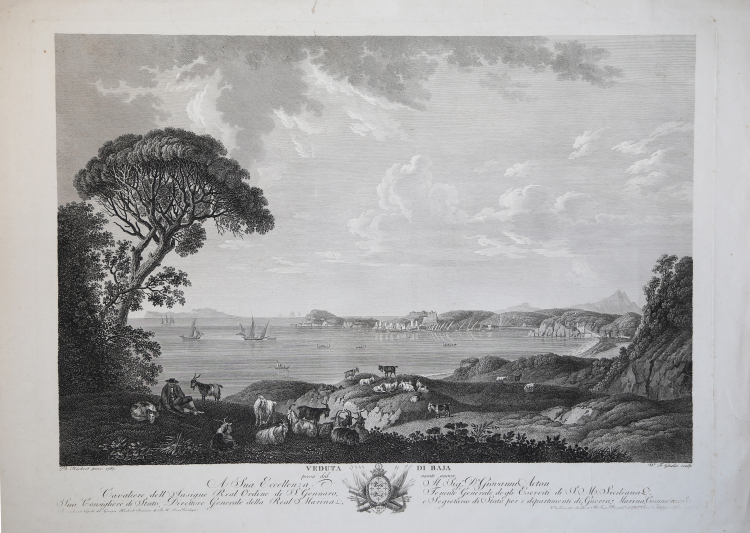
Panoramic view of the gulf with Pozzuoli and Capri, engraved by William Gmelin, from a painting by Jacob Philip Hackert, dated 1787.
The work is published by Hackert's brother, Georg Abraham.
Etching and engraver, with margins, in excellent condition.
19th century edition.
Wilhelm Friedrich GMELIN (Badenweiler 1760 - Roma 1820)
|
Wilhelm Friedrich Gmelin, an engraver of German origins, was born in Badenweiler in 1760 and specialized in the workshop of Christian von Mechel (Basel 1737-Berlin 1817), especially in the translation of views from some of the most illustrious landscape painters of the seventeenth century such as Nicolas Poussin, Claude Lorrain and Gaspard Dughet, as can be seen from contemporary criticism (Tozzi 1994, p. 253), where great space is left to nature, which becomes for the first time the absolute protagonist of the scene, while the small figures are relegated to occupy a smaller and certainly secondary space. In 1786 he moved to Rome and, shortly thereafter, thanks to his connections with Jacob Philipp Hackert, went to Naples to translate his views into engravings (Cavazzi Palladini 1976, pp. 45-46). He lived in Germany between 1798 and 1802, returning to Rome where, from 1814, he became an Accademia di San Luca, until his death in 1820. As Le Blanc points out, his production is characterized primarily by the creation of portraits, reliefs of monuments, and views of the Roman and Lazio countryside, and a large number of landscapes derived primarily from paintings by Claude Lorrain. In addition to his translated prints, with Arcadian and bucolic landscapes from Poussin and Lorrain, the engraver also created a series of imaginative views in which his innovative spirit is already clear, tending to distance himself from the tradition of eighteenth-century landscape painting to arrive at a language that preludes the drama of an already fully Romantic interpretation of nature.
|
Wilhelm Friedrich GMELIN (Badenweiler 1760 - Roma 1820)
|
Wilhelm Friedrich Gmelin, an engraver of German origins, was born in Badenweiler in 1760 and specialized in the workshop of Christian von Mechel (Basel 1737-Berlin 1817), especially in the translation of views from some of the most illustrious landscape painters of the seventeenth century such as Nicolas Poussin, Claude Lorrain and Gaspard Dughet, as can be seen from contemporary criticism (Tozzi 1994, p. 253), where great space is left to nature, which becomes for the first time the absolute protagonist of the scene, while the small figures are relegated to occupy a smaller and certainly secondary space. In 1786 he moved to Rome and, shortly thereafter, thanks to his connections with Jacob Philipp Hackert, went to Naples to translate his views into engravings (Cavazzi Palladini 1976, pp. 45-46). He lived in Germany between 1798 and 1802, returning to Rome where, from 1814, he became an Accademia di San Luca, until his death in 1820. As Le Blanc points out, his production is characterized primarily by the creation of portraits, reliefs of monuments, and views of the Roman and Lazio countryside, and a large number of landscapes derived primarily from paintings by Claude Lorrain. In addition to his translated prints, with Arcadian and bucolic landscapes from Poussin and Lorrain, the engraver also created a series of imaginative views in which his innovative spirit is already clear, tending to distance himself from the tradition of eighteenth-century landscape painting to arrive at a language that preludes the drama of an already fully Romantic interpretation of nature.
|