
- New
| Reference: | S32021 |
| Author | Gian Jacopo CARAGLIO |
| Year: | 1540 ca. |
| Measures: | 252 x 355 mm |
| Reference: | S32021 |
| Author | Gian Jacopo CARAGLIO |
| Year: | 1540 ca. |
| Measures: | 252 x 355 mm |
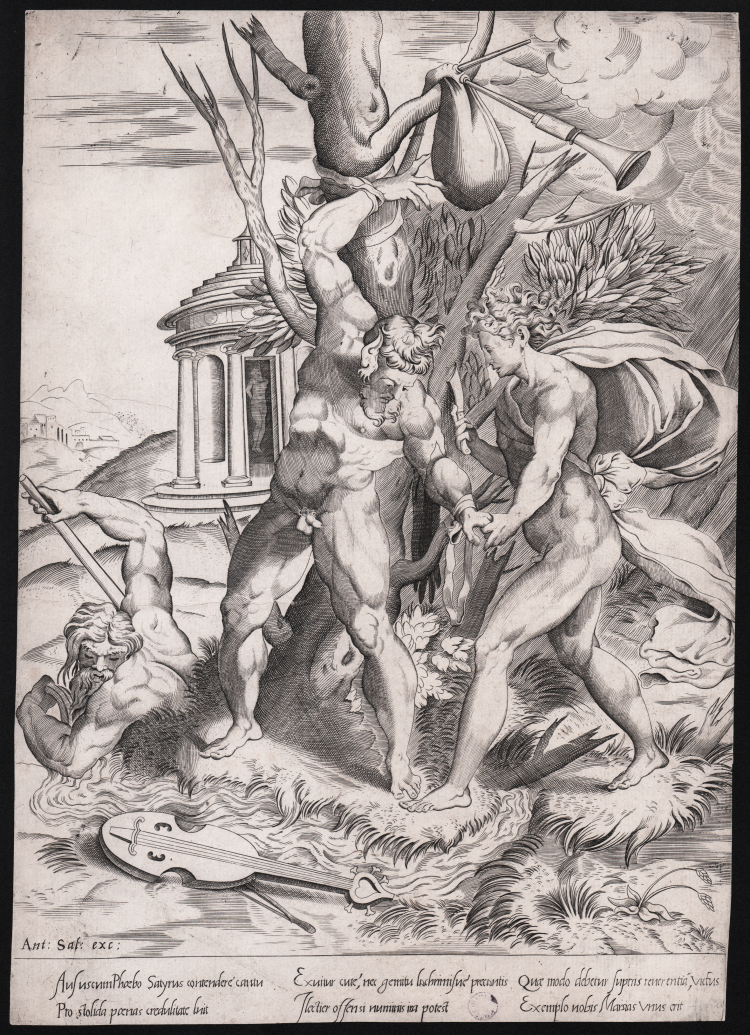
Engraving, circa 1540, with Antonio Salamanca's excudit at the bottom left.
Based on a subject by Francesco Salviati or Perino del Vaga.
In the lower margin, six Latin verses arranged in three columns: 'Ausus cum Phaebo Satyrus contendere' cantu Pro stolida paenas credulitate luit ...
Example of the second state of four, with the addressed of Antonio Salamanca; subsequent reprints bear the addresses of De Rossi and Pacifici.
Marsyas is tied, standing, to a tree while Apollo, armed with a knife, prepares to flay him. Contrary to traditional iconography of the subject, Marsyas is not positioned upside down. This was, in fact, the punishment for Marsyas's pride in daring to challenge Apollo, god of music and the arts, to a musical contest. In the background, Bramante's Tempietto with San Pietro in Montorio is visible, while at the bottom is the personification of a river flowing from the cave of Celaenae.
According to Diodorus Siculus, the Nysaeans were chosen as judges for the challenge. After carefully listening to the performances of Marsyas on the flute and Apollo on the lyre, they awarded victory to the former. However, the god, feeling defeated, played a second harmony accompanied by a melodious song, convincing the judges to reverse their verdict. Marsyas protested the unfairness of the contest, but Apollo objected that singing was no different from blowing into the flute, so neither of them should use their mouths to play, only their fingers. Thanks to this deception, Marsyas was defeated. In other versions of the myth, such as in Apollodorus' text, Apollo wins by turning the lyre upside down and inviting Marsyas to imitate him. However, while the god, with the instrument upside down, can continue playing, the upside-down flute produces no sound, causing the satyr to lose.
This is an extremely rare print, unknown to Bartsch, whose subject is attributed to Francesco Salviati, as previously argued by Nagler. In 1912, Hermann Voss attributed the invention to Francesco Salviati and the engraving, along with two other prints, to Girolamo Fagiuoli. He based this attribution on Vasari, who recounted that Salviati gave Fagiuoli several drawings for engraving. Suzanne Boorsch rejected both attributions and hypothesized that Perino del Vaga was the author of the drawing.
This engraving is the counterpart to the more common print attributed to Girolamo Fagiuoli. The work was first attributed to Giacomo Caraglio by Zanetti (Zanetti, b. 1453); reproduced in Alfredo Petrucci, Panorama della Incisione italiana: il Cinquecento (Petrucci, 44). Regardless of the question of attribution, the print is striking for its Mannerist pathos and the captivating visual appeal of the composition. Based on the fact that this plate was published by Salamanca, we can chronologically place this plate before that of Fagiuoli, printed by the rival Antonio Lafreri (cfr. Rubach n. 159).
A fine work, printed on contemporary laid paper with a "kneeling saint" watermark, similar to Briquet 7628, two horizontal paper folds, otherwise in excellent condition.
Collection’s mark of Plinio Nardecchia.
Bibliografia
Massari, Tra mito e allegoria, p. 317; Borea, Stampe da modelli fiorentini nel Cinquecento, p. 271; Nova 'Francesco Salviati e gli editori 1. Le incisioni', in “Francesco Salviati (1510-1563) o la Bella Maniera”, 1998, p.67; S. Boorsch, 'Salviati and Prints: the Question of Fagiuoli', in “Francesco Salviati et la bella maniera”, 2001; Luisa Mortari, Francesco Salviati, 1992, n.26, p. 300.
Gian Jacopo CARAGLIO (Verona 1505 - Cracovia 1565)
|
Giovanni Jacopo Caraglio or Caralio, Caral, Caralius, was a copper engraver, gem cutter, goldsmith and maybe even architect, according to Vasari. Caraglio was born approximately in 1505, in Verona or Parma, that is the reason why he often refers to himself as Veronensis or Parmensis. Because of the Sack of Rome he was obliged to leave unfinished his Ratto delle Sabine (The Rape of the Sabine Women), after a drawing of Rosso Fiorentino. He moved to Venice, were he worked until 1537.
While in Rome, he worked for Baviera, realizing in 1562 Dei dell’Olimpo, Fatiche di Ercole and Amori degli Dei, all after Rosso’s drawings, his favourite artist, together with Baldinelli and Parmigianino. While in Venice, on the contrary, he worked on subjects from Titian.
He moved to Poland in 1539 and started spreading the graphic art of Marcantonio in the Eastern Countries.
On July the 3rd, 1545, he joined the Court of Siegmund II, with an annual salary of 60 florins, till the death of the King in 1548; he afterwards worked for King Siegmund II Augustus as goldsmith and gem cutter. In 1552 he’s said to be working in Vilna, in Lithuania, the second capital city of the kingdom where the Court had temporarily moved. He went back and forth from Italy to Lithuania untill he died, on August the 26th, 1565.
Bartsch has listed 65 engravings belonging to Caraglio; Le Blanc has added other four subjects.
|
Gian Jacopo CARAGLIO (Verona 1505 - Cracovia 1565)
|
Giovanni Jacopo Caraglio or Caralio, Caral, Caralius, was a copper engraver, gem cutter, goldsmith and maybe even architect, according to Vasari. Caraglio was born approximately in 1505, in Verona or Parma, that is the reason why he often refers to himself as Veronensis or Parmensis. Because of the Sack of Rome he was obliged to leave unfinished his Ratto delle Sabine (The Rape of the Sabine Women), after a drawing of Rosso Fiorentino. He moved to Venice, were he worked until 1537.
While in Rome, he worked for Baviera, realizing in 1562 Dei dell’Olimpo, Fatiche di Ercole and Amori degli Dei, all after Rosso’s drawings, his favourite artist, together with Baldinelli and Parmigianino. While in Venice, on the contrary, he worked on subjects from Titian.
He moved to Poland in 1539 and started spreading the graphic art of Marcantonio in the Eastern Countries.
On July the 3rd, 1545, he joined the Court of Siegmund II, with an annual salary of 60 florins, till the death of the King in 1548; he afterwards worked for King Siegmund II Augustus as goldsmith and gem cutter. In 1552 he’s said to be working in Vilna, in Lithuania, the second capital city of the kingdom where the Court had temporarily moved. He went back and forth from Italy to Lithuania untill he died, on August the 26th, 1565.
Bartsch has listed 65 engravings belonging to Caraglio; Le Blanc has added other four subjects.
|