
- New
| Reference: | A53742 |
| Author | Ugo da CARPI |
| Year: | 1525 ca. |
| Measures: | 215 x 265 mm |
| Reference: | A53742 |
| Author | Ugo da CARPI |
| Year: | 1525 ca. |
| Measures: | 215 x 265 mm |
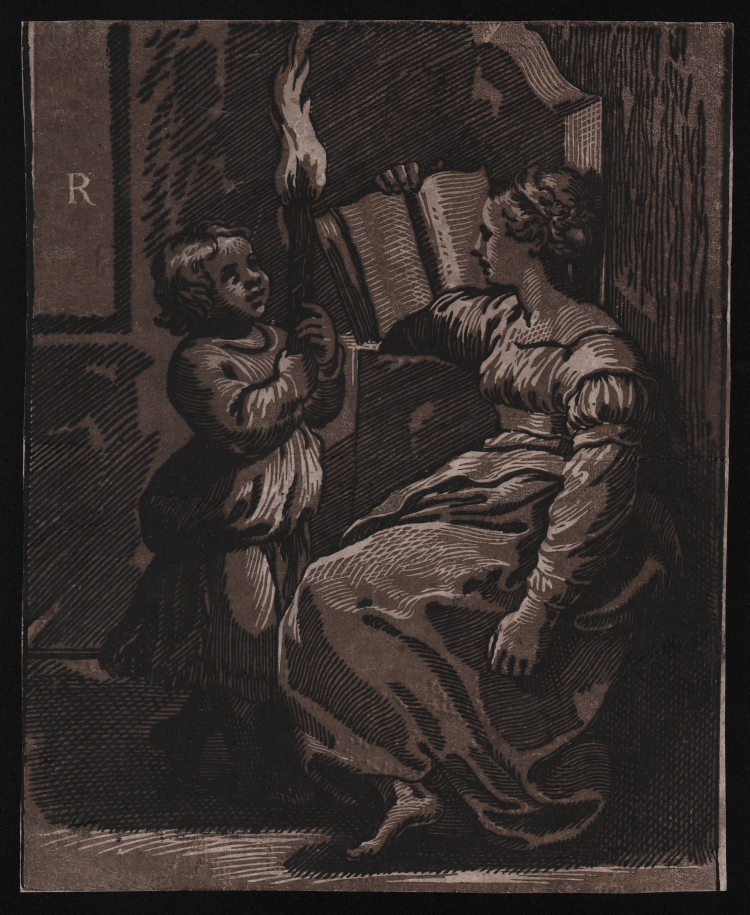
Chiaroscuro woodcut from two blocks, printed in brown and black ink, c. 1525.
Based on a lost drawing by Raphael (Raffaello Sanzio).
This version, featuring a “Sibyl turned toward the left” was attributed by Adam Bartsch to Ugo da Carpi; however, more recent scholarship disputes this, identifying the version in which the “Sibyl looks toward the right” as the authentic work by Ugo da Carpi.
Traditionally, The Sibyl Reading has been considered Ugo da Carpi’s first print after Raphael, representing one of the artist’s early experiments with the chiaroscuro woodcut technique. More recent studies, however, have called into question the attribution of both the woodcut itself and the underlying drawing. Following a hypothesis proposed by Konrad Oberhuber, Achim Gnann has tentatively attributed this work to Antonio da Trento, based on a drawing by Parmigianino.
The style of The Sibyl Reading differs significantly from that of other two-block woodcuts firmly attributed to Ugo and based on drawings by Raphael or his school. The extensive areas defined by long, parallel lines of uniform thickness, as well as the irregular patterns of cross-hatching, have no parallel in his other works. The absence of a signature is also puzzling, as Ugo’s woodblocks typically bear his name (though Hercules and the Nemean Lion serves as another exception in this regard). With the exception of Lucantonio degli Uberti - who produced a single chiaroscuro woodcut - Ugo is the only known artist to have practiced this technique before the arrival of Antonio da Trento at Parmigianino’s workshop in Bologna, which occurred after 1527. Furthermore, the early (albeit approximate) dating tends to rule out the involvement of Parmigianino, who arrived in Rome in 1524.
No preparatory drawing for The Sibyl Reading has survived. Vasari, the first to attribute the print to Ugo, states that it was based on "a drawing by Raphael executed in chiaroscuro". It is unknown whether the original drawing was a preliminary study or a finished work, nor whether it was created specifically for the print or as a preparation for another, unrealized project. It is also impossible to determine the technique used for the original drawing. Nevertheless, if we accept the attribution to Ugo, one might hypothesize that the technique - or the intentionally sketchy, summary nature of the preparatory drawing - did not easily translate into the woodcut medium, thereby contributing to the print’s unusual carving style.
There are three distinct chiaroscuro versions of The Sibyl Reading: two in reverse and one oriented in the same direction as the original; it is, therefore, the most frequently replicated subject for an Italian chiaroscuro woodcut.
Although Adam Bartsch identified this version - facing to the left - as Ugo’s original, the identity of the artist who created it remains unknown. Certain clues, including a watermark appearing on one impressions - a "jug surmounted by an elaborate crown" [Boston, Museum of Fine Arts] - suggest that it was printed in France. Although the watermark is not recorded by Briquet, it bears affinities to examples he described that are attributable to 16th-century French production (on this point, see Naoko Takahatake, 'The Chiaroscuro Woodcut in Renaissance Italy', p. 70).
However, it is my personal opinion - based on an analysis of this specific impression - which lacks a watermark but appears to be printed on the type of Italian paper characteristic of the period’s chiaroscuro woodcuts - and on the technical vigor of this “Sibyl turned toward the left” - which aligns much more closely with the style of other works by Ugo da Carpi - that Adam Bartsch was not mistaken. Furthermore, it cannot be ruled out that both works might be by the same artist - one of those famous "replicas" that were not uncommon at the time. Whether carved by Ugo da Carpi or Antonio da Trento, we believe that both versions are, in any case, of Italian origin.
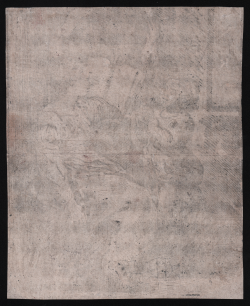
A magnificent impression, rich in tonal range, printed on contemporary laid paper without a watermark; irregularly trimmed to the borderline, with minor reconstructive restorations at the lower corners and along the middle of the left side, small repaired tears in the paper, and a horizontal printing crease across the center; overall in a good state of preservation.
Bibliografia
Naoko Takahatake, 'The chiaroscuro woodcut in Renaissance Italy', Los Angeles 2018, cat.4-6; Bartsch, Le Peintre graveur (XII.89.6); Johnson J., "I chiaroscuri di Ugo da Carpi", in Print Collector - Il conoscitore di stampe, Milano, 1982, pp. 23–24, n. 4; Gnann A., In Farbe! Clair-obscur-Holzschnitte der Renaissance - Meisterwerke aus der Sammlung Georg Baselitz und der Albertina in Wien, Monaco, 2013, p. 162, n. 72; Takahatake N., Atlante delle xilografie italiane del Rinascimento, ALU.0941.1
https://archivi.cini.it/storiaarte/detail/45487/stampa-45487.html
Ugo da CARPI (Carpi 1480 circa – Bologna 1532)
|
Vasari, the sixteenth-century biographer of Italian artists, claimed that Ugo (about 1450-1525) invented the chiaroscuro (light and shade) woodcut. His claim to the invention of this process has long been contested. Hans Burgkmair and Lucas Cranach were known to have made chiaroscuro prints in the north before 1510, whereas there is no definite evidence of Ugo’s work in this technique until 1516, when he appealed to the Venetian senate for protection from his imitators. Carpi was active in Venice and Rome. Many of his chiaroscuro prints are after drawings by Raphael and Parmigianino. None of his paintings survives.
|