
| Reference: | CO-867 |
| Author | Wilhelm Friedrich GMELIN |
| Year: | 1809 |
| Zone: | Ferentino |
| Printed: | Rome |
| Measures: | 355 x 280 mm |
| Reference: | CO-867 |
| Author | Wilhelm Friedrich GMELIN |
| Year: | 1809 |
| Zone: | Ferentino |
| Printed: | Rome |
| Measures: | 355 x 280 mm |
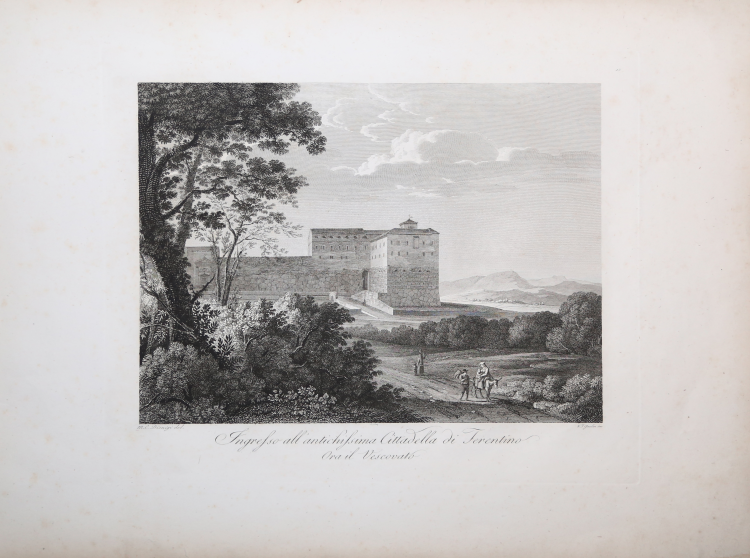
Veduta di Ferentino tratta dal celebre VIAGGI IN ALCUNE CITTÀ DEL LAZIO CHE DICONSI FONDATE DAL RE SATURNO di Marianna Dionigi, stampato a Roma nel 1809.
Edizione originale del diario di viaggio di Marianna Candidi Dionigi, «viaggiatrice in città perdute dal cui grembo ella non si stancava di sollecitare verità rinascenti»; La Dionigi nel 1807 o poco prima si era avventurata alla scoperta di quel territorio allora poco conosciuto che erano le cosiddette città di Saturno: Ferentino, Alatri, Arpino, Atina, Anagni. Ne era risultata quest'opera che unisce al racconto delle bellissime tavole, su disegni dell'Autrice, in cui sono raffigurati paesaggi, piante e vedute di città, i principali monumenti, rovine e tratti di mura, scenari allora poco conosciuti appunto e dei quali esistono ben poche testimonianze figurative. Le tavole con vedute di città e rappresentazioni paesaggistiche furono affidate a Wilhelm Friedrich Gmelin, il cui nome compare su 7 incisioni (6 nel nostro esemplare, scompleto della tavola con la Veduta di Alatri), mentre le raffigurazioni dei siti archeologici vennero incise da Vincenzo Feoli (22 tavole). Una sola tavola non reca né la firma dell'Autrice, né quella degli incisori. «La Dionigi obbediva [...] al dettame di Hackert sull'escursione dal primo piano, consacrato all'esattezza di ciascuno di un'infinità di dettagli, alla totalità indistinta dello sfondo [...]. Questo filo conduttore della propria produzione artistica fu perseguito da Marianna anche nei Viaggi, dove circa un quarto delle acqueforti (sette su ventinove) pur nell'attendibilità dell'insieme, trasmette l'incanto del paesaggio più che lo scrupolo [...]. Non a caso, il compito di delineare dai propri disegni originali questo gruppo di tavole fu affidato dall'autrice all'incisore di origine tedesca Wilhelm Friedrich Gmelin, forse il miglior specialista allora attivo a Roma».
Wilhelm Friedrich GMELIN (Badenweiler 1760 - Roma 1820)
|
Wilhelm Friedrich Gmelin, an engraver of German origins, was born in Badenweiler in 1760 and specialized in the workshop of Christian von Mechel (Basel 1737-Berlin 1817), especially in the translation of views from some of the most illustrious landscape painters of the seventeenth century such as Nicolas Poussin, Claude Lorrain and Gaspard Dughet, as can be seen from contemporary criticism (Tozzi 1994, p. 253), where great space is left to nature, which becomes for the first time the absolute protagonist of the scene, while the small figures are relegated to occupy a smaller and certainly secondary space. In 1786 he moved to Rome and, shortly thereafter, thanks to his connections with Jacob Philipp Hackert, went to Naples to translate his views into engravings (Cavazzi Palladini 1976, pp. 45-46). He lived in Germany between 1798 and 1802, returning to Rome where, from 1814, he became an Accademia di San Luca, until his death in 1820. As Le Blanc points out, his production is characterized primarily by the creation of portraits, reliefs of monuments, and views of the Roman and Lazio countryside, and a large number of landscapes derived primarily from paintings by Claude Lorrain. In addition to his translated prints, with Arcadian and bucolic landscapes from Poussin and Lorrain, the engraver also created a series of imaginative views in which his innovative spirit is already clear, tending to distance himself from the tradition of eighteenth-century landscape painting to arrive at a language that preludes the drama of an already fully Romantic interpretation of nature.
|
Wilhelm Friedrich GMELIN (Badenweiler 1760 - Roma 1820)
|
Wilhelm Friedrich Gmelin, an engraver of German origins, was born in Badenweiler in 1760 and specialized in the workshop of Christian von Mechel (Basel 1737-Berlin 1817), especially in the translation of views from some of the most illustrious landscape painters of the seventeenth century such as Nicolas Poussin, Claude Lorrain and Gaspard Dughet, as can be seen from contemporary criticism (Tozzi 1994, p. 253), where great space is left to nature, which becomes for the first time the absolute protagonist of the scene, while the small figures are relegated to occupy a smaller and certainly secondary space. In 1786 he moved to Rome and, shortly thereafter, thanks to his connections with Jacob Philipp Hackert, went to Naples to translate his views into engravings (Cavazzi Palladini 1976, pp. 45-46). He lived in Germany between 1798 and 1802, returning to Rome where, from 1814, he became an Accademia di San Luca, until his death in 1820. As Le Blanc points out, his production is characterized primarily by the creation of portraits, reliefs of monuments, and views of the Roman and Lazio countryside, and a large number of landscapes derived primarily from paintings by Claude Lorrain. In addition to his translated prints, with Arcadian and bucolic landscapes from Poussin and Lorrain, the engraver also created a series of imaginative views in which his innovative spirit is already clear, tending to distance himself from the tradition of eighteenth-century landscape painting to arrive at a language that preludes the drama of an already fully Romantic interpretation of nature.
|