
| Reference: | A54855 |
| Author | Antoine-Marie Chenavard |
| Year: | 1861 |
| Zone: | Minturno |
| Measures: | 260 x 155 mm |
| Reference: | A54855 |
| Author | Antoine-Marie Chenavard |
| Year: | 1861 |
| Zone: | Minturno |
| Measures: | 260 x 155 mm |
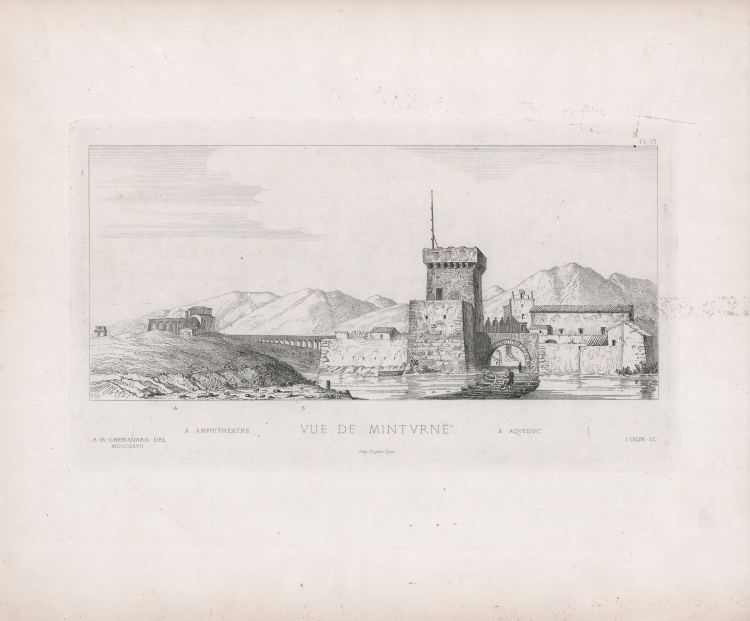
A view of the “Turris Gareliani” (or the Torre della Scafa of Traetto) and the crossing of the Garigliano River at Minturno. This tower, along with the Bastia complex, was demolished in 1828 to make way for the suspension bridge designed by Luigi Giura.
This view is taken from the rare Vues d'Italie, de Sicile et d'Istrie by Antoine-Marie Chenavard - an album published in Lyon in 1861 by the printing house of Louis Perrin. It features plates engraved by Dubouchet, Séon, and Thomassin, reproducing a selection of drawings created during the architect’s formative travels through Italy, Sicily, and Istria.
Between 1816 and 1818, Chenavard traveled through Italy alongside several other young architects of his generation, including Augustin-Nicolas Caristie, Jean-Aimé Moutier, François-Alexandre Duquesney, and Henri Van Cleemputte. Their sketchbooks were filled with drawings of Rome, Naples, Sicily, and Istria; the original sketches are now held in the library of the Institut national d’histoire de l’art.
More than forty years passed before Chenavard decided to have a selection of these studies engraved and published. In the intervening time, he had spent the greater part of his career in Lyon—first as an architect for the Rhône department, and later as a professor at the *École des beaux-arts*. By the time the album was published, the journey of 1816–1818 had become a distant episode from his youth.
Etching, in excellent condition.
Antoine-Marie Chenavard (Lione 1787 - 1883)
|
Antoine-Marie Chenavard was born in 1787 in Lyon; his father, Joseph, was a silk merchant and dyer. He began his studies at the École des Beaux-Arts in Lyon—where he was a student of, among others, Claude-Pierre Durand and Barthélemy Vignon—before being admitted to the École des Beaux-Arts in Paris in 1809. His friend, Pierre-Marie Prost, even sculpted a series of tombs based on his designs. Chenavard was a founding member of the Academic Society of Architecture of Lyon (Société académique d'architecture de Lyon). He served as architect for the Rhône department between 1819 and 1850 and taught at the École des Beaux-Arts Notre-Dame in Lyon from 1823 to 1861. He collaborated with the archaeologist François Artaud (1767–1838) to map the ancient city of Lugdunum, a project that served as the basis for a series of etchings by Lucien Butavand (1830–1831). Chenavard became a member of the Academy of Sciences, Belles-Lettres and Arts of Lyon in 1830, and an emeritus member in 1854. Between 1816 and 1844, he undertook several trips to Italy and Greece—documenting them in writing and bringing back numerous drawings—and in 1855, he was named a correspondent of the Institut (Académie des Beaux-Arts). Chenavard was selected as the architect for the Grand Théâtre-Opéra in Lyon from 1826 to 1832, and, alongside Louis Dupasquier, served as the diocesan architect for Belley until 1854. On August 14, 1862, he was appointed a Knight of the Legion of Honour.
|