
| Reference: | A53527 |
| Author | C. Pioline |
| Year: | 1865 |
| Zone: | Sulmona |
| Measures: | 230 x 170 mm |
| Reference: | A53527 |
| Author | C. Pioline |
| Year: | 1865 |
| Zone: | Sulmona |
| Measures: | 230 x 170 mm |
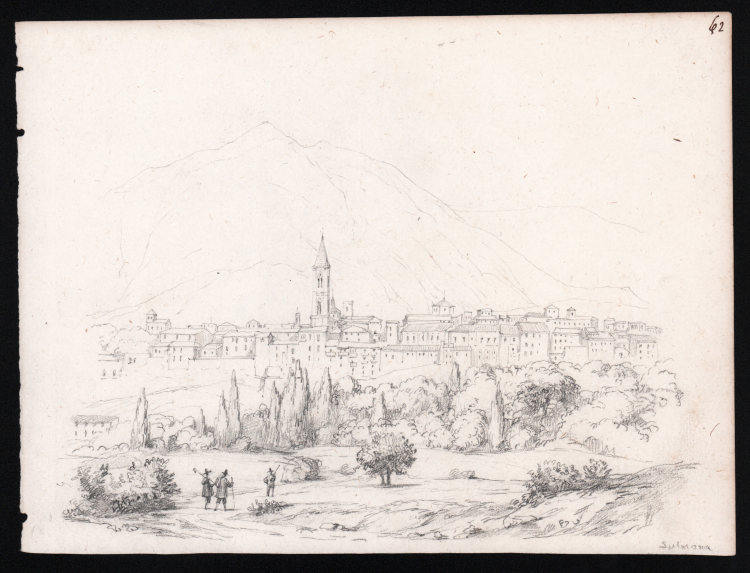
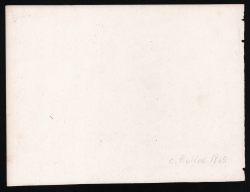
Finely executed pencil drawing on paper; the location is indicated at the bottom right, while the artist's signature and the date of execution are on the verso: "C. Pioline 1865".
The sheet, typical of the style of 19th-century Grand Tour travelers, belonged to a travel notebook: at the top right, in brown ink, is the sequential number "62".
It depicts a panoramic view of the city of Sulmona; in the background, the Maiella and Morrone mountains loom, surrounding the Peligna Valley. In the center of the city, the imposing bell tower of the Santissima Annunziata stands out, one of the town's most important architectural symbols. In the foreground, a tree-lined valley appears with human figures in classical/19th-century dress walking along a path.
Although signed, we have not been able to identify the artist, who is not listed in the main repertoires (Bénézit and Thieme-Becker). The surname Pioline is typically French, especially common in the Normandy and western France regions. Although not among the most celebrated academic painters of the period, "C. Pioline" belongs to the large group of cultured artists, travelers, or talented amateur draftsmen who visited Italy in the mid-19th century to immortalize its most picturesque landscapes.
The date 1865 is of great historical interest: Italy had been unified only four years earlier (1861), and Abruzzo was undergoing a period of profound transition. At the time, reaching Sulmona and the Peligna Valley required adventurous journeys on foot, horseback, or by carriage through the rugged Apennine passes, an experience that attracted many foreign artists seeking unspoiled scenery. Despite being a life drawing, the artist demonstrates excellent accuracy in reproducing the skyline of Sulmona. He made the transition between the dense city architecture and the surrounding nature perfectly recognizable, placing the visual focus precisely on the historic bell towers rising above the rooftops. Works of this type -animated views of central Italy signed and dated by artists on the Grand Tour or in the early post-unification period - possess considerable historical and documentary value, as they depict the urban layout before the major building transformations and restorations of the twentieth century.
In excellent condition.
C. Pioline (attivo intorno al 1860/70)
|
Unidentified artist, whose name is associated with a series of pencil and ink drawings of cities from the Grand Tour period.
|
C. Pioline (attivo intorno al 1860/70)
|
Unidentified artist, whose name is associated with a series of pencil and ink drawings of cities from the Grand Tour period.
|