
- New
| Reference: | s23465 |
| Author | Nicolas LESUEUR |
| Year: | 1740 ca. |
| Measures: | 215 x 365 mm |
| Reference: | s23465 |
| Author | Nicolas LESUEUR |
| Year: | 1740 ca. |
| Measures: | 215 x 365 mm |
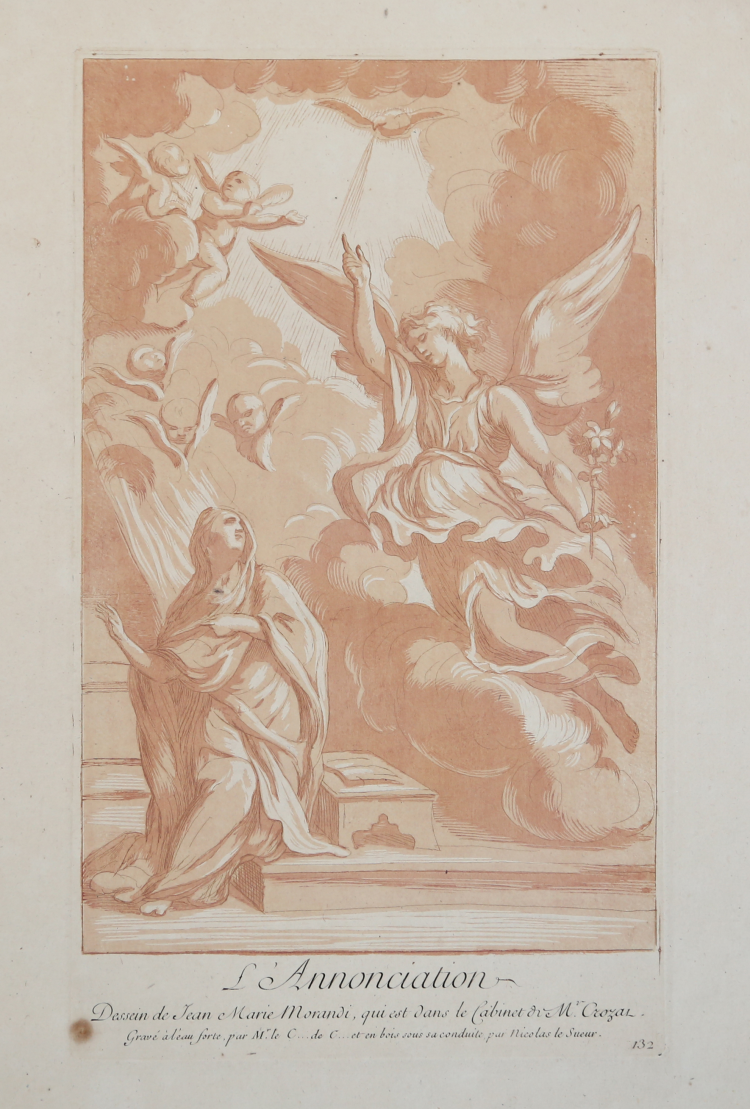
Chiaroscuro woodcut and etching, circa 1740; signed in the plate at the bottom center.
After a design by Giovanni Maria Morandi (Italian, Florence 1622–1717 Rome)
The work was created using a highly complex - and therefore unusual - technique that combines woodblocks with copper-plate etching. The chiaroscuro woodcut is the work of Nicolas Le Sueur (Paris, 1690–1764), while the etching was executed by Anne-Claude-Philippe de Tubières, known as the Comte de Caylus (1692–1765).
The print belongs to the series Recueil d'estampes d'après les plus beaux tableaux et d'après les plus beaux desseins qui sont en France. Also known as the "Recueil Crozat" the series consists of two volumes of plates commissioned by the French collector Pierre Crozat, reproducing famous paintings and drawings of his time. The first volume, containing 140 plates, was published in 1729; the second—comprising 42 plates (rather than the originally planned 110)—was published in 1740. After Crozat's death, the printing plates were sold to booksellers who commissioned Pierre Mariette to reorganize the collection. Mariette organized the plates into two volumes, adding some missing descriptions and publishing the work in 1742.
Nicolas Lesueur (also known as Le Sueur) was one of the most celebrated French draftsmen and printmakers of the 18th century, universally recognized as the most prominent member of a historic Parisian dynasty of woodcutters. He holds a pivotal place in history for reviving the complex technique of chiaroscuro woodcut, innovatively combining it with copper etching. Lesueur formed a close artistic partnership with the archaeologist and printmaker the Comte de Caylus (1692–1765). Caylus etched the outline details onto copper plates, while Lesueur masterfully created the woodblocks used to print the tonal color variations. Together, they produced approximately 30 extraordinary prints based on drawings by Italian masters such as Raphael, Giulio Romano, Polidoro da Caravaggio, and Parmigianino. Caylus was a prominent figure in France and Europe between 1714 and 1765. His passion for the arts and letters led him to abandon a military career and devote himself to travel in order to further his search for antiquities. The relationship between Caylus and the painter Watteau was highly significant; the Count undertook his apprenticeship as an engraver in Watteau's studio. Caylus's role as a patron in 18th-century Paris is evidenced by his election as an honorary member of the *Académie Royale de Peinture et de Sculpture* and, subsequently, the *Académie des Inscriptions et Belles-Lettres*, where he championed the establishment of a literary prize dedicated to the study of ancient peoples.
A good impression, printed on contemporary laid paper, in excellent condition.
Bibliografia
Nagler, n. 6: Le Blanc, Manuel de l'Amateur d'Estampes, n. 5.
Nicolas LESUEUR (Parigi 1691 - 1764)
|
Born in Paris in 1691, Nicolas grew up immersed in the art of woodcarving. He came from a family of artists: his father was the engraver Pierre Lesueur (1663–1698) and his uncle was Vincent Lesueur; both were renowned wood craftsmen. Under his family's guidance, he learned the secrets of traditional woodcut printing, yet he soon developed a refined, distinctive graphic style, habitually signing his works with the monogram "NLS." His son, Blaise Nicolas Lesueur (1714–1783), continued the family's artistic legacy, becoming an esteemed painter and director of the Berlin Academy of Art. Lesueur’s most significant historical contribution was the refinement of *chiaroscuro* detail. This technique mimicked the effects of the ink-wash and watercolor drawings characteristic of the great Renaissance and Baroque masters. The pinnacle of Lesueur’s career came when the wealthy banker and collector Pierre Crozat (1665–1740) selected him to participate in one of the 18th century's most magnificent publishing endeavors: the *Cabinet Crozat* (also known as the *Recueil Crozat*, published between 1729 and 1742). The project aimed to reproduce the finest paintings and drawings found in French collections. In this context, Lesueur forged a close artistic partnership with the archaeologist and engraver the Count of Caylus (1692–1765). Caylus was responsible for etching the outlines onto copper plates, while Lesueur masterfully crafted the woodblocks used to print the tonal shading. Together, they produced about 30 extraordinary plates based on drawings by Italian masters such as Raphael, Giulio Romano, Polidoro da Caravaggio, and Parmigianino.
|