
- New
| Reference: | A54007 |
| Author | Cornelis SCHUT I |
| Year: | 1630 ca. |
| Measures: | 120 x 135 mm |
| Reference: | A54007 |
| Author | Cornelis SCHUT I |
| Year: | 1630 ca. |
| Measures: | 120 x 135 mm |
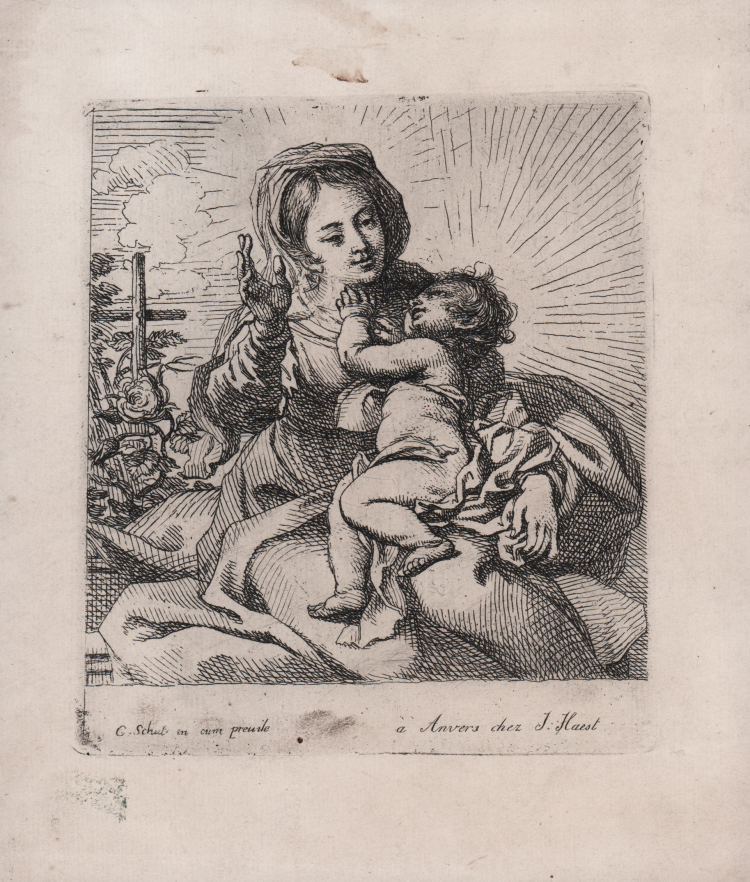
Virgin with Child; sitting half-length, turned slightly to right, the Cross with roses in left background.
Etching, 1630 circa, inscription in lower margin left: "C. Schut in cum preuile".
Example of the third state, bearing the address of Jan Haest (active in Antwerp in the mid-17th century).
Cornelis Schut (Antwerp, 1597 – 1655), was a Flemish painter, draughtsman, engraver and tapestry designer who specialized in religious and mythological scenes. Presumed to have trained under Rubens, he treated Counter-Reformation subjects in a High-Baroque style. After a stay in Italy, he worked mainly in Antwerp where he was one of the leading history painters in the first half of the 17th century.
A very good impression, on contemporary laid paper, with margins, good condition.
Bibliografia
Hollstein, Dutch and Flemish etchings, engravings and woodcuts c.1450-1700 (37.III); Nagler 1858-79 / Die Monogrammisten (19).
Cornelis SCHUT I (Anversa 1597 - 1655)
|
Flemish painter, draughtsman and etcher, active in Italy. In 1618/19 he became a member of the Guild of St Luke in Antwerp.
From 1624 to 1627 he was in Rome, where he was a founder-member of the Schildersbent (the group of Netherlandish artists active in Rome at that time). Schut worked there under the patronage of the Flemish merchant Pieter de Vischere, whose country house at Frascati Schut decorated with mythological scenes.
During these years Schut also painted small-scale works depicting allegorical and mythological themes, perhaps intended for the open market. In 1628 he was in Florence, where he designed tapestries for the Arazzeria Medicea. Schut adopted, and retained throughout his career, the new High Baroque style of painting, developed in Italy after 1625 under the influence of such artists as Pietro da Cortona.
Features of this style include a strong sense of animation and pathos, in which light and colour play a major role. Elements of late Mannerism are also evident, and Schut's style, which is characterized by fierce foreshortening, sharp light contrasts and extreme facial expressions, bears some affinity with the work of Federico Barocci, which was important in the evolution of Baroque painting.
|
Cornelis SCHUT I (Anversa 1597 - 1655)
|
Flemish painter, draughtsman and etcher, active in Italy. In 1618/19 he became a member of the Guild of St Luke in Antwerp.
From 1624 to 1627 he was in Rome, where he was a founder-member of the Schildersbent (the group of Netherlandish artists active in Rome at that time). Schut worked there under the patronage of the Flemish merchant Pieter de Vischere, whose country house at Frascati Schut decorated with mythological scenes.
During these years Schut also painted small-scale works depicting allegorical and mythological themes, perhaps intended for the open market. In 1628 he was in Florence, where he designed tapestries for the Arazzeria Medicea. Schut adopted, and retained throughout his career, the new High Baroque style of painting, developed in Italy after 1625 under the influence of such artists as Pietro da Cortona.
Features of this style include a strong sense of animation and pathos, in which light and colour play a major role. Elements of late Mannerism are also evident, and Schut's style, which is characterized by fierce foreshortening, sharp light contrasts and extreme facial expressions, bears some affinity with the work of Federico Barocci, which was important in the evolution of Baroque painting.
|