
- New
| Reference: | S21792 |
| Author | Robert Van AUDENAURDE |
| Year: | 1685 ca. |
| Measures: | 135 x 190 mm |
| Reference: | S21792 |
| Author | Robert Van AUDENAURDE |
| Year: | 1685 ca. |
| Measures: | 135 x 190 mm |
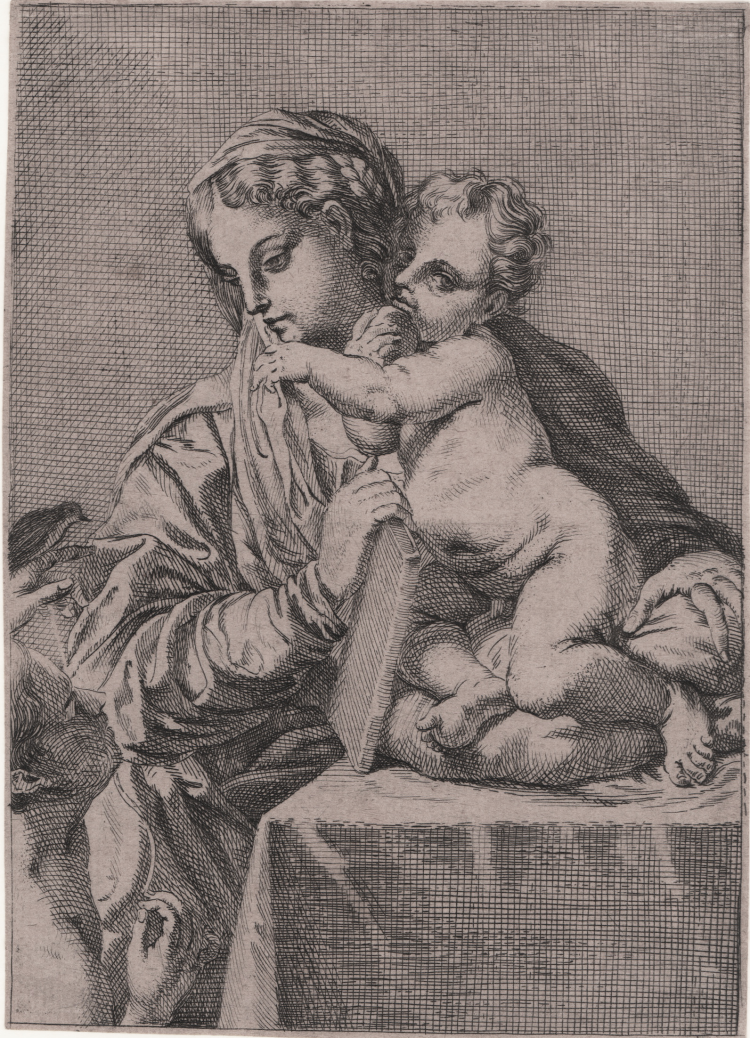
Etching and engraving, circa 1685/87, signed on the plate at the bottom (in the white margin not present in this copy): A. Carracci Invenit RAV Colignon formis
Based on an invention by Annibale Carracci, translated into print by the engravers Robert van Audenaerd and published in Rome by Francois Collignon. Based on the biographies of the engraver and the publisher, the plate is dated between 1685 and 1687.
It depicts the Virgin Mary with the Child Jesus; the infant rests on a table covered with a finely drawn drape, while in the lower left corner emerges the figure of a praying devotee in profile. The work is traditionally called "Madonna della Rondinella" (Madonna of the Swallow) due to the presence of the small bird visible in the background on the right, a theological symbol of the Resurrection. The composition fully reflects the classicism and formal grace typical of the Bolognese Carracci school.
Robert van Audenaerde or Ouden-Aerd (1663–1748) was a Flemish painter and printmaker. Born in Ghent, he was initially a pupil of Francis van Mierhop, but later studied with Hans van Cleef. At the age of twenty-two, he went to Rome, where he became a disciple of Carlo Maratti. Under this master's guidance, he distinguished himself as a skilled painter of historical subjects. In his spare time, he dabbled in precision painting, and some of his engravings were shown to Carlo Maratti, who advised him to devote himself entirely to the art of engraving. However, he also painted several paintings for the churches of his hometown, to which he returned after an absence said to have lasted thirty-seven years. He died in Ghent in 1748. His finest work is the high altarpiece of the Carthusians' church in Ghent, depicting "Saint Peter Appearing to a Group of Monks of that Order." In the church of San Giacomo, there is a painting by him depicting "Saint Catherine Refusing to Worship False Gods." Several other works by this master are found in the churches and convents of his hometown, all painted in the Maratti style.
Etching, printed on contemporary laid paper, trimmed to the platemark and missing the lower white part, traces of glue on the verso, otherwise in good condition. Rare.
Bibliografia
Borea E./ Mariani G., Annibale Carracci e i suoi incisori, p. 27 n. XII.
Robert Van AUDENAURDE (Gand 1663-1743)
|
Robert van Audenaerde or Ouden-Aerd (1663–1748) was a Flemish painter and engraver.
He was born at Ghent, and was first a scholar of Francis van Mierhop, but he afterwards studied under Hans van Cleef. When he was twenty-two years of age he went to Rome, where he became a disciple of Carlo Maratti. Under this master he became a good painter of historical subjects. He amused himself with the point in his leisure moments, and some of his plates were shown to Carlo Maratti, who recommended him to devote himself entirely to the art of engraving. He, however, painted several pictures for the churches of his native city, to which he returned after an absence, it is said, of thirty-seven years. He died at Ghent in 1748. His best work is the altar-piece of the high altar in the church of the Carthusians at Ghent, representing 'St. Peter appearing to a group of Monks of that order'. In the church of St. James is a picture by him of 'St. Catharine refusing to worship the False Gods'. Several other works by this master are in the churches and convents of his native city, all of which are painted in the style of Maratti.
|
Robert Van AUDENAURDE (Gand 1663-1743)
|
Robert van Audenaerde or Ouden-Aerd (1663–1748) was a Flemish painter and engraver.
He was born at Ghent, and was first a scholar of Francis van Mierhop, but he afterwards studied under Hans van Cleef. When he was twenty-two years of age he went to Rome, where he became a disciple of Carlo Maratti. Under this master he became a good painter of historical subjects. He amused himself with the point in his leisure moments, and some of his plates were shown to Carlo Maratti, who recommended him to devote himself entirely to the art of engraving. He, however, painted several pictures for the churches of his native city, to which he returned after an absence, it is said, of thirty-seven years. He died at Ghent in 1748. His best work is the altar-piece of the high altar in the church of the Carthusians at Ghent, representing 'St. Peter appearing to a group of Monks of that order'. In the church of St. James is a picture by him of 'St. Catharine refusing to worship the False Gods'. Several other works by this master are in the churches and convents of his native city, all of which are painted in the style of Maratti.
|