
| Reference: | S37957 |
| Author | Matthaeus GREUTER |
| Year: | 1625 ca. |
| Measures: | 351 x 217 mm |
| Reference: | S37957 |
| Author | Matthaeus GREUTER |
| Year: | 1625 ca. |
| Measures: | 351 x 217 mm |
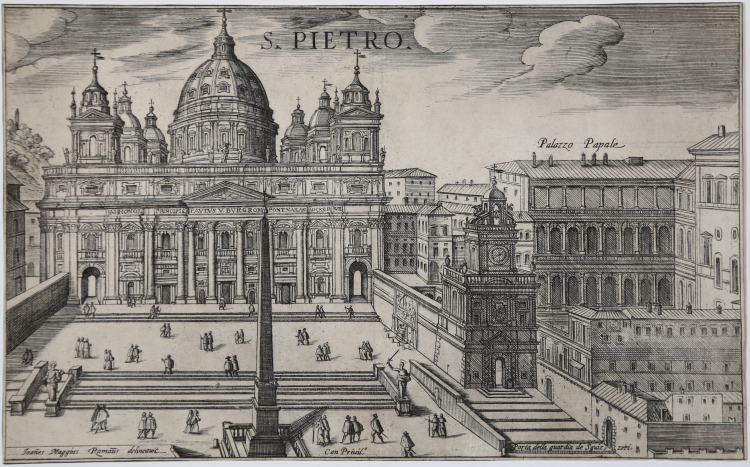
Engraving, circa 1625, at lower left: Joan[n]es Maggius Roma[n]us delineavit, followed by Con privil.[egi]o.
Magnificent and rare view of St. Peter's, belonging to a series depicting the Jubilee Churches of Rome, engraved by Mattheus Greuter based on a drawing by Giovanni Maggi and published by Paolo Maupin.
“Giovanni Maggi was responsible for the drawings of the churches and the set was printed and perhaps also engraved by Matthäus Greuter, but it seems to have been published by Paolo Maupin (fl. 1591-1635). Maupin is a slightly mysterious figure who somehow acquired drawings prepared by Maggi for a great woodcut map of Rome, which he published on 48 sheets in 1625. […] Maupin dedicated the prints to Christine de Lorraine, Grand Duchess of Tuscany (1565-1637). This dedication and Greuter's excudit appear on the sheet showing St John Lateran and this print was probably regarded as the first in the series. Greuter and Maupin were possibly partners in the venture - Greuter's privilege to issue the prints is also recorded on the print with Maupin's dedication. Jörg Diefenbacher catalogues the prints as if they were engraved by Greuter, but because he is nowhere recorded in this specific capacity they are here merely attributed to him” (cf. The Print Collection of Cassiano dal Pozzo, part II, vol. I, p. 190).
Good example, printed on contemporary laid paper, trimmed at margins, in very good condition.
Bibliografia
The New Hollstein, The Greuter Family, II, pp. 89-102, n. 250; Mark McDonald, The Print Collection of Cassiano dal Pozzo, part II, vol. I, pp. 190-219, n. 2014.
Matthaeus GREUTER (Strasburgo 1564 - Roma 1638)
|
Matthaus or Mathias or Matheus Greuter was a draftsman, engraver, and publisher. Son of the goldsmith Konrad of Kempten, he was born around 1565-66, probably in Strasbourg. He died in Rome in 1564, where he was buried in the church of St. Eustachius in 1638. In 1588, Greuter was also recorded as a goldsmith, although he had already been producing dated prints for at least two years, thus starting the activity to which he would dedicate the rest of his life. A Lutheran, he converted to Catholicism around 1593 and, perhaps because of this choice, he abandoned Strasbourg, moving to Lyon (around 1595-99), at that time the second most important center in France for engraving and book production, and then to Avignon (1600-03). In mid-1603, Greuter arrived in Rome with three children from his first marriage, including Johann Friedrich and Susanna (c. 1591–1629), and lived there until his death. He remarried, to Innocenza Grandoni, with whom he had a son, Carlo Felice, born in 1606 and baptized in the parish of San Marcello. Greuter is certainly recorded as having resided in this parish from 1630 to 1636 with the family of his son Johann Friedrich and several collaborators: D. Widmann, an assistant engraver, and J. Widmer, a printer's apprentice. The Flemish printer Geert van Schayck, Italianized as Gotifredo Scaicchi, Greuter's son-in-law, worked in Greuter's workshop - first indicated along the Corso near S. Marcello (for example in 1608 and 1612) and then, according to the 1618 Map of Rome published by Greuter under the sign of the Black Eagle, near S. Tommaso in Parione - even though we cannot know whether he worked there or in another building, some copper plates from this workshop certainly became the property of Greuter and F. De Rossi in 1648, later merging into the Calcografia camerale. In the later years of his life, the Stati delle anime (1633-34) mention G.'s house, near the border with the parish of S. Maria in Aquiro, as that of "the printer". Greuter's professional success in Rome was immediate, as evidenced by the considerable number of dated works from his earliest years and the repeated granting of ten-year privileges (1604, 1621), which were intended to guarantee the artist exclusivity over his creations, which were often copied. The extensive catalogue of his works, which is nevertheless subject to some additions, has been reconstructed by R. Zijlma, and includes hundreds of prints, both on loose sheets and in books. This demonstrates the artist's versatility, having trained himself on the examples of late Northern Mannerism and then increasingly drawn to Roman Baroque culture. He experimented in many fields, from independent figurative invention to engraving, from other artists' prototypes to geographical and architectural images, always with appreciable results. The main problem in establishing an accurate catalogue is the existence of numerous engravings signed "M.G.F." (or "M.G.f."), some of which were engraved in Rome in the 1580s. These cannot be attributed to Greuter, as they had not yet arrived in Italy at that time, and should therefore be removed from his catalogue, also due to the stylistic differences with his production prior to his Roman years.
Greuter's first dated engravings in Rome date to 1604. During this period, he produced prints based on drawings by others, often very complex, as well as his own. His early relationships with the Oratorians were significant, for whom he produced various reproductions of Philip Neri. Among the numerous documentary and devotional images, those relating to the ceremonies for the marriage of Cosimo de' Medici to Magdalene of Austria (1608: five engravings) and the canonization apparatus of Charles Borromeo (1610) and Ignatius of Loyola (1622) are noteworthy. One of the areas in which Greuter seemed to achieve the greatest success was topographical and architectural engravings. In 1618, he published the large and complex map of Rome he drew and engraved, based on careful measurements and real-life assessments (it was republished in 1626 and 1638).
|
Matthaeus GREUTER (Strasburgo 1564 - Roma 1638)
|
Matthaus or Mathias or Matheus Greuter was a draftsman, engraver, and publisher. Son of the goldsmith Konrad of Kempten, he was born around 1565-66, probably in Strasbourg. He died in Rome in 1564, where he was buried in the church of St. Eustachius in 1638. In 1588, Greuter was also recorded as a goldsmith, although he had already been producing dated prints for at least two years, thus starting the activity to which he would dedicate the rest of his life. A Lutheran, he converted to Catholicism around 1593 and, perhaps because of this choice, he abandoned Strasbourg, moving to Lyon (around 1595-99), at that time the second most important center in France for engraving and book production, and then to Avignon (1600-03). In mid-1603, Greuter arrived in Rome with three children from his first marriage, including Johann Friedrich and Susanna (c. 1591–1629), and lived there until his death. He remarried, to Innocenza Grandoni, with whom he had a son, Carlo Felice, born in 1606 and baptized in the parish of San Marcello. Greuter is certainly recorded as having resided in this parish from 1630 to 1636 with the family of his son Johann Friedrich and several collaborators: D. Widmann, an assistant engraver, and J. Widmer, a printer's apprentice. The Flemish printer Geert van Schayck, Italianized as Gotifredo Scaicchi, Greuter's son-in-law, worked in Greuter's workshop - first indicated along the Corso near S. Marcello (for example in 1608 and 1612) and then, according to the 1618 Map of Rome published by Greuter under the sign of the Black Eagle, near S. Tommaso in Parione - even though we cannot know whether he worked there or in another building, some copper plates from this workshop certainly became the property of Greuter and F. De Rossi in 1648, later merging into the Calcografia camerale. In the later years of his life, the Stati delle anime (1633-34) mention G.'s house, near the border with the parish of S. Maria in Aquiro, as that of "the printer". Greuter's professional success in Rome was immediate, as evidenced by the considerable number of dated works from his earliest years and the repeated granting of ten-year privileges (1604, 1621), which were intended to guarantee the artist exclusivity over his creations, which were often copied. The extensive catalogue of his works, which is nevertheless subject to some additions, has been reconstructed by R. Zijlma, and includes hundreds of prints, both on loose sheets and in books. This demonstrates the artist's versatility, having trained himself on the examples of late Northern Mannerism and then increasingly drawn to Roman Baroque culture. He experimented in many fields, from independent figurative invention to engraving, from other artists' prototypes to geographical and architectural images, always with appreciable results. The main problem in establishing an accurate catalogue is the existence of numerous engravings signed "M.G.F." (or "M.G.f."), some of which were engraved in Rome in the 1580s. These cannot be attributed to Greuter, as they had not yet arrived in Italy at that time, and should therefore be removed from his catalogue, also due to the stylistic differences with his production prior to his Roman years.
Greuter's first dated engravings in Rome date to 1604. During this period, he produced prints based on drawings by others, often very complex, as well as his own. His early relationships with the Oratorians were significant, for whom he produced various reproductions of Philip Neri. Among the numerous documentary and devotional images, those relating to the ceremonies for the marriage of Cosimo de' Medici to Magdalene of Austria (1608: five engravings) and the canonization apparatus of Charles Borromeo (1610) and Ignatius of Loyola (1622) are noteworthy. One of the areas in which Greuter seemed to achieve the greatest success was topographical and architectural engravings. In 1618, he published the large and complex map of Rome he drew and engraved, based on careful measurements and real-life assessments (it was republished in 1626 and 1638).
|