
- New
| Reference: | S35273 |
| Author | Hendrick HONDIUS |
| Year: | 1614 ca. |
| Measures: | 265 x 210 mm |
| Reference: | S35273 |
| Author | Hendrick HONDIUS |
| Year: | 1614 ca. |
| Measures: | 265 x 210 mm |
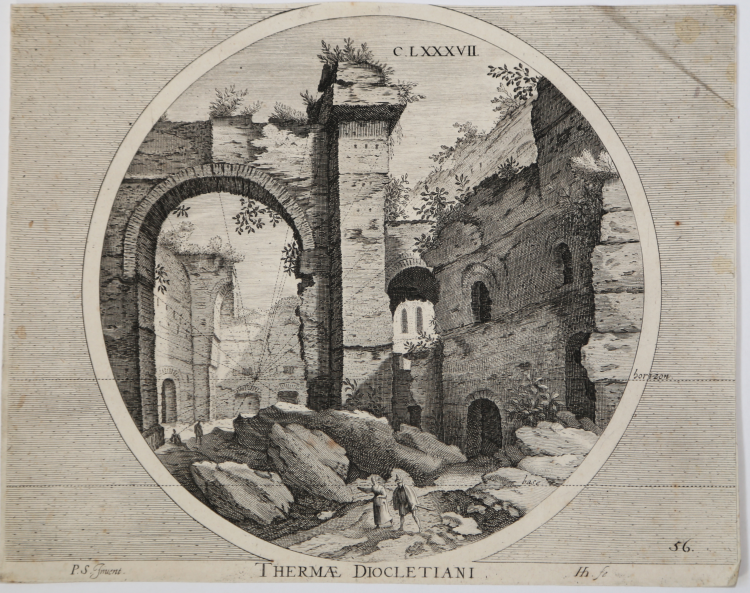
Engraving, 1614 circa, lettered below: 'P. S. Jnuent. THERMAE DIOCLETIANI Hh fe'. Numbered below on the right:'56', and at the top CLXXXVII.
View of the ruins of the baths of Diocletian, with two figures in the foreground, used in Samuel Marolois in 'Perspective contenant la theorie, practique et instruction fondamentale d'icelle' in 1614 and for the following editions.
It is plausible that the print belongs to a series of engravings of roman ruins realized in the last decade of the 16th century, suggesting that the artist may have visited Italy at an early stage in his career. This can be seen also in the signature: in the present engraving he signed as “Petrus Stephanus Invent” whereas in later landscape engravings “P. Stephani Invent”.
Pieter Stevens (1567-after 1624) was a Flemish painter and draftsman, specialized in landscape paintings, and can be appointed as one of the first developer of landscape as a genre, often presenting human figures, characterized by atmospheric effects. Some of his designs were reproduced in “pietra dura” as decoration for furniture, and also in print series. In 1594, he became court painter of Emperor Rudolf II in Prague, alongside other artistic figures such as Roelandt Savery, Paulus van Vianen, Hans Verdeman de Vries, and Philippus van den Bossche. When Rudolf II died in 1612, it is possible that Stevens entered the court of Prince Charles of Liechtenstein, Stadtholder of Bohemia.
Hendrik Hondius (circa 1573 - 1650) was a Flemish engraver, cartographer and publisher who founded his own business in The Hague, the Nederlands, in 1597. During the 1630s he shifted his focus primarily to publishing rather than engravings and printings. His published works encompassed maps, portraits, and books on diverse topics. Hondius often reused original plates and blocks by earlier artists for reprinting, which constituted a significant portion of his publishing endeavors. However, by the 1640s, he returned to the art of printing, exclusively concentrating on etching.
A fine impression, printed on contemporary laid paper, trimmed close to platemark, in very good condition.
Bibliographic reference
F. W. H Hollstein, Orenstein, Nadine, Luijten, Ger. Hendrick Hondius. New Hollstein Dutch & Flemish Etchings, Engravings and Woodcuts, 1450-1700. Roosendaal, Netherlands: Koninklijke van Poll in co-operation with the Rijksprentenkabinet, Rijksmuseum, 1994. - Orenstein, Nadine. Hendrick Hondius and the Business of Prints in Seventeenth-Century Holland. Studies in Prints and Printmaking, V. 1. Rotterdam: Sound & Vision Interactive, 1996.
|
New Hollstein Dutch 49; Hollstein Dutch 54.
|
Hendrick HONDIUS (Amsterdam 1597 - 1651)
|
Son of Jodocus Hondius (1563-1612) - engraver, cartographer, printer and publisher - in 1627 he began working in the family publishing business, managed, after the death of his father, by his mother and the printer Johannes Janssonius, who in 1612 had married Hendrick's (lat. Henricus) sister, Elisabeth. The Hondius typography was one of the most important of the time, even thanks to the collection of Mercator’s plates and the pubbication of many charts and atlases. In 1604, Hondius bought the copperplates of Mercator’s Atlas at the auction of Gerard Jr.’s effects. He added another forty maps, including new maps of the Continents and important regional maps of the Americas, before publishing a new edition of the Atlas, in 1606, in competition with Ortelius’ Theatrum. As many of the maps were more up-to-date, the Mercator-Hondius Atlas effectively superseded Ortelius’ Theatrum. On his death in 1612 his widow, Coletta van den Keere continued the business; from 1619 onwards their son Henry (II) (1597-1651) took over. From 1633 publication was carried on in co-operation with Jan Jansson Jr., Henry’s brother-in-law.
|
|
New Hollstein Dutch 49; Hollstein Dutch 54.
|
Hendrick HONDIUS (Amsterdam 1597 - 1651)
|
Son of Jodocus Hondius (1563-1612) - engraver, cartographer, printer and publisher - in 1627 he began working in the family publishing business, managed, after the death of his father, by his mother and the printer Johannes Janssonius, who in 1612 had married Hendrick's (lat. Henricus) sister, Elisabeth. The Hondius typography was one of the most important of the time, even thanks to the collection of Mercator’s plates and the pubbication of many charts and atlases. In 1604, Hondius bought the copperplates of Mercator’s Atlas at the auction of Gerard Jr.’s effects. He added another forty maps, including new maps of the Continents and important regional maps of the Americas, before publishing a new edition of the Atlas, in 1606, in competition with Ortelius’ Theatrum. As many of the maps were more up-to-date, the Mercator-Hondius Atlas effectively superseded Ortelius’ Theatrum. On his death in 1612 his widow, Coletta van den Keere continued the business; from 1619 onwards their son Henry (II) (1597-1651) took over. From 1633 publication was carried on in co-operation with Jan Jansson Jr., Henry’s brother-in-law.
|