
- New
| Reference: | A53600 |
| Author | Hubert GOLTZIUS |
| Year: | 1557 |
| Measures: | 180 x 180 mm |
| Reference: | A53600 |
| Author | Hubert GOLTZIUS |
| Year: | 1557 |
| Measures: | 180 x 180 mm |
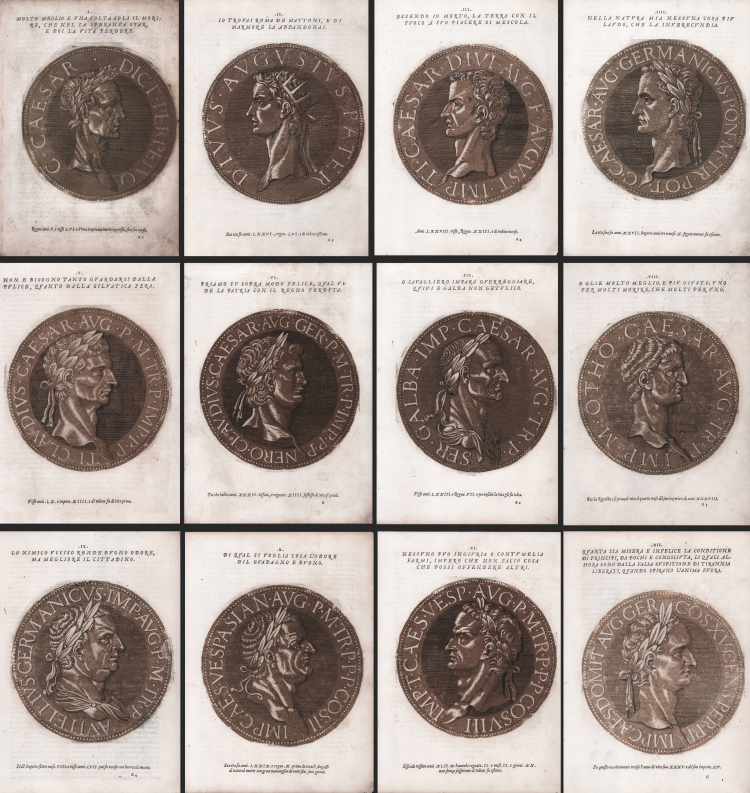
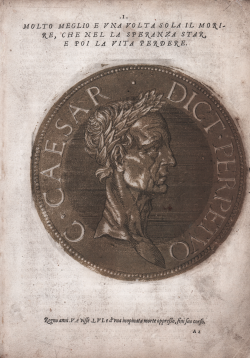
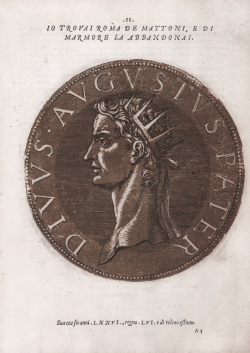
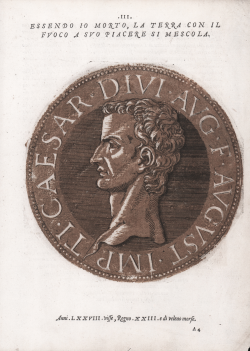
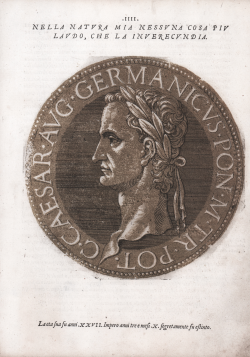
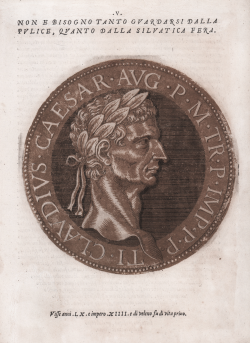
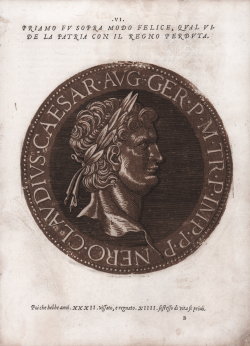
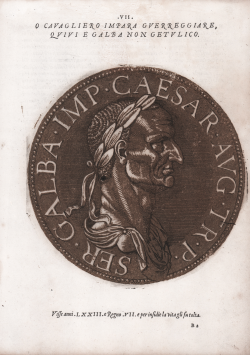
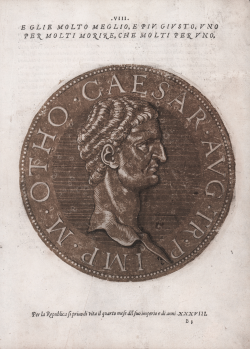
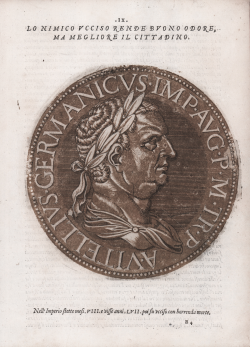
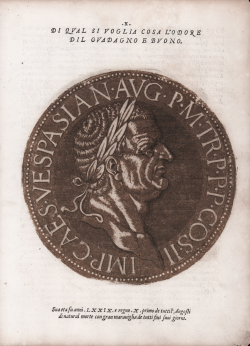
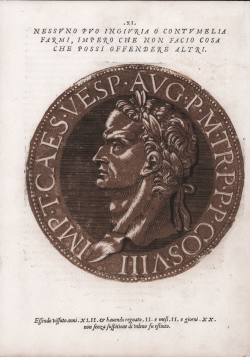
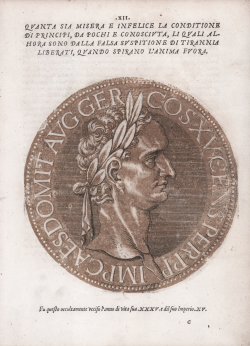
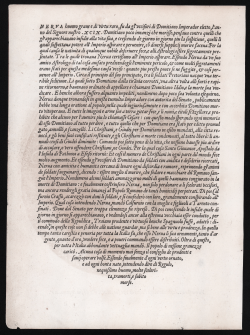
A suite of 12 etchings, executed in a chiaroscuro style and printed in black and ochre ink, depicting the "Twelve Caesars" - Gaius Julius Caesar and the first eleven Roman emperors: Octavian Augustus, Tiberius, Caligula, Claudius, Nero, Galba, Otho, Vitellius, Vespasian, Titus, and Domitian.
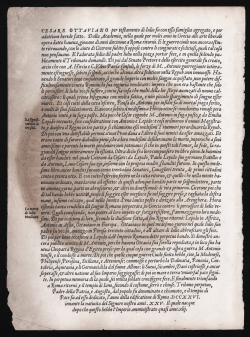
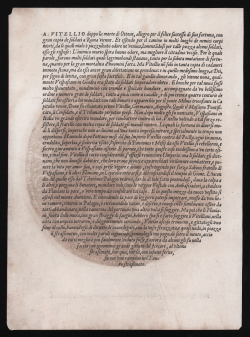
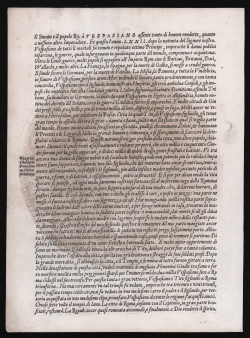
These prints belong to an exceptionally rare 1557 edition featuring Italian text, which followed a Latin-language edition printed by Gillis Coppens van Diest in the same year.
The term "The Twelve Caesars" originates from De vita Caesarum ("The Lives of the Caesars"), the historiographical masterpiece by the Roman writer Gaius Suetonius Tranquillus, composed between 119 and 122 AD. The work compiles the biographies of Gaius Julius Caesar and the first eleven Roman emperors, chronicling the transition from the Roman Republic to the Principate through intimate details, vices, virtues, and anecdotes concerning its central figures.
Hubert Goltzius (1526–1583) was the first artist to successfully adapt the chiaroscuro printing technique for large-scale book illustration. These prints were featured in his work on ancient and modern portrait medals, titled Vivae Omnium Fere Imperatorum Imagines. It is generally believed that Hubert Goltzius personally engraved the outlines, while the woodblocks were carved by Joos Gietleughen.
Within the medallions, the engraved plate functions as an independent line-based matrix, defining the primary elements of the composition. The block for the dark tone plays a limited role: confined to a circle immediately surrounding the emperor’s face, it serves as the background of the coin, from which the portrait bust and the inscription emerge in fairly pronounced relief. To further enhance the resemblance to the original models, Goltzius printed the illustrations using two combinations of metallic colors: yellow ochre and brown, or olive green and green.
A possible source for this highly functional use of chiaroscuro is Hans Burgkmair’s Portrait of Julius II - a large-scale chiaroscuro woodcut (1511) created using two blocks, believed to be based on a 1506 medallion by Caradosso. Burgkmair depicted the face in profile - as Hubert Goltzius would later do in most of his own chiaroscuro prints - and employed a block for a yellow-ochre tone, thereby suggesting the metallic nature of the medallion. To define the surface of the object, Burgkmair chose to use the black ink from the line block rather than a second tone block; in other respects, however, his approach is very similar to that of Goltzius.
The combination of relief and intaglio printing, as adopted by Hubert Goltzius, had already been used in Italy - albeit rarely - as early as around 1530. Around that time, Parmigianino created a chiaroscuro print by combining an etched line plate with a woodblock for the tone, based on Raphael’s famous cartoon for the tapestry depicting Saints Peter and John at the Beautiful Gate of the Temple. Subsequently, Beccafumi also produced several chiaroscuro prints that employed both woodcut and intaglio techniques. However, Hubert Goltzius’s decision to use etching in combination with woodcut was driven by motivations different from those of his Italian predecessors. The latter likely sought to recreate the effects of a drawing, using an etched or engraved plate to reproduce the flexibility and delicacy of pen strokes with greater precision. In contrast, Hubert Goltzius’s choice was probably dictated by the need to produce the medallions more quickly: etching 131 plates required significantly less time than carving an equivalent number of woodblocks. Upon realizing that this combination was not the most efficient for the printing process, he replaced the etched plates with woodblocks. When Hubert Goltzius’s complete works were reprinted by Plantin in 1645, the illustrations for the Imagines consisted of pure woodcuts, each using a single block for tone; the blocks were carved by Christoffel Jegher, who also created two chiaroscuro woodcuts based on designs by Rubens.
Twelve sheets, each measuring 215x295 mm, containing an engraving that measures 180x180 mm. Magnificent impressions, in an excellent state of preservation.
Bibliografia
Nancy Bialler, Chiaroscuro Woodcuts. Hendrick Goltzius (1558-1617) and his Time, pp. 30-34, n. 2.
Hubert GOLTZIUS (Venlo 1526 - 1583)
|
Hubert Goltzius or Hubertus Goltzius, latinized form of Hubrecht Goltz or Hubert Goltz (Venlo, 30 October 1526 – Bruges, 24 March 1583) was a Renaissance painter, engraver, publisher, printer and numismatist from the Habsburg Netherlands. He was also active as an art and antique dealer. He was the great-uncle of the now better known engraver and painter Hendrik Goltzius. He is now recognized mainly for his contribution to numismatics and has been referred to as the 'father of ancient numismatics'.
Goltzius was born in Venlo as the son of Rutger van Weertsburg and Catharina Goltzius. His father was an architect and painter originally from Wurzburg. His mother was the daughter of Hubrecht Goltz or Goltzius (the Elder), a painter who was originally from Hinsbeck in Upper Guelders (present-day Germany), a town close to Venlo, also in Upper Guelders (present-day Netherlands) where he had moved in 1494. His father had adopted the name of his wife at their marriage. Hubert was initially trained by his father. He was then sent to Liège where from 1544 to 1546 he studied painting and engraving at the academy operated by the prominent humanist and painter Lambert Lombard. In addition to being a painter, architect, printmaker and writer, Lombard was an avid coin collector, an activity he had likely started while residing in Rome. It was Lombard who introduced Goltzius to coin collecting and numismatics and thought him printmaking.
|