
- New
| Reference: | A54012 |
| Author | Niccolò ROSSIGLIANI detto "Il Vicentino" |
| Year: | 1540 ca. |
| Measures: | 420 x 280 mm |
| Reference: | A54012 |
| Author | Niccolò ROSSIGLIANI detto "Il Vicentino" |
| Year: | 1540 ca. |
| Measures: | 420 x 280 mm |
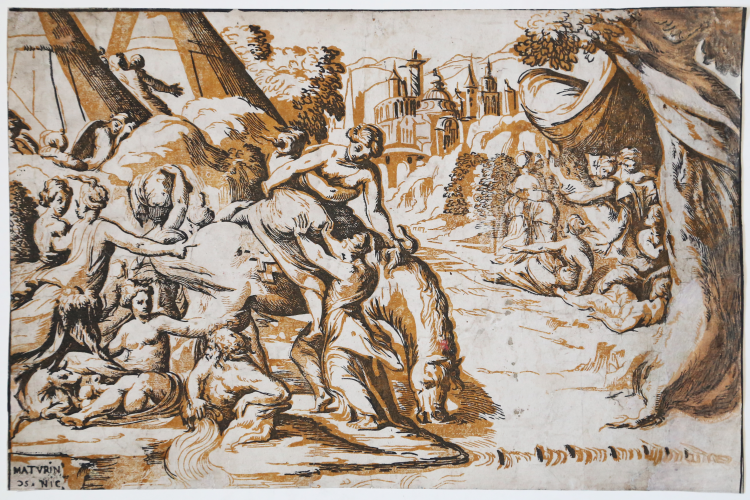
Chiaroscuro woodcut from two blocks - orange-brown and black - dating to approximately 1540–50.
The composition is based on a fresco by Maturino da Firenze (Florence, 1490 – Rome, 1528) originally in the Villa Lante and now housed in the Palazzo Zuccari.
This is an impression in the first of two states, featuring an inscription incised into the darker block: “MATVRIN/ IOS. NIC/ VICENT” at the bottom left. The second state bears the signature of Andrea Andreani and the date 1608.
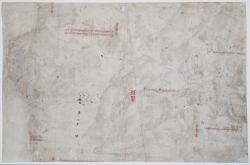
Virtually all known impressions of the first state - described by Naoko Takahatake, who considers the piece an early work by Vicentino - were printed using three blocks in varying colors. However, our impression of the first state was printed using only two blocks (orange-brown and black); the block for the lighter tone is missing. Greek characters printed in red appear on the verso of the print.
According to Takahatake, this is one of the intermediate printings she classifies as having been produced “by the Printer of Greek Text.” In the context of research into the circulation and reprinting of original woodblocks (such as those associated with Niccolò Vicentino’s workshop and Parmigianino’s designs), her studies have identified a specific group of chiaroscuro prints pulled on the backs of waste sheets. The distinctive feature of these later editions is that the blocks were acquired by a printing house specializing in the production of Greek liturgical texts in red ink. To date, Takahatake has documented twenty-one different compositions featuring these characteristic red Greek liturgical texts on the verso. This discovery has provided art historians with crucial physical evidence for tracing the chronology, the changes in ownership of the woodblocks, and the paper-recycling practices in 16th-century print shops.
Our example is identical to the impression held at Yale [1964.9.13a].
https://artgallery.yale.edu/collections/objects/7810
The episode is recounted by Livy: the Etruscan king Lars Porsena had besieged Rome and taken the noblewoman Cloelia hostage; during the night, she and her companions escaped. The scene depicts Cloelia fleeing, being helped onto a horse to cross the Tiber River alongside her companions. The architectural outlines of Rome are visible in the background, while the personification of the Tiber river god emerges in the lower left.
A fine impression, printed on contemporary laid paper with an "anchor in a circle with a flower" watermark (similar to Woodward 177); irregularly trimmed to the borderline with slight loss of the engraved image at the bottom; the right side features numerous reconstructive repairs; minor defects along the left side; otherwise in good condition.
Bibliografia
Bartsch A., Le peintre graveur, 1803-1821, v. XII, p. 96, n. 5; B. Barryte, Myth, Allegory and Faith. The Kirk Edward Long Collection of Mannerist Prints, n. 452; Takahatake N., Atlante delle xilografie italiane del Rinascimento, ALU.0988.1, https://archivi.cini.it/storiaarte/detail/48587/stampa-48587.html
Niccolò ROSSIGLIANI detto "Il Vicentino" (Attivo a Vicenza 1540-50)
|
Italian woodcutter and printer. He signed five chiaroscuro woodcuts, each after a different artist and all undated. Probably the earliest is a two-block woodcut of Hercules and the Lion after Giulio Romano. Cloelia after Maturino or Giulio Romano, in three blocks, is still rather crudely cut and registered, and probably the next chronologically. A very cursive, elegant line manifests itself in subsequent works, such as Ajax and Agamemnon after Polidoro da Caravaggio, the Sacra Conversazione with St Catherine after a design attributed to Camillo Boccaccino and Christ Healing the Lepers after Parmigianino. An unsigned Adoration of the Magi and The Cardinal and the Doctor can also reasonably be ascribed to him. His hand is doubtless one of several discernible in a large group of anonymous chiaroscuros based on designs by Parmigianino that may represent the products of a workshop supervised by Vicentino. Vasari related how Parmigianino had certain chiaroscuros cut by Antonio da Trento, and that many other designs were printed after the painter’s death by ‘Joannicolo Vicentino’. A group of ten small anonymous two-block chiaroscuros after silverpoint drawings by Parmigianino as well as the Twelve Apostles in which two cutting hands are visible, are presumably part of this output, along with about a dozen more anonymous chiaroscuros. That Vicentino had a workshop is further suggested by the fact that a large number of the Parmigianino drawings related to the chiaroscuros remained together and that Andrea Andreani seems to have acquired many of the blocks and reprinted them later in the 16th century.
|